AI Adoption in Software Market: What Buyers Want, What Vendors Must Deliver

January 22, 2026
Contributor: Amita Jain

Learn how AI is reshaping software buying in 2026–insights from a global survey of 3,300+ B2B software buyers.

In 2026, nearly every software buyer is evaluating products through the lens of artificial intelligence (AI). 77% of software buyers are increasing their budgets in 2026, and 42% cite adding new AI functionality as the primary driver. This surge shows buyers are excited about AI, but winning them requires understanding how they’re evaluating AI-powered solutions. 

The 2025 Software Buying Trends survey revealed that AI spending was surging. So, this year we asked: what’s behind the demand? This year, we uncovered which AI features matter most to buyers and how they’re approaching adoption.

Read on to learn what the 2026 Software Buying Trends Survey* revealed about AI in the software buying journey, and how vendors can use these findings to position their offerings.
 

1. Most buyers take balanced approach to AI adoption

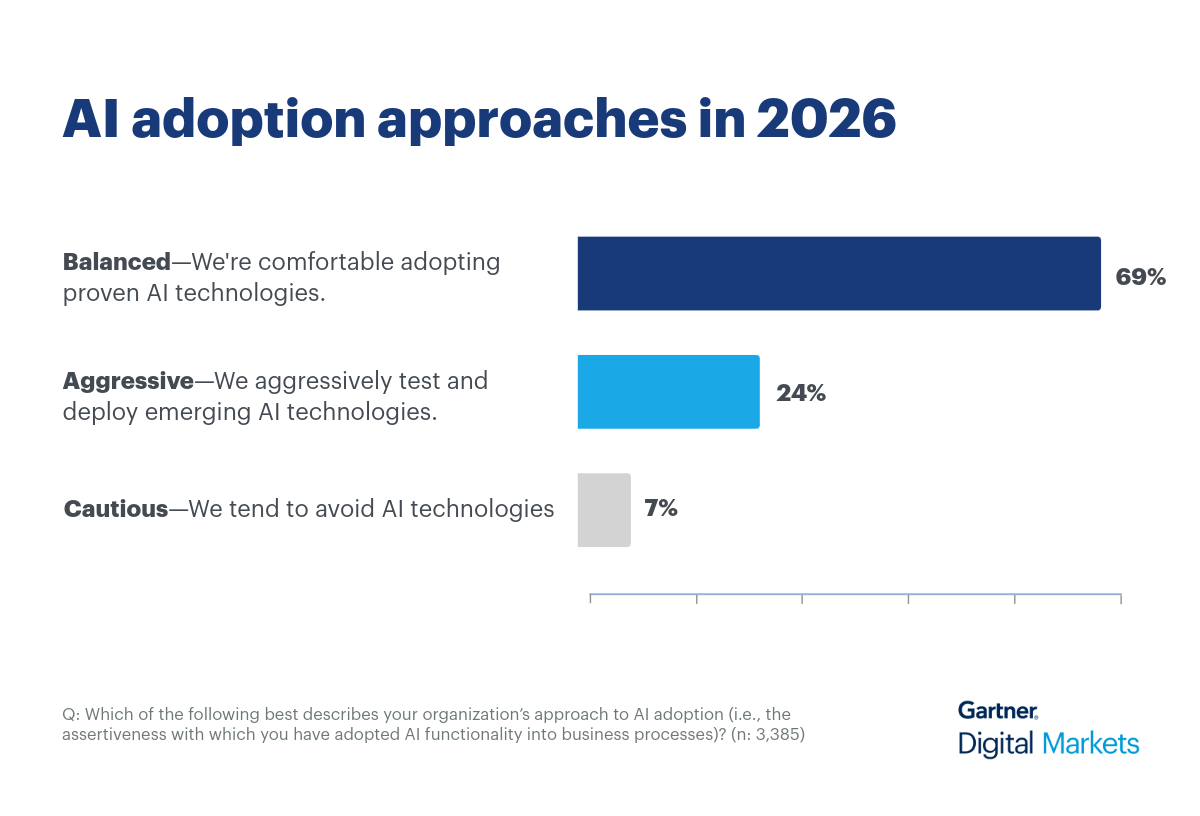
AI adoption is entering a maturity phase. Proven capabilities dominate buyer priorities. Only about a quarter of buyers are still in aggressive, early-adopter mode.  

This split reflects two distinct buyer mindsets:

  • Balanced adopters (69%), who want innovation but also reliability. They know that adopting AI is necessary to stay competitive, but their approach is tempered by caution and risk management.
  • Aggressive adopters (24%), who are willing to pilot new tools and accept some risk for competitive advantage. 

Whether you're selling AI chatbots, forecasting tools, or other functionalities, the 69/24 split means that the window for "revolutionary" positioning is narrow. Most buyers now evaluate AI tools the same way as any business tool: through the lens of ROI and investment risk.

Tip for vendors: Lead with proof over promise. Provide buyers with testimonials, user reviews, case studies, ROI calculators, low-risk pilots, and implementation support.

2. Practical AI use cases dominate buyer priorities

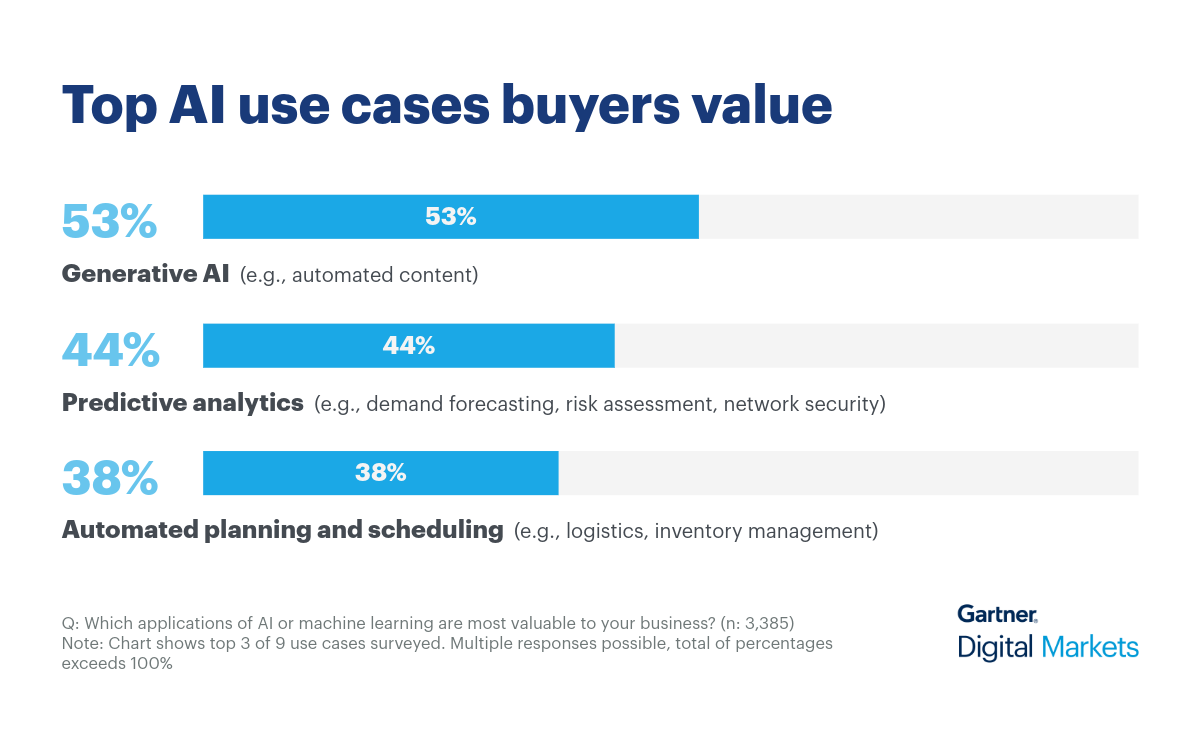
Buyers are focused on proven AI applications that deliver immediate, measurable business outcomes, with a clear top three emerging. Generative AI (GenAI) leads the way, followed by predictive analytics and automated planning or scheduling.

Industry patterns reveal clear concentrations. IT and finance show the strongest appetite for GenAI at 60% and 59% respectively; significantly above the 53% baseline. Retail businesses focus more on automated planning at 47% vs. 38% overall, likely driven by supply chain and inventory management pressures. 

This signals a fundamental reorganization of how businesses operate. Companies are using AI tools to produce content at scale, make data-backed decisions in real-time, and eliminate operational bottlenecks that once required entire teams. 

Tip for vendors: Update your product profiles to highlight the specific use cases that matter to your target industries, and collect user reviews that speak to these AI applications.


3. Implementation concerns outpace pricing


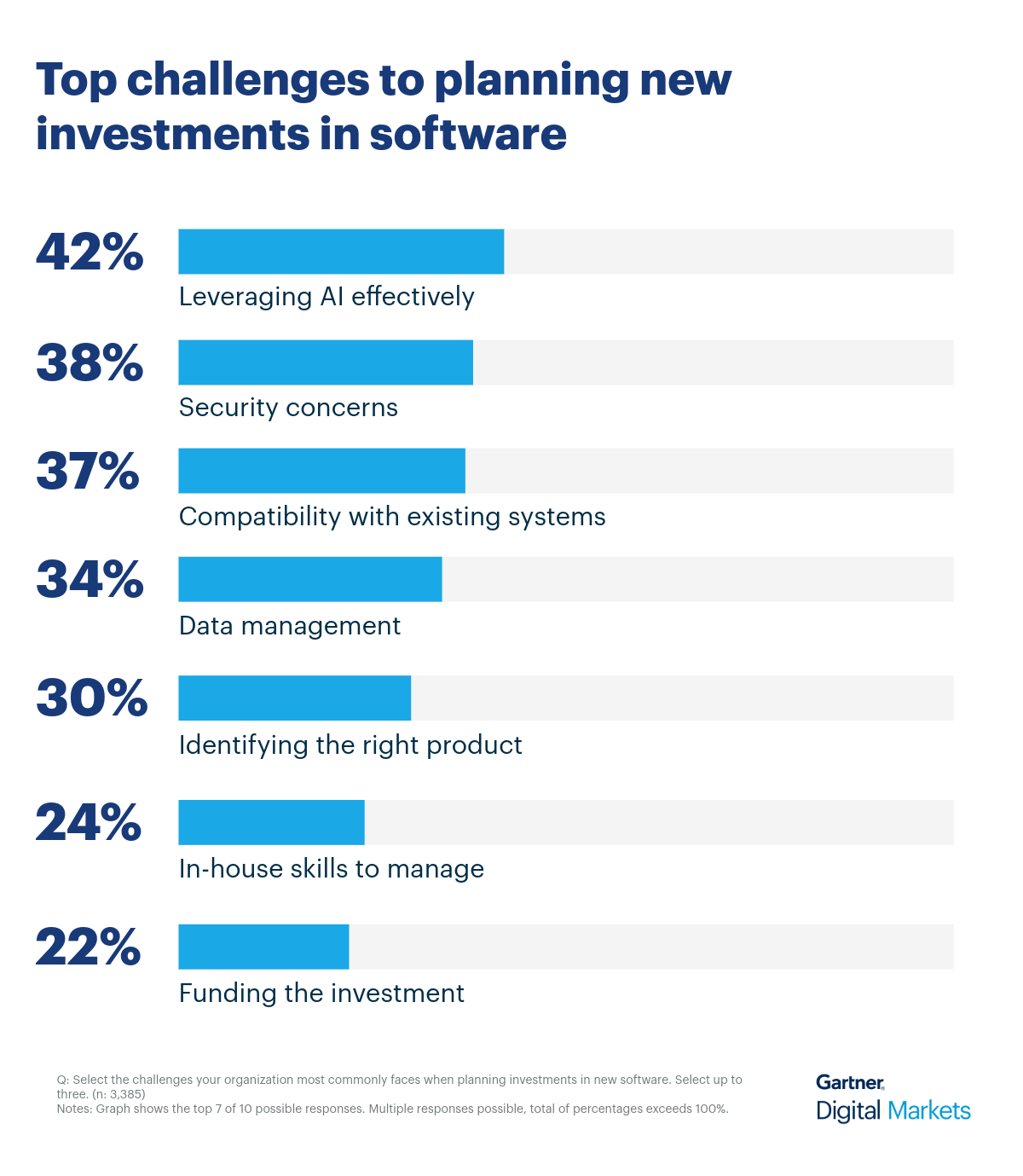
As buyers embrace AI, their biggest concern is how to make it work. Leveraging AI effectively is the top challenge for 43%, followed by security concerns at 38% and system compatibility at 37%. Meanwhile, funding ranks much lower at just 22%.

Buyers have a budget and interest in AI. What they lack is confidence that they can deploy it effectively and securely. 

For vendors, this means prioritizing simplified AI onboarding and making security a visible part of your value proposition.

Tip for vendors: Show buyers how to get value from your AI capabilities quickly and make your security measures explicit and easy to understand in sales and marketing communications.

4. Aggressive AI adoption correlates with buyer disappointment

Buyers who report disappointment with their software investments are nearly twice as likely to have adopted AI aggressively (33% vs. 17% among successful adopters). This aggressive stance translates into specific technology choices.

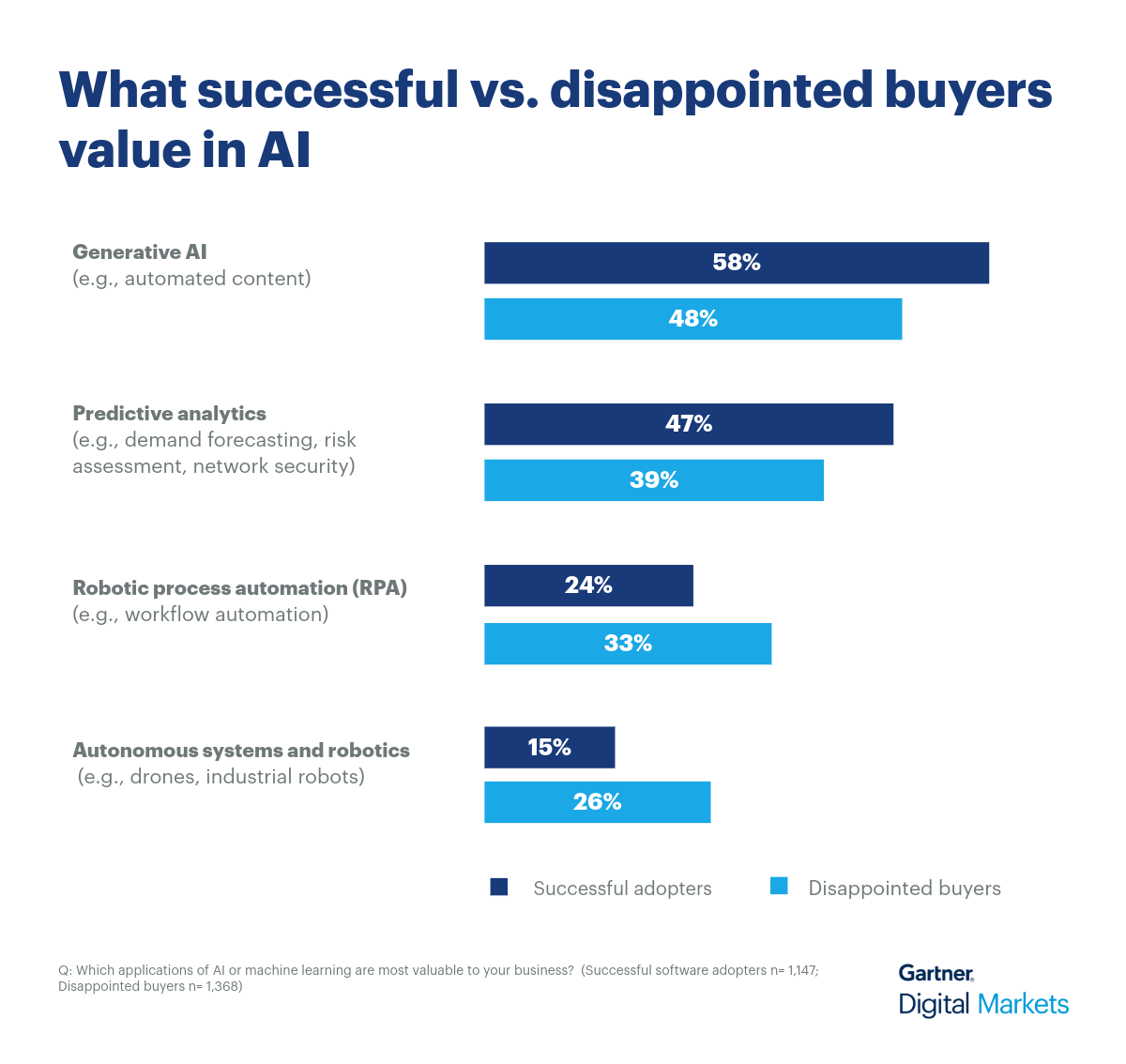
Disappointed buyers overindex on advanced AI capabilities like autonomous systems, recommendation engines, and robotic process automation technologies that can be harder to implement and justify ROI.

Successful adopters take a different path. They are more likely to invest in proven, high-demand applications like GenAI, predictive analytics, and automated planning. These capabilities have clearer use cases and faster time-to-value.

Tip for vendors: When buyers push for advanced AI features, assess their implementation readiness first. If they're not ready, redirect them to practical use cases that deliver quick wins and drive stronger reviews, renewals, and referrals.

5. Successful adopters trust review sites over AI search

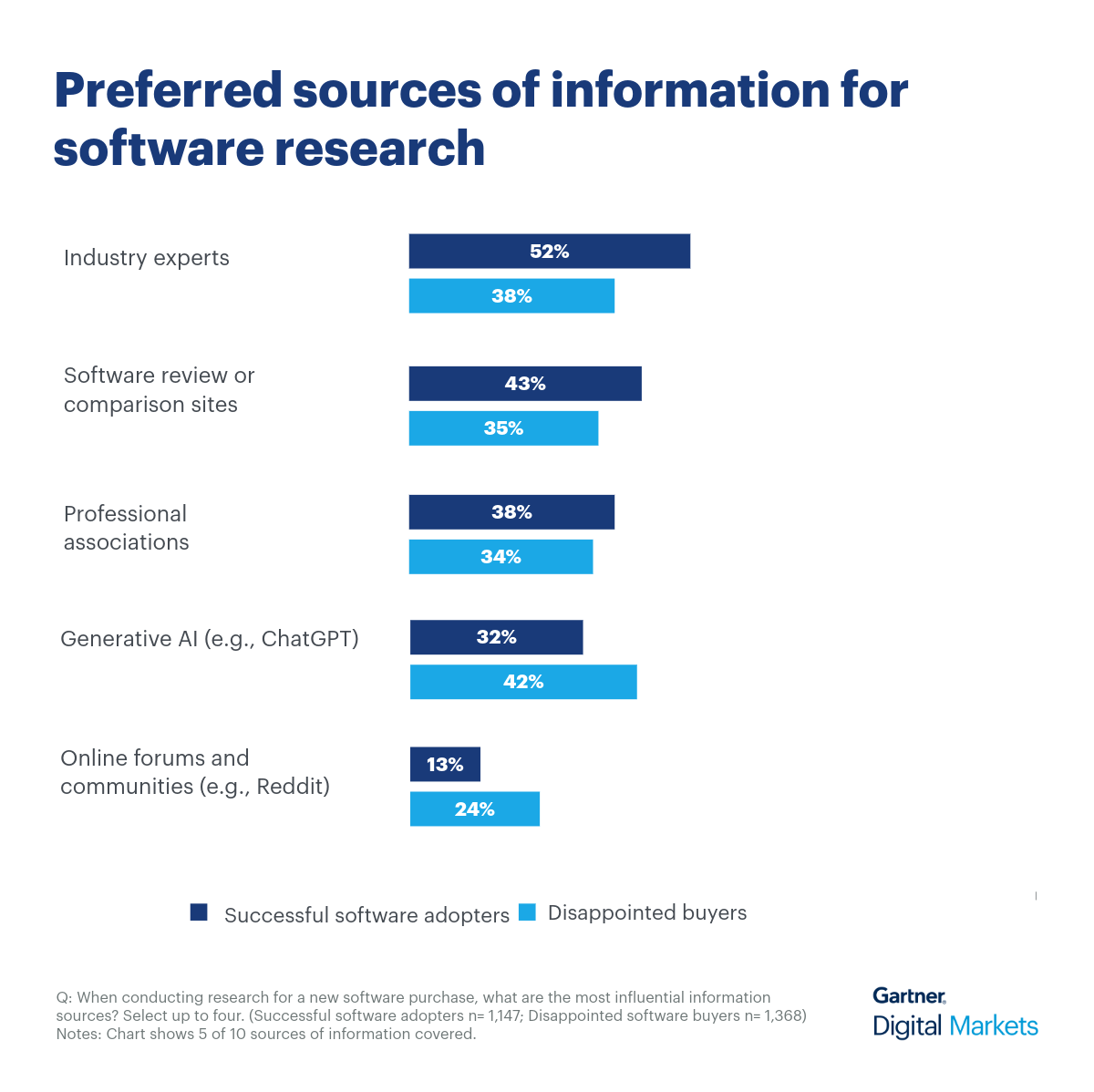
Successful software adopters are more likely to use expert insights and software review platforms when conducting research and developing shortlists. Disappointed buyers, on the other hand, often rely on GenAI tools and online communities like Reddit. 

While it can be tempting to outsource product research entirely to GenAI tools, such as ChatGPT, they may provide less reliable or relevant information and lead to hallucinations. 

For vendors, this underlines the importance of being visible on trusted software review and comparison sites and the role of social proof in shaping software buyers’ confidence.

Tip for vendors: Prioritize building presence on trusted software review platforms where successful adopters conduct research. Gartner Digital Markets platforms, including Capterra, GetApp, and Software Advice, connect you with 100M+ buyers annually who prioritize verified reviews..

Adapt to AI-driven software market in 2026

Software buyers in 2026 are pragmatic about AI adoption. They want proven capabilities that solve real problems, not just emerging AI features that promise more than they deliver. They've moved past the hype cycle and now evaluate AI tools with the same rigor they apply to any software investment: does it work, is it secure, and can we actually use it?

Those who can anticipate these needs and address them will not only navigate but excel in a competitive and AI-driven software market. Watch our on-demand webinar to learn how successful software buyers build shortlists and what that means for positioning AI capabilities in 2026.

*Survey methodology:

Gartner Digital Market’s 2026 Software Buying Trends survey was conducted online in August 2025 among 3,385 respondents in Australia (n=281), Brazil (n=278), Canada (n=293), France (n=283), Germany (n=279), India (n=260), Italy (n=263), Mexico (n=288), Spain (n=273), the U.K. (n=299), and the U.S. (n=588), at businesses across multiple industries, ages (1 year in business or longer), and sizes (5 or more employees). Business sizes represented in the survey include: 1,676 small (5-249 full-time employees), 822 midsize (250-999), and 887 enterprise (1,000+). The goal of this study was to understand the timelines, organizational challenges, research behaviors, and adoption processes of business software buyers. Respondents were screened to ensure their involvement in business software purchasing decisions.


Amita Jain

Amita Jain

Amita Jain is a senior writer for Gartner Digital Markets, covering finance technology with a focus on expense management and accounting solutions for small and midsize businesses. Her work has been featured in Careers360, among other publications. 

Get the Gartner Digital Markets Newsletter

We value your privacy. By submitting this form, you agree we may use your information in accordance with the terms of the Gartner Digital Markets Privacy Policy.

Connect. Convert. Thrive.

Connect to millions of in-market software buyers around the globe with our all-encompassing suite of marketing services.