Tools buyers are replacing with inventory management software
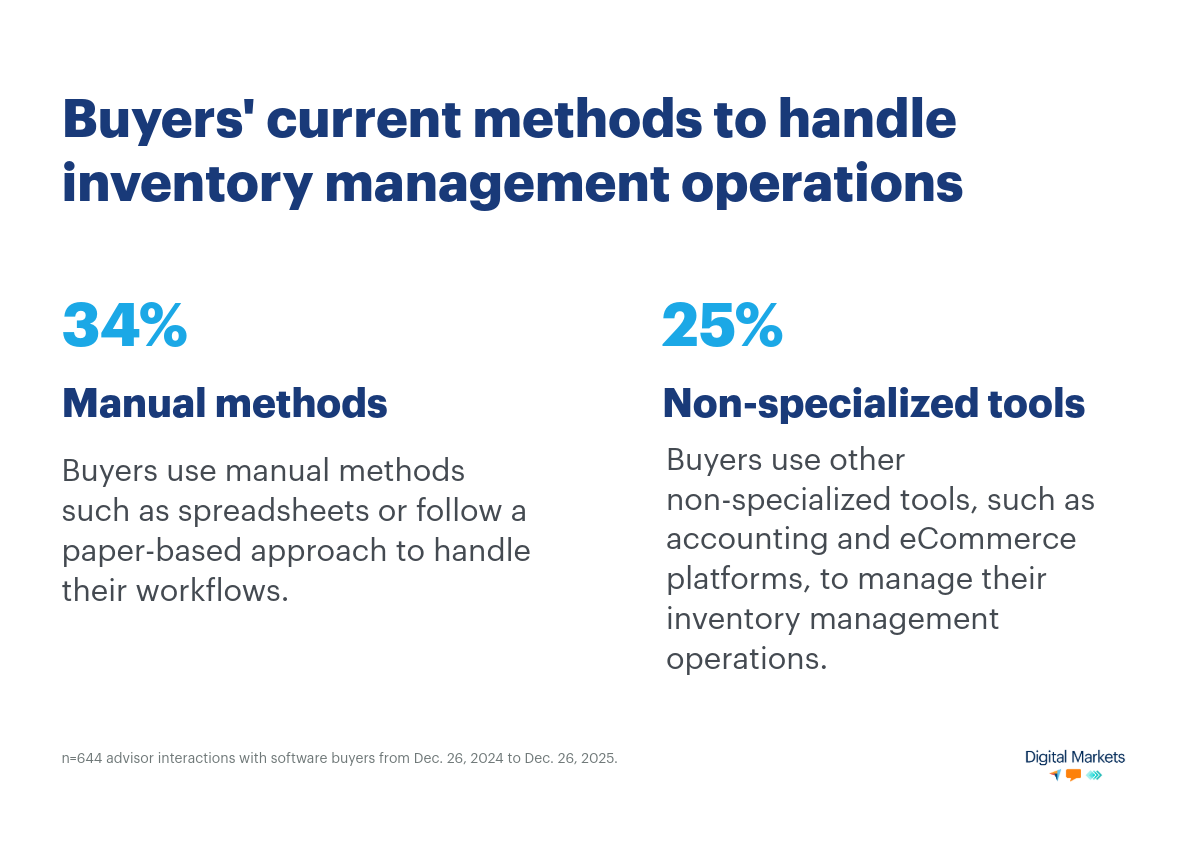
When our advisors asked buyers what methods they were currently using to handle their day-to-day inventory management operations, here's what they found:
- Around 34% of buyers use manual methods, including spreadsheets and pen-and-paper based approaches for managing their operation workflows.
- Nearly 25% of buyers rely on non-specialized tools, such as accounting and eCommerce platforms.
- Surprisingly, 22% do not have any system in place.
While spreadsheets and pen-and-paper may work for very small teams, they quickly become a liability as operations scale. Manual tracking leads to stock inaccuracies, delayed order fulfillment, and poor visibility into inventory levels. These inefficiencies often result in lost sales and higher carrying costs—issues SMBs cannot afford in competitive markets.
Similarly, generic platforms offer basic inventory functions but lack depth. They fragment workflows and fail to provide essential capabilities such as automated stock alerts, demand forecasting, and centralized reporting. Without these features, SMBs struggle to maintain accuracy and agility, limiting their ability to respond to supply chain disruptions or seasonal demand spikes.
Bottom line: Manual methods and generic tools slow growth and increase risk. A dedicated inventory management solution delivers automation, real-time visibility, and scalability—capabilities that SMBs need to stay competitive.
The opportunity: This gap presents a clear window for vendors. In your marketing communications, emphasize how a dedicated inventory management system addresses these challenges by consolidating data, automating routine tasks, and providing predictive insights. Advanced features such as AI-driven demand forecasting, integrated supplier management, and performance analytics enable SMBs to reduce costs and improve efficiency.