Insights From our Software Advisors: Stand out in Supply Chain Management

January 6, 2026
Contributor: Shephalii Kapoor

Global supply chains face rising costs and frequent disruptions, driving SMBs to adopt supply chain management (SCM) software for visibility and automation.

But buyer decisions are shifting mid-process—priorities like cost savings often change after integration and scalability checks. Vendors struggle to anticipate these evolving needs, making software selection a strategic challenge rather than a simple purchase.

With a multitude of tools on Gartner Digital Markets’ buyer destination sites—Capterra, GetApp, and Software Advice–how can vendors ensure they stand out and get their fair share of buyer attention?

Our software advisors speak with thousands of buyers every year, qualifying them based on budget, authority, need, and timeline (BANT). We’ve analyzed these real buyer conversations to help vendors sharpen their messaging and position their supply chain management software to match what buyers are actually looking for.

Key insights

  • Most businesses rely either on non-specialized tools or manual methods to manage their day-to-day supply chain practices. A significant portion of buyers do not have any system in place yet.
  • Switching to supply chain management software is driven by the need for efficiency, functional sufficiency, and new business opportunities.
  •  Software buyers prioritize warehouse management during purchase, while current users rank inventory management as the top need in supply chain management tools.
  • The top five buyer segments for supply chain management software spend between $147 and $258 per user, per month, with an average of $167.

Tools buyers are replacing with supply chain management software

When our advisors asked buyers what methods they were currently using to handle their day-to-day supply chain operations, here's what they found:

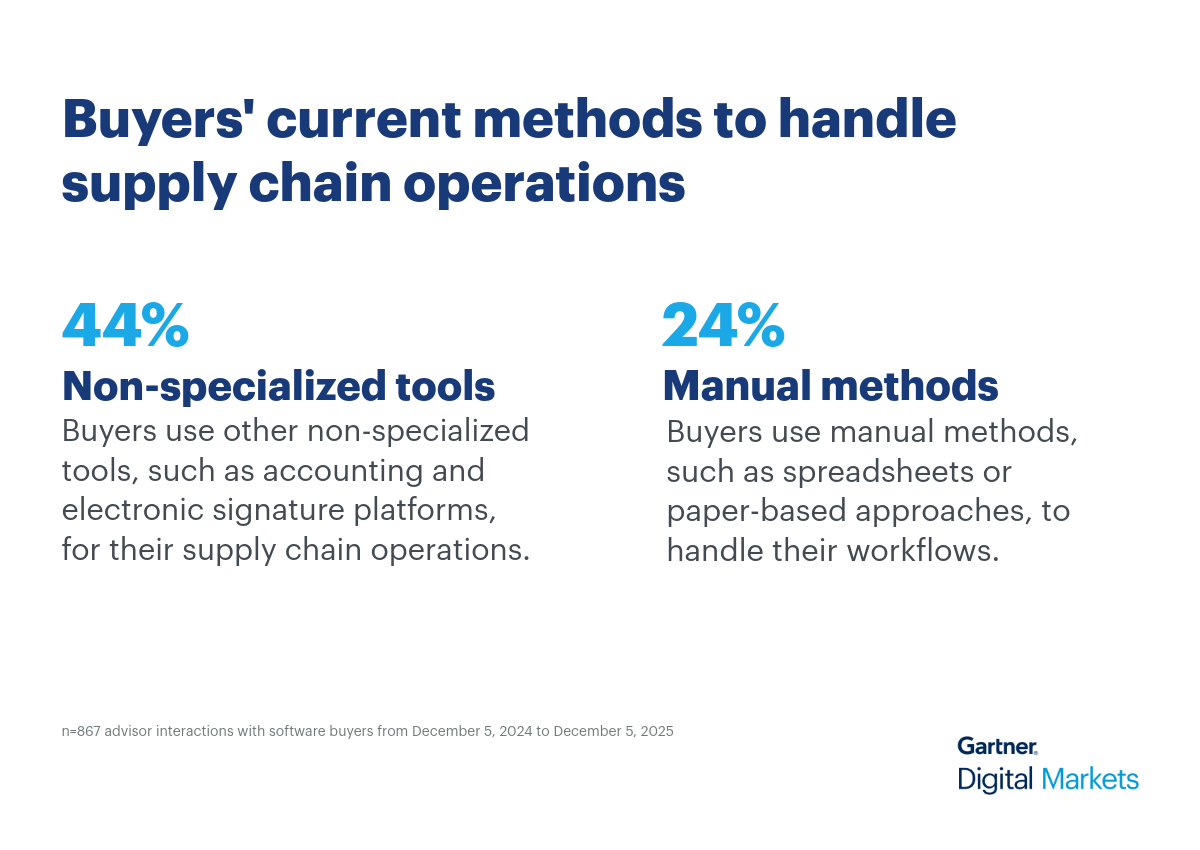
  • Around 44% of buyers use non-specialized tools, such as accounting and e-signature software for managing their operation workflows.
  • Nearly 24% of buyers rely on manual methods such as spreadsheets or have a paper-based approach, whereas 22% do not have any system in place.

While manual methods may work for small, simple supply chains, they introduce delays, data errors, and missed savings as volume and complexity grow. Non‑specialized tools fragment workflows and limit visibility. They typically lack demand planning, real‑time inventory and order tracking, exception alerts, supplier collaboration, multi‑warehouse controls, and audit-ready traceability—capabilities essential for efficient operations and reliable fulfillment.

This gap presents an opportunity for vendors. A dedicated supply chain management software solves these issues by centralizing workflows and providing real-time visibility across inventory, orders, and logistics, reducing delays and errors. It also offers specialized features such as demand forecasting, automated replenishment, and supplier collaboration, enabling scalability and efficiency that manual methods and generic tools cannot match.

Pro tip: Start by identifying everyday challenges supply chain professionals face—then demonstrate how your software’s tailored capabilities can solve them. Emphasize its industry-specific tools, flexible customization options, and seamless integrations that align with the operational demands of supply chain teams.

Why buyers switch to supply chain management software

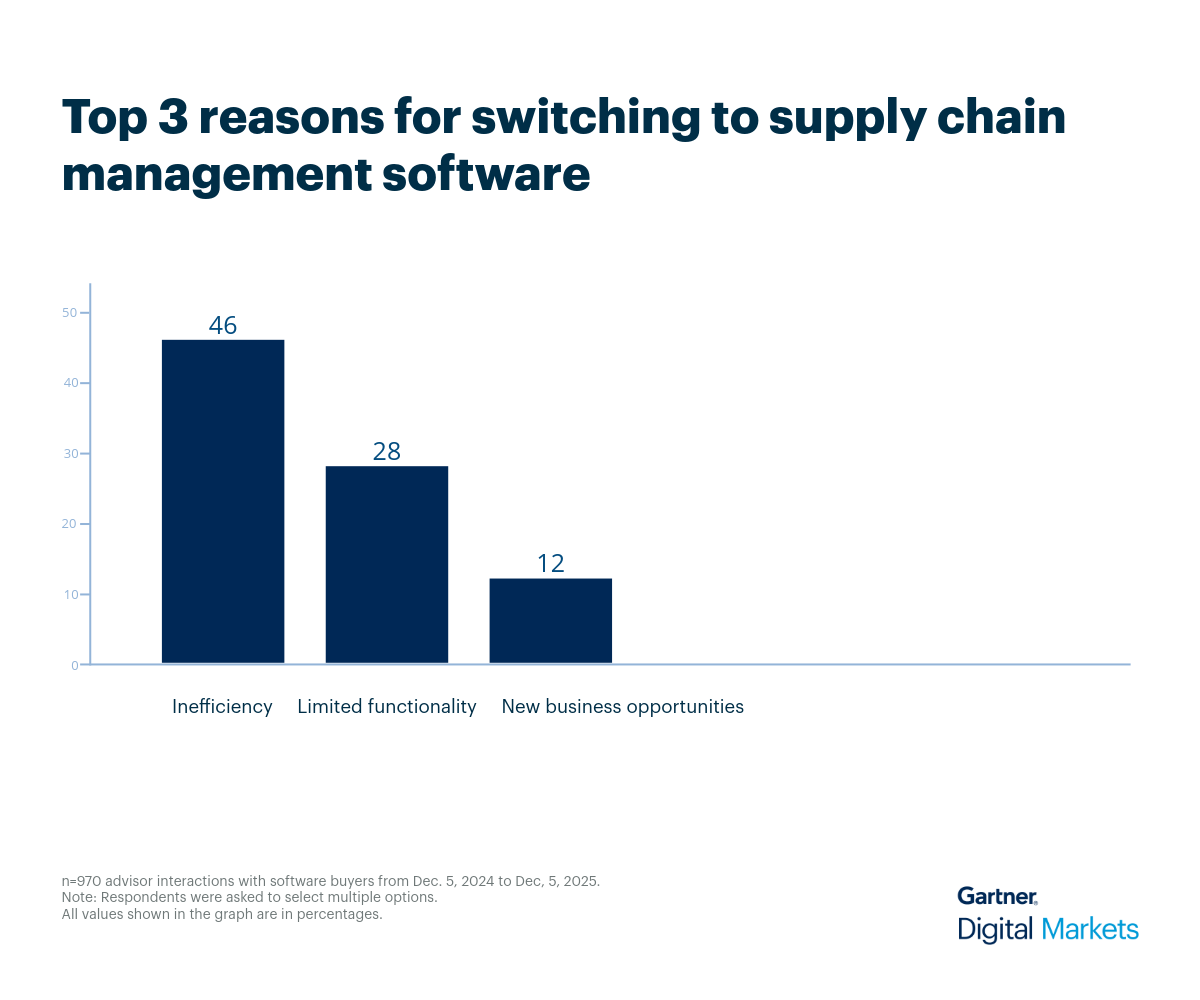
Our advisors conversed with buyers seeking a switch to supply chain management software from their current manual methods or non-specialized software. These discussions shed light on businesses’ real-life challenges with their existing tools—including inefficiency (46%), limited functionality (28%), and new business opportunities (12%).

  • Inefficiency: Manual supply chain processes—like paper-based order tracking and spreadsheet-driven inventory slow down operations and increase error risk. Data entry mistakes, delayed updates, and siloed information make it hard to maintain real-time visibility. Likewise, non-specialized tools add complexity by requiring multiple disconnected systems, forcing teams to switch between platforms and rely on manual reconciliations, which wastes time and reduces accuracy.
  • Limited functionality: Generic tools and spreadsheets aren’t built for the dynamic nature of supply chain workflows. They lack features such as automated replenishment, real-time inventory tracking, shipment visibility, and supplier collaboration portals. Without these capabilities, teams struggle to manage multi-location operations, handle exceptions quickly, or optimize processes, especially as order volumes and supplier networks grow.
  • New business opportunities: Manual methods and non-specialized tools don’t provide the analytics or forecasting needed to identify trends, optimize procurement, or negotiate better supplier terms. They lack integrated dashboards for measuring key performance indicators (KPI) like lead times, fill rates, and cost-to-serve, making it difficult to uncover efficiency gains or expand into new markets. As a result, businesses miss opportunities to improve margins, enhance service levels, and scale competitively.

From our interactions with buyers, it’s clear that many vendors miss the mark in showing how their software improves supply chain managers’ daily workflows. Compared to manual methods and non-specialized tools, dedicated supply chain management systems offer clear, purpose-built advantages, as listed below:

  • End-to-end visibility: Dedicated SCM software gives businesses a unified view of inventory, orders, and shipments across all locations in real time. This eliminates data silos and manual reconciliations, enabling faster decisions and proactive issue resolution. Teams can track every movement from supplier to customer without relying on fragmented spreadsheets.
  • Demand forecasting and planning: Unlike manual methods or non-specialized tools, advanced SCM tools with forecasting capabilities can analyze historical trends, seasonal patterns, and market signals to predict demand accurately. This helps businesses align procurement and production with actual needs, reducing costly stockouts and excess inventory. Better planning also improves supplier negotiations and optimizes working capital.
  • Automated workflows: SCM software automates repetitive tasks such as purchase order creation, replenishment triggers, and returns processing. Automation reduces human error, speeds up cycle times, and ensures consistency across processes. This frees staff from manual data entry, allowing them to focus on strategic supply chain improvements.
  • Supplier collaboration: Integrated portals and communication features in SCM software allow suppliers to share confirmations, lead times, and shipping updates in real time. This improves coordination, reduces miscommunication, and strengthens relationships. Businesses gain better visibility into supplier performance and can respond quickly to delays or disruptions.
  • Compliance and traceability: SCM systems capture detailed batch and lot information, maintain audit trails, and store compliance documentation for every transaction. This ensures businesses meet regulatory requirements and can trace products quickly during recalls or quality checks. Full traceability builds trust with customers and minimizes risk.

Pro tip: Help your sales team uncover what prospects truly need by gathering detailed requirements and tailoring product demos to match. Reinforce these demos with real-world success stories and client testimonials that highlight how your software improves productivity and reliability—building trust and positioning your solution to close more deals.

What supply chain management software features are valued the most

When evaluating supply chain management software, our advisor conversations and review analysis reveal a gap between what buyers seek and what users value most.

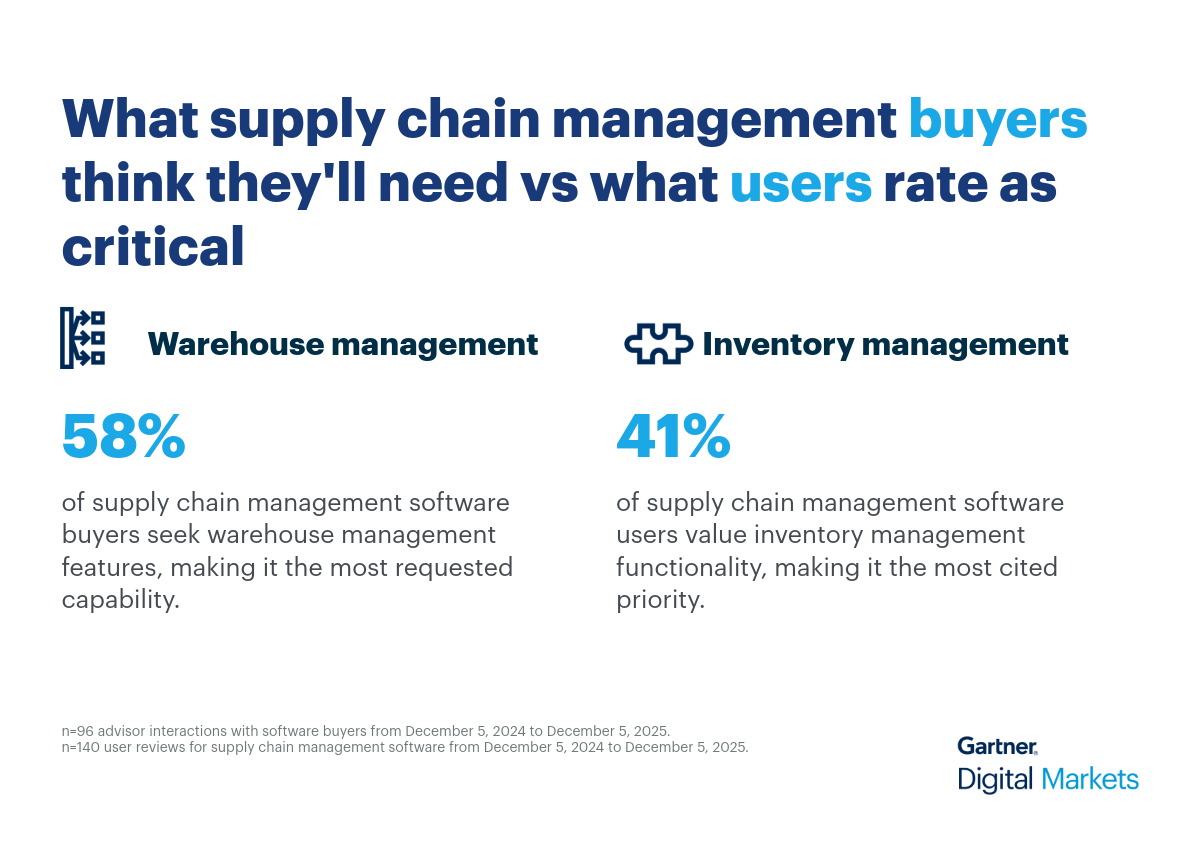
  • Around 58% buyers prioritize warehouse management, followed by transportation management (17%), contact management (9%), and procurement (8%).
  • On the other hand, the majority of the current users (41%) rate inventory management as critical in a supply chain management tool.
     

This discrepancy highlights a key insight: while buyers prioritize core capabilities like warehouse and transportation management during purchase, current users place higher value on inventory control for day-to-day operations. This gap suggests that purchase decisions often focus on structural workflows, whereas actual usage emphasizes real-time stock visibility and accuracy.

  • Warehouse management enables businesses to control storage, movement, and handling of goods within facilities. It includes tools for space optimization, picking and packing, barcode scanning, and inbound/outbound shipment coordination—ensuring efficient operations and reduced handling errors.
  • Inventory management tracks stock levels, movements, and valuation across multiple locations in real time. It helps prevent stockouts and overstocking, supports automated replenishment, and provides visibility into item availability—critical for accurate order fulfillment and cost control.

Pro tip: Update the listing in your Gartner Digital Markets account to highlight buyer priorities such as warehouse management and transportation management. Showcase how users apply these features in real life. Adding social proof, such as industry research, awards, and badges strengthens credibility and sets your product apart. 

Use cases for supply chain management software

Beyond traditional supply chain teams, dedicated supply chain management software supports a wide range of industries such as retail and e‑commerce, manufacturing, healthcare and pharmaceuticals, food and beverage, and more—each with distinct workflows and specialized feature needs. For example:

  • Building and garden materials businesses manage bulky stock keeping unit (SKUs), seasonal demand, and complex delivery constraints (crane slots, weight limits, site access). They need inventory by lot and dimension, yard management, transportation planning with special handling, configurable pricing/quotes, and proof-of-delivery with photos. Their needs differ through emphasis on load building, job-site scheduling, and returns/claims tied to damaged goods or mismatched quantities
  • Third-party logistics (3PL) use SCM software to orchestrate multi-client warehousing, transportation, and fulfillment under strict service-level agreements. They need multi-tenant capabilities, order and shipment visibility, carrier management, rate shopping, dock scheduling, billing automation, and electronic data interchange (EDI) integrations to connect with shippers and marketplaces. Unlike asset-light shippers, 3PLs require granular contract/account separation, configurable workflows by client, and profitability tracking per account.
  • Food and beverage industries rely on temperature-controlled logistics, strict traceability, and shelf-life planning. They need batch/lot tracking, expiration management, recall readiness, cold-chain monitoring, Hazard Analysis and Critical Control Points (HACCP) documentation, and demand forecasting in SCM tools that accounts for promotions and seasonality. Compared with other sectors, F&B prioritizes compliance, real-time quality checks, and FEFO (first-expired-first-out) inventory logic to reduce waste and meet regulatory standards.
  • Businesses dealing with industrial machinery, equipment, and supplies handle long lead times, configurable products, spare parts, and service logistics. They need demand planning for slow/medium movers, kit management, warranty/serial tracking, field service integration, and parts availability across depots. Their needs differ through emphasis on lifecycle support (install, maintain, repair), predictive spare-part stocking, and coordination between projects, service teams, and suppliers to minimize downtime.
  • Consumer goods businesses companies balance multi-channel demand (retail, e-commerce, wholesale) and frequent product launches. They need omnichannel order management, distributed inventory visibility, replenishment automation, vendor collaboration portals, returns processing, and promotion-aware forecasting. Their differentiation lies in speed-to-market, allocation across channels, and analytics for service levels, stockouts, and margin performance across fast-moving assortments.
     

Average budgets for supply chain management software across industries

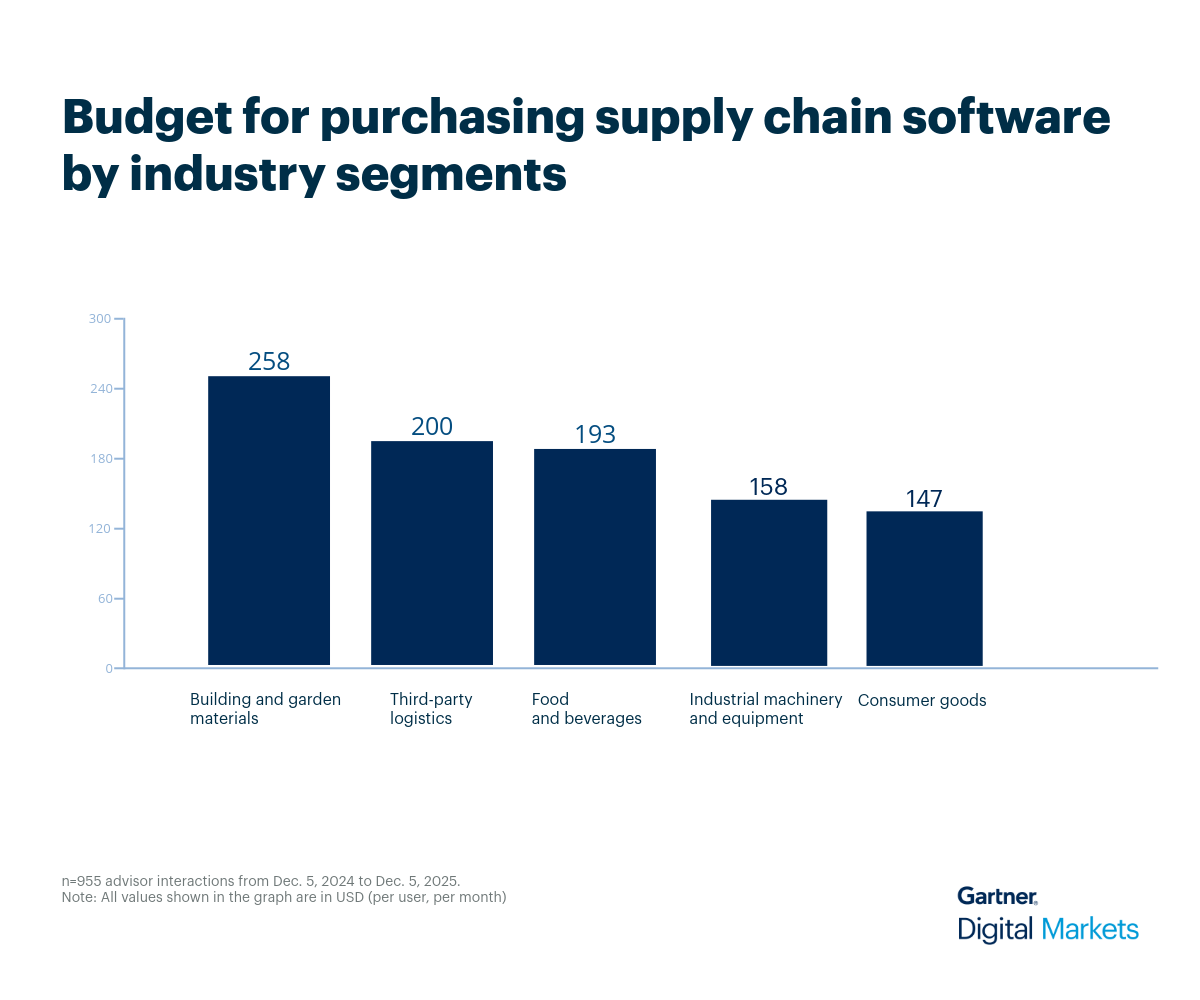
Organizations across the top five industries within the broader field of supply chain management are willing to allocate an average budget of between $147 to $258 per user, per month. Additionally, the overall average budget for purchasing supply chain software is approximately $167 per user, per month.

However, the budget for purchasing supply chain management software varies from one industry to another based on factors such as:

  • User count and roles
  • Required modules
  • Add‑ons
  • Integration complexity
  • Data migration scope
  • Training and change management
  • Compliance needs (e.g., HACCP/traceability)
  • Deployment model
  • Support tier and customization for multi‑site or industry‑specific workflows.

Here’s how different supply chain industry segments budget (in dollars, per user, per month) for purchasing supply chain management software.

Buyer goals and challenges—what advisors are hearing

Recommended actions for supply chain management software vendors

Here are five strategic actions vendors can take to better meet buyer expectations and stand out in a competitive market:

  1. Position your solution as a replacement for fragmented workflows: Highlight how your SCM software eliminates inefficiencies caused by spreadsheets and non-specialized tools. Emphasize features like real-time inventory visibility, automated replenishment, and supplier collaboration that manual methods cannot deliver. Show how centralizing workflows reduces delays, errors, and missed savings opportunities.
  2. Align demos with buyer priorities and user realities: Buyers often prioritize warehouse and transportation management during purchase, while users value inventory control for daily operations. Structure demos to start with warehouse and transportation features, then showcase inventory management and automation capabilities that improve accuracy and speed.
  3. Showcase industry-specific capabilities:Tailor messaging and demos to vertical needs—such as cold-chain monitoring for food and beverage, multi-tenant workflows for 3PLs, or lot-level tracking for building materials. Vendors that demonstrate deep understanding of sector-specific challenges (e.g., compliance, FEFO logic, EDI integration) stand out as strategic partners rather than generic providers.
  4. Be transparent on pricing and integration readiness: Publish clear pricing aligned with the average buyer budget of $147–$258 per user/month and detail integration options with ERP, accounting, and e-commerce platforms. Buyers expect seamless connectivity for inventory, procurement, and order management—position your solution as integration-ready to reduce adoption friction.
  5. Highlight predictive and risk management capabilities: Buyers increasingly seek tools that help them anticipate disruptions and optimize decisions. Position your software’s predictive analytics, demand forecasting, and exception alerts as strategic enablers—not just operational features. Show how these capabilities reduce stockouts, improve supplier negotiations, and mitigate risks from delays or compliance issues. While buyers prioritize warehouse, transportation, and procurement during purchase, these advanced features help vendors differentiate and address evolving needs for resilience and scalability.
     

Rise above your competition with strategic insights

Supply chain management software marketers face enormous pressure to set their products apart from the competition in a crowded marketplace. But with the right insights, you can better understand the key priorities and pain points of your target audience and address them directly in your product messaging to claim your fair share of buyer attention.

With more than 10 million active software buyers on our sites every month, Gartner Digital Markets can equip you with the strategic insights you need to level up your marketing strategy and become a leader in your category.

Log into your Gartner Digital Markets account and optimize your profile to ensure buyers understand how your software meets their evolving needs.

Once your profile is ready, use this insight to build a high-quality sales pipeline and this resource to master follow-ups that convert leads into customers.

Methodology and buyer demographics

Findings are based on data from conversations that Gartner Digital Markets’ advisor team has daily with software buyers seeking guidance on purchase decisions. The data used to create this report is based on interactions with small-to-midsize businesses seeking supply chain management tools. For this report, we analyzed approximately 900+ phone interactions from December 5, 2024, to December 5, 2025.

The findings of this report represent buyers who contacted Gartner Digital Markets and may not be indicative of the market as a whole. Data points are rounded to the nearest whole number.

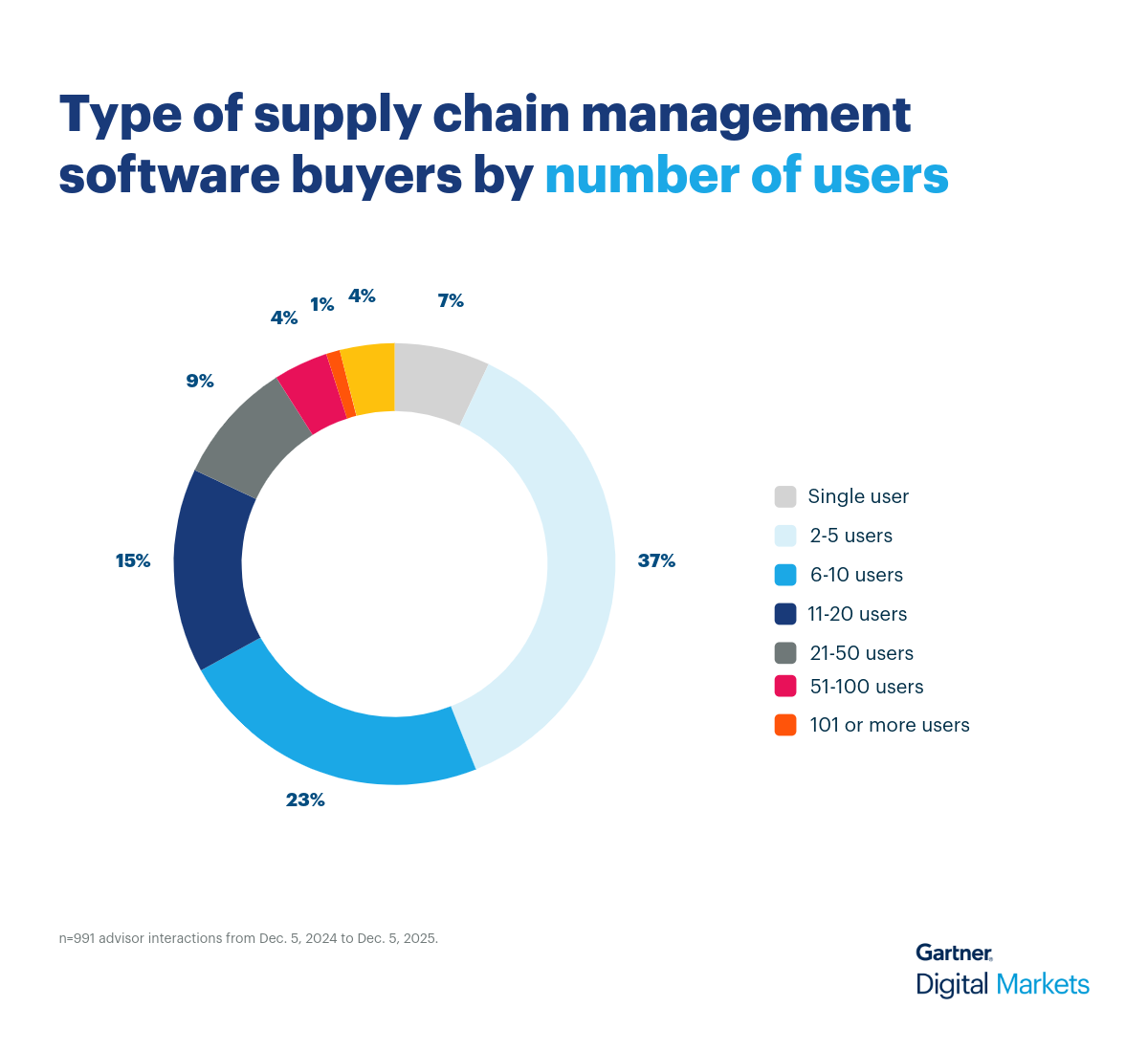
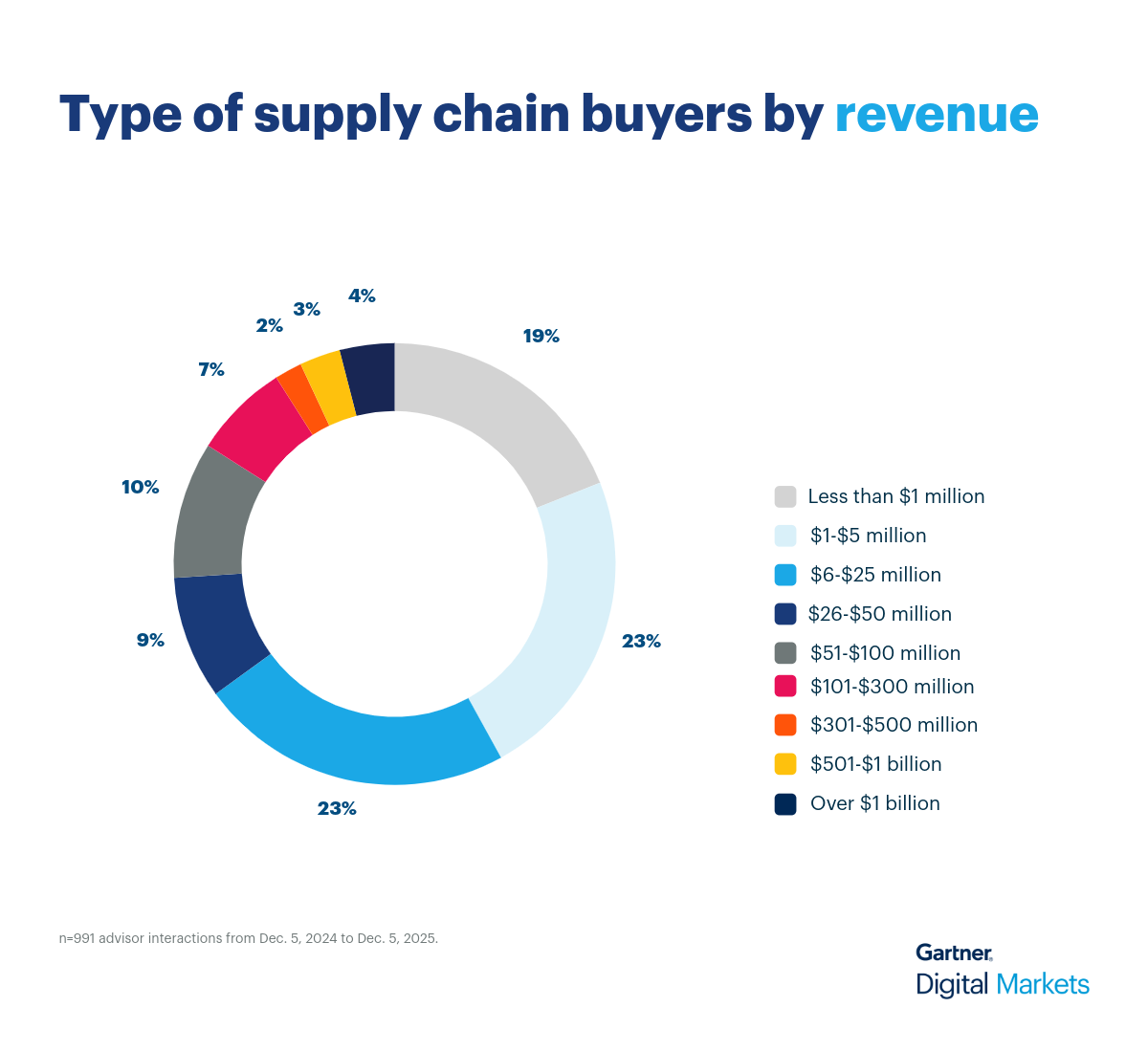
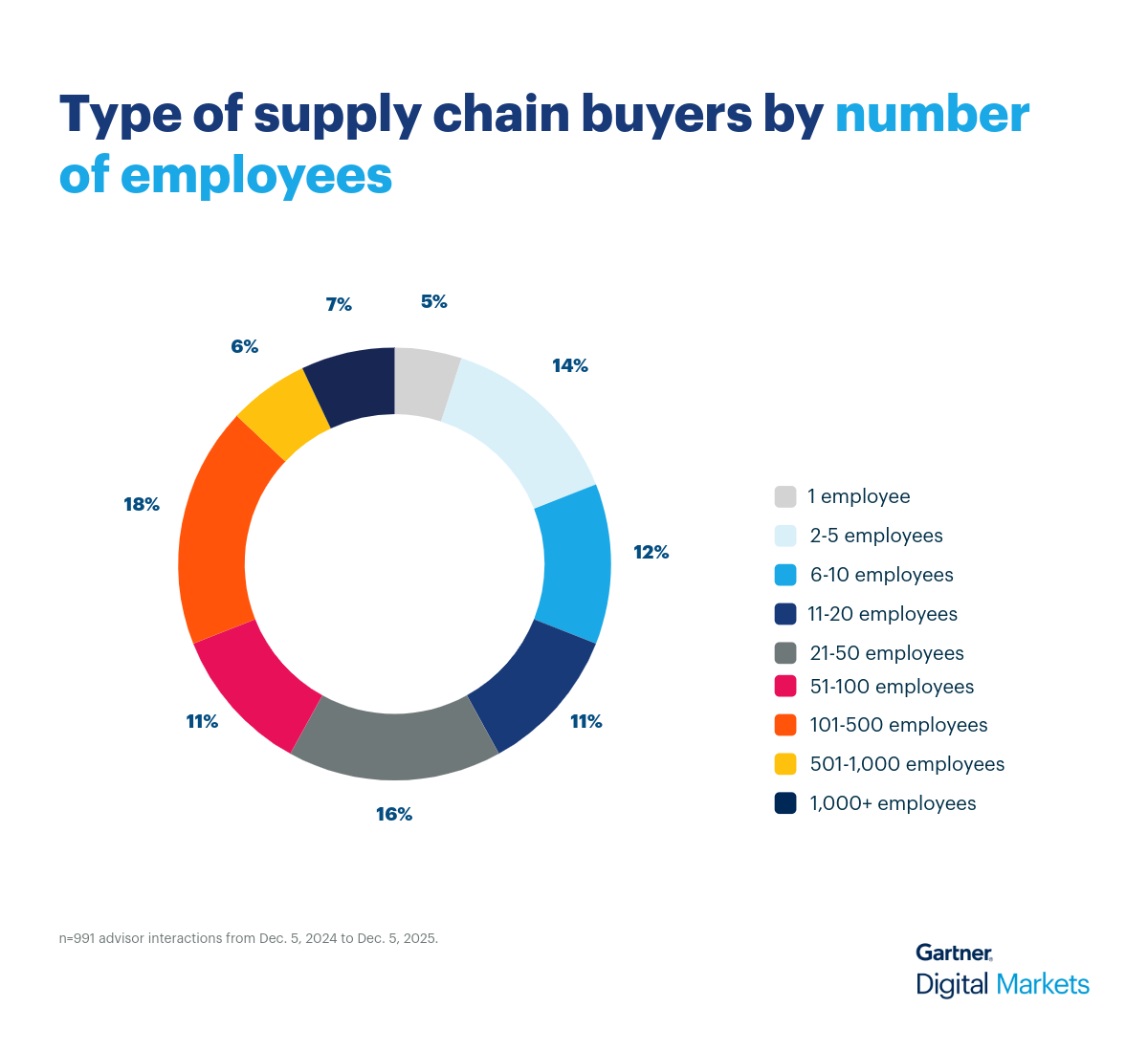
The buyers we interacted with are largely small businesses representing a growing majority of supply chain management software purchases. Below you’ll find the demographics of the buyers so you can see the size and type of businesses, from annual revenue to industry.


Shephalii Kapoor

Shephalii Kapoor

Shephalii Kapoor is a writer at Gartner Digital Markets. She provides insights to help small businesses identify the right software for their needs by analyzing over 550,000 Gartner Digital Markets user reviews and nearly 48,000 interactions between Gartner Digital Markets software advisors and buyers.

Supply chain user
Supply chain revenue
Supply chain employees
Get the Gartner Digital Markets Newsletter

We value your privacy. By submitting this form, you agree we may use your information in accordance with the terms of the Gartner Digital Markets Privacy Policy.

Connect. Convert. Thrive.

Connect to millions of in-market software buyers around the globe with our all-encompassing suite of marketing services.