While headcount reductions specifically attributable to AI are elusive, the technology is bringing real productivity gains for teams that use it effectively.
- Gartner client? Log in for personalized search results.
Put more effort into transforming jobs than eliminating them
AI investments come with lofty management expectations for productivity gains that could eventually lead to headcount reductions. Yet current evidence suggests those expectations are overblown.
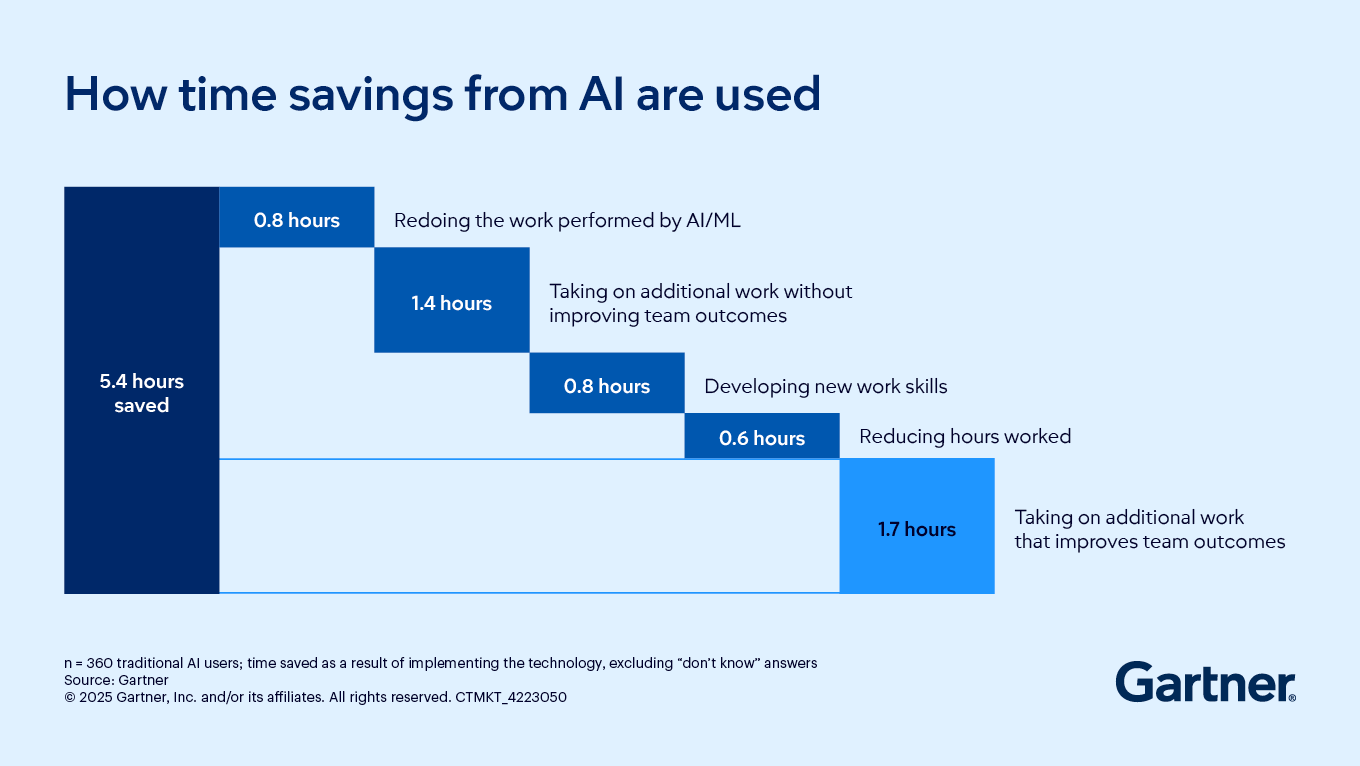
While teams that deploy AI achieve time savings equivalent to five hours per person per week, most of this time saving tends to be spent on non-value-added tasks, as shown in the figure. Also, the productivity gains from AI are no higher than those captured by teams that implement other technologies. Nor are the productivity gains enough to drive net job reductions.
These factors and others suggest it’s time to move the AI-productivity conversation away from headcount reduction and toward business value.
Adapt expectations for how AI-driven productivity affects jobs
Less than 1% of announced layoffs in the first half of 2025 are attributable to productivity gains from AI. Furthermore, Gartner forecasts a net increase in jobs from AI beginning in 2028.
Organizations should expect greater impact from job changes than from job shedding, as teams leverage AI and transform their operating models.
Understand the real-world impacts of AI productivity
A recent Gartner study found that around one in three AI-enabled teams reported high productivity gains from using the technology. These teams saw outcomes such as employees completing daily work faster and the team completing more work with the same resources, while spending more time on value-added tasks.
None of those productivity gains led to net headcount reductions, though they did extend beyond efficiency improvements to produce downstream outcomes. These included:
Enterprise cost savings. Eighty-one percent of the high-AI-productivity teams reported, on average, 27% higher enterprise cost savings compared with teams reporting lower productivity gains.
Greater innovation. Seventy-one percent of high-AI-productivity teams reported creating more novel products and offerings.
- Quality improvements. Sixty-eight percent of high-AI-productivity teams reported bigger improvements in the quality of their enterprise’s products or offerings.
Learn from functions with higher AI exposure
Certain enterprise functions have been particularly successful in achieving AI-enabled productivity gains. Marketing teams have seen strong adoption because they redesign workflows to integrate AI into core processes — for example, automating content generation and using AI-driven insights for market and customer segmentation. This proactive approach accelerates marketing campaign execution and frees time for strategic work.
In contrast, legal and HR teams lag due to risk concerns and slower adoption, highlighting the importance of building trust in AI and creating governance frameworks that enable safe experimentation.
Success depends on human adaptability and willingness to redesign processes, not just technology adoption.
Secure AI productivity gains with three best practices
Simply implementing AI technologies does not guarantee productivity gains. High-productivity teams approach AI with three best practices:
Adapt the operating model to AI. This includes redesigning structures and processes to reflect AI-native workflows, eliminating process bottlenecks and enabling time shifting to value-added tasks.
- Promote knowledge sharing on AI. Build communities that drive collaboration and knowledge exchange among users and power users of AI. This drastically improves the credibility and predictive power of AI algorithms while unearthing new use cases.
- Nurture a culture of AI acceptance. Hold managers accountable for coaching their teams to approach AI with an openness to learn without fear of being displaced.
AI’s impact on productivity and headcount FAQs
What metrics capture the real-world impacts of AI?
Consider measuring employee Net Promoter Score (NPS) for AI (showing improved worker well-being and engagement) or various metrics for cost reduction (e.g., average labor cost per worker, days working capital, supplier spend reduction, contract penalty enforcement rate), risk reduction (e.g., days without accidents, on-schedule supply delivery rate, underwriting accuracy rate) and revenue growth (e.g., median time to deliver value, sales conversion rate, average contract value, increased innovation/strategic output from high-experience workers).
What is the technology industry doing differently with AI to achieve headcount reductions?
The stock market rewards companies for announcing layoffs enabled by AI-induced productivity gains, so tech CEOs describe layoffs in those terms. Yet Gartner analysis of AI layoffs broadly suggests that most (79%) have been unrelated to AI. Instead, these layoffs represent a strategic repositioning and reshaping of the workforce with cuts in some areas and pivoting talent and budgets into new roles and markets focused on capturing AI product and service opportunities.
Attend a Conference
Accelerate growth with Gartner conferences
Gain exclusive insights on the latest trends, receive one-on-one guidance from a Gartner analyst, network with a community of your peers and leave ready to tackle your mission-critical priorities.

Drive stronger performance on your mission-critical priorities.