In one assessment, get a clear maturity score across strategy, data, governance, engineering, operating model, culture and AI product/value — plus a prioritized roadmap to move from pilots to measurable ROI.
- Gartner client? Log in for personalized search results.
Gartner AI Maturity Assessment
Rigorous diagnostic and prioritized actions drive real decisions and measurable AI impact.

Accelerate your AI maturity with Gartner
Determine your organization’s AI maturity
Take the guided AI maturity assessment questionnaire to gauge your current capabilities in seven core AI pillars. This provides a starting point for your AI roadmap.
Prioritize your AI initiatives
Identify the gaps and opportunities between where you are today and where you need to be. Use the scoring system to prioritize your AI initiatives strategically.
Get a practical roadmap aligned to your business goals
Export visualizations and action plans as you continuously inform your AI roadmap, and identify the most feasible opportunities that promise the greatest value.
Develop playbooks for governance, use cases and operating models
Dig deeper into the moving parts of each workstream in your AI roadmap, and receive tailored recommendations on Gartner resources and best practices.
As a client, your in-depth report includes:

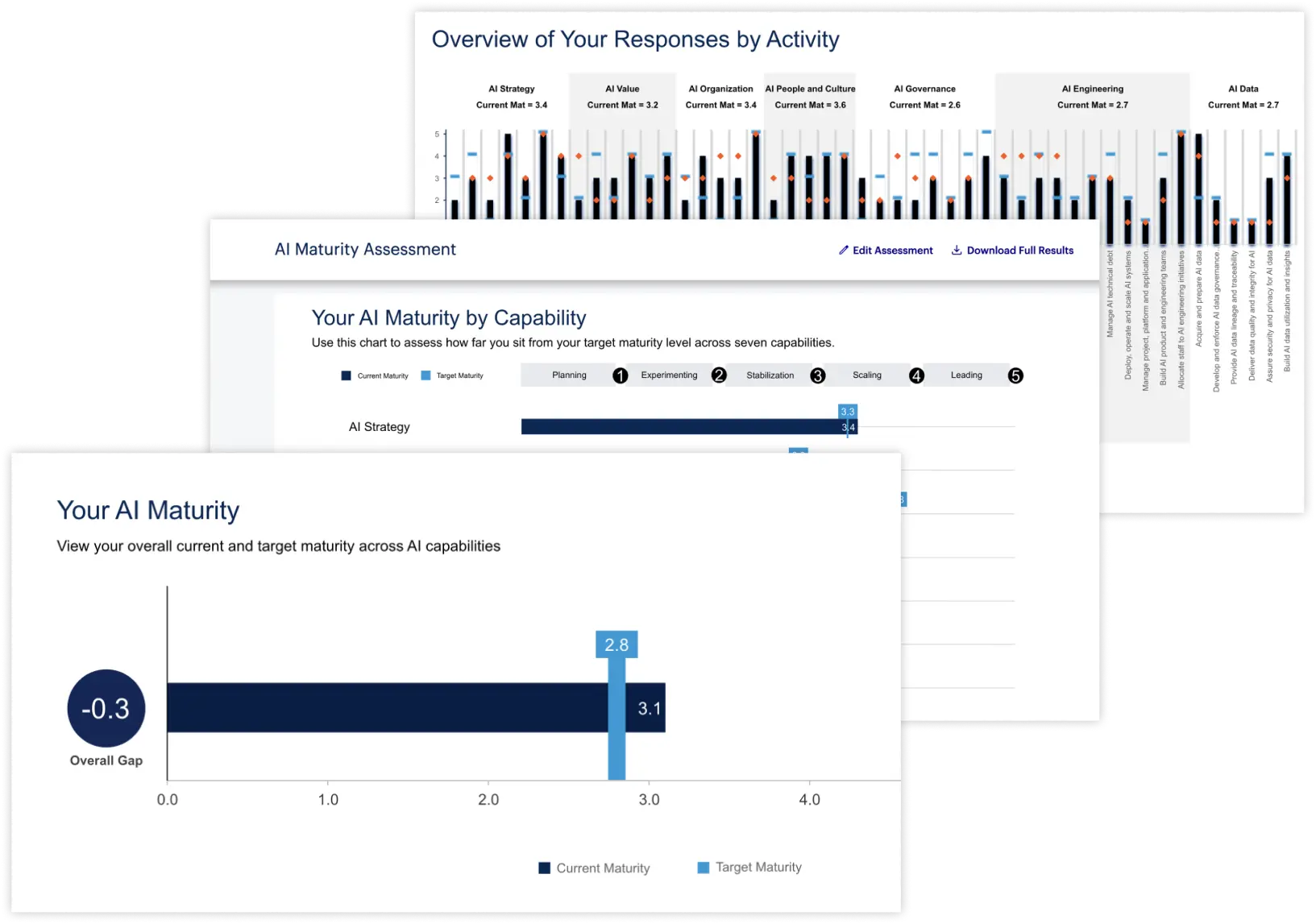
AI maturity heat map
Review your current maturity and target maturity level for each capability.

A visualization of key gaps
See the largest gaps between current and target maturity that you should consider for improvement.

Analyst recommendations
Review recommendations and strategic resources to address each gap.

AI maturity model FAQs
What is an AI maturity model?
An AI maturity model is a structured framework that assesses an organization’s level of capability in leveraging AI across a set of fundamental pillars or objectives, is used to identify current capabilities and capability gaps, and informs roadmaps and prioritization of actions to increase AI readiness and value realization.
Using an AI maturity model helps leaders answer key questions:
Are we experimenting or truly scaling AI?
Are our data, technology and teams ready?
Where should we invest next to drive measurable impact?
A strong AI maturity model looks across strategy, data, technology, governance, talent and business value — not just tools.
Why and how do I use an AI maturity model?
It serves as a planning and diagnostic tool to:
Establish a baseline of AI capability for the enterprise or a business function
Guide strategic planning and resource allocation (set adoption targets, build roadmaps and prioritize initiatives)
Track progress over time and trigger strategy realignment when needed
Models measure maturity across multiple domains (objectives and activities) and can be applied enterprisewide or to specific functions (for example finance or marketing) to inform tailored roadmaps and use case prioritization.
What are the stages of AI maturity?
Using the Gartner AI maturity model, organizations are typically grouped into five stages:
Foundational — Ad hoc experimentation with limited coordination
Emerging — Early pilots and growing executive interest
Operational — AI embedded in select processes with defined ownership
Scaled — AI capabilities deployed across functions with measurable ROI
Transformational — AI reshapes decision making, operating models and competitive advantage
Understanding your current stage allows you to focus investments where they matter most.
Drive stronger performance on your mission-critical priorities.