Expose where the problem lies and start fixing it.
- Gartner client? Log in for personalized search results.
AI resistance hides in organizational systems
Gartner business and technology insights show that every 100 days implementing AI demands 25 extra days of training and up to 200 days of change management. With CxOs under pressure to show AI’s value stat, this is unacceptable — and organizational entrenchment is often to blame.
Defined as the “calcification” of an organization’s systems, processes, structures, incentives and routines, organizational entrenchment, in the face of AI, goes from a source of stability to an invisible hand that quietly sabotages transformation. When you attempt to layer AI onto an already entrenched organization, you expose problems that have been festering all along, making the cracks in your foundation impossible to ignore.
Organizational entrenchment exposes AI barriers
Understand the factors behind organizational entrenchment, determine how to minimize them and track the impact of interventions.
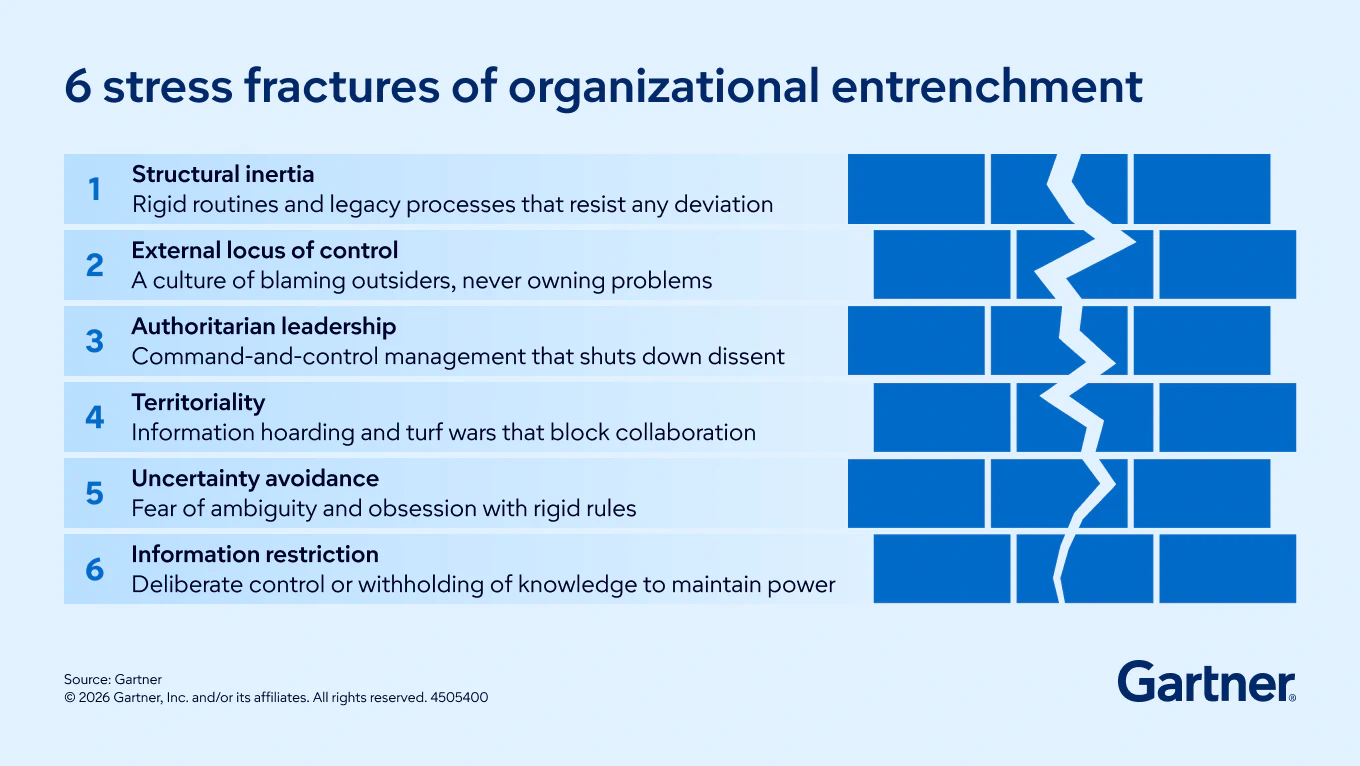
6 types of organizational entrenchment
These stress fractures reveal exactly where your organization will struggle with AI adoption — and where intervention is needed most.
Structural inertia: Rigid routines and legacy workflows that reject any deviation from established processes, causing AI to layer onto outdated systems where productivity gains vanish.
External locus of control: A blame culture that points fingers at vendors, markets or other departments rather than examining internal systems.
Authoritarian leadership: Command-and-control management that shuts down the dissent and experimentation AI needs to thrive.
Territoriality: Information hoarding and turf wars that block the collaboration AI demands.
Uncertainty avoidance: Fear of ambiguity and obsession with rigid rules that create unrealistic accuracy demands for AI tools, stalling productionization.
Information restriction: Deliberate control or withholding of knowledge to maintain power, causing employees to tune out even when training is offered.
Key actions to combat organizational entrenchment
High entrenchment demands structural intervention. Standard change management reinforces resistance rather than overcoming it.
Dismantle legacy power structures by redrawing reporting lines and restructuring teams to disrupt entrenched hierarchies. Reduce management layers. Consolidate teams to streamline AI ownership. Renegotiate external contracts as AI agents take over tasks.
Replace or remove leaders who perpetuate resistance and block change. This goes beyond blame — you're creating conditions for success.
Inject fresh energy by hiring recent graduates (within the last three years) who already use AI constantly. They introduce fresh thinking without a hefty “AI genius” price tag.
Work with finance to classify initiatives into blue (productivity) and green (profit) money. Implement funding gates to control capital allocation and force accountability.
How to measure success in breaking AI resistance
After taking steps to remedy organizational entrenchment, evaluate the success of AI initiatives using the same key performance indicators (KPIs) and business metrics your organization already relies on to measure success. These include:
ROI and productivity leak to show financial and strategic impact
Conversion rates, response times and other measures of operational efficiency
Residual risk, control effectiveness and stakeholder feedback on risk management and governance
Energy/water consumption and greenhouse gas emissions to align AI adoption with broader business and societal imperatives
Return on employee (ROE), user adoption metrics, training outcomes, employee net promoter score (eNPS)
Organizational entrenchment FAQs
What is organizational entrenchment and how does it block AI adoption?
Organizational entrenchment refers to calcified systems, processes, structures and routines that persist regardless of who fills roles. AI layered onto outdated processes and technical debt can’t be fixed with standard change management, which often reinforce resistance.
What strategies work for organizations with high entrenchment?
Shift from change manager to capital allocator. Treat high entrenchment as investment risk. Dismantle legacy power structures, replace resistant leaders, hire AI-native graduates and work with the CFO to control capital allocation. Standard training budgets become sunk costs.
Attend a Conference
Accelerate growth with Gartner conferences
Gain exclusive insights on the latest trends, receive one-on-one guidance from a Gartner analyst, network with a community of your peers and leave ready to tackle your mission-critical priorities.

Drive stronger performance on your mission-critical priorities.