Executive leaders struggle to quantify and communicate AI’s value. These metrics change that.
- Gartner client? Log in for personalized search results.
The AI ROI problem: Activity doesn’t equal outcomes
CEOs consistently identify AI as the technology most likely to impact their organization’s business outcomes. Yet executive leaders struggle to quantify its ROI in terms the boardroom understands, largely because their organizations measure AI success through activity-based metrics like “productivity” or “adoption rates” rather than tangible financial outcomes.
To prove AI’s worth across the enterprise, move beyond inputs and activities to focus on metrics that directly tie to the bottom line: cost reduction, revenue growth or improved employee experience.
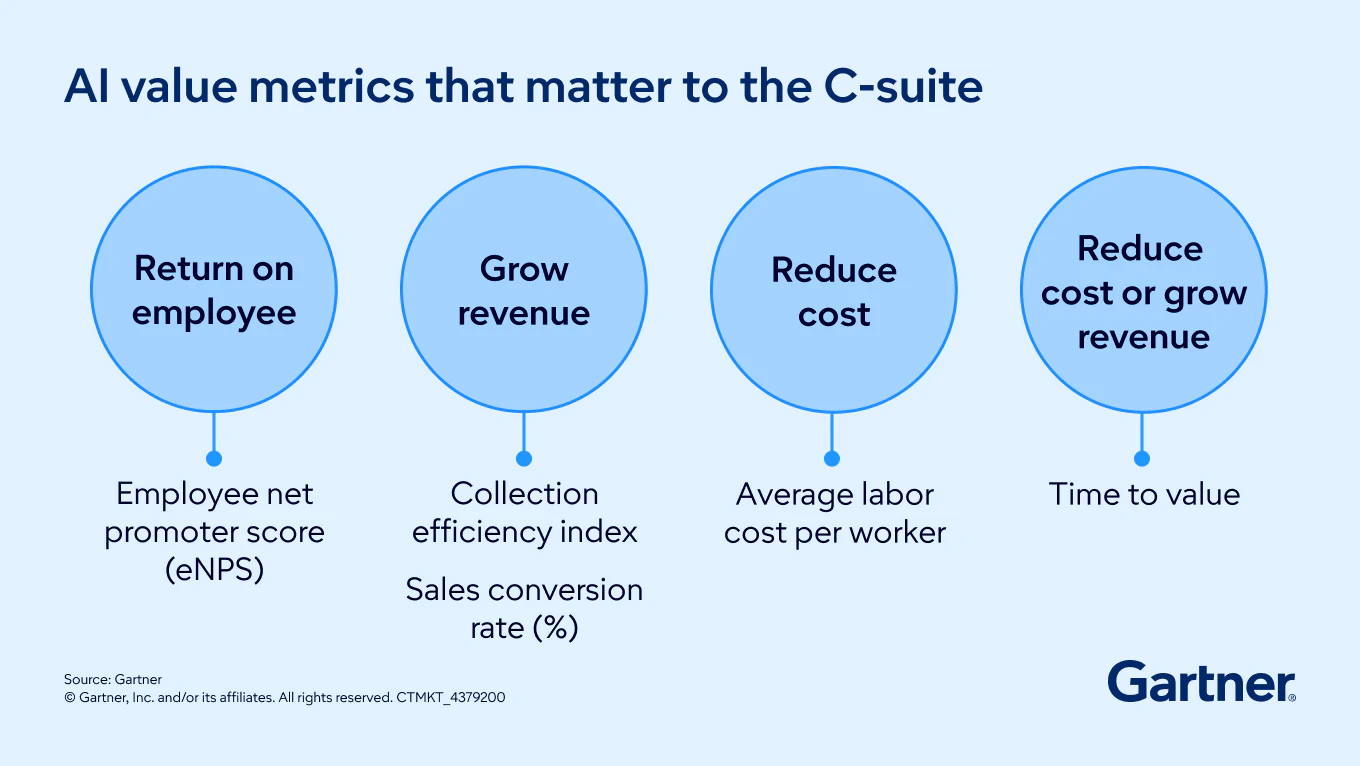
5 AI metrics that resonate across the enterprise
Gartner insights identify 10 metrics that best demonstrate AI’s tangible impact with multiple C-suite stakeholders and can be implemented quickly. To see the full list, fill out the form on this page to explore becoming a Gartner client.
1. Sales conversion rate
Why it matters: This is where AI’s impact on revenue becomes immediately visible and quantifiable. While many AI investments promise future returns, improved sales conversion delivers measurable revenue growth within weeks or months.
How it works: AI analyzes customer communications for signals like uncertainty or confusion, guiding sellers to adapt their messaging in real time. This creates emotional resonance with prospective buyers and reduces the cognitive effort required to make a purchase decision.
What to do: Deploy a sentiment-analyzing AI that gives real-time guidance to sales representatives based on customer signals. Start with one sales segment and run an A/B test against a control group to measure impact. Track leading indicators, including adoption rate of AI-driven recommendations by your sales team and increased customer engagement metrics during the sales process.
76% of CEOs believe AI will have the most significant impact on their industry, and 71% of boards want enterprises to take more technology risks with AI.
2. Average labor cost per worker
Why it matters: This cost reduction metric addresses one of the most significant line items in any organization’s budget: payroll.
How it works: AI enables “experience compression,” allowing employees in lower-complexity roles to perform like more experienced workers. This allows organizations to optimize workforce composition without sacrificing performance or quality.
What to do: Select a standardized function like customer support or IT service desk where performance can be quantified across different experience bands. Run a pilot to test whether AI-equipped employees improve performance faster than historical onboarding data shows.
3. Time to value
Why it matters: This dual-impact metric affects both revenue growth and cost reduction by fundamentally changing how quickly organizations realize returns from new initiatives.
How it works: AI shortens the development and launch cycle for new products and services. Unlike metrics that measure efficiency in existing processes, this one captures the compounding effect of speed — faster delivery means earlier revenue, more iterations per year and competitive advantage.
What to do: Analyze your project management data from the last two years to identify common bottlenecks. Create an “AI acceleration map,” highlighting tasks most suitable for automation or augmentation.
4. Collection efficiency index
Why it matters: This revenue-focused metric directly impacts cash flow, one of the most critical indicators of organizational health. Frequent delays in cash collection caused by exceptions — disputes, unique terms, billing errors — can significantly impact working capital. It can also improve customer relationships and highlight underlying issues in the sales cycle that need addressing.
How it works: AI handles individual cases in a customized yet automated way, preventing delays and reducing collection time without overwhelming teams.
What to do: Implement an AI assistant to help collections teams draft personalized, effective communications based on each customer’s payment history and proven successful patterns. Track leading indicators, including straight-through processing rate (invoices processed without manual intervention) and average time to resolve exceptions.
5. Employee net promoter score (eNPS)
Why it matters: While the previous four metrics show immediate financial returns, eNPS represents the foundation for sustained AI value and long-term organizational health.
How it works: AI increases worker well-being and engagement. Employees who use productivity tools (e.g., Microsoft Copilot) more than once per week report higher eNPS scores, making this a lever for talent retention and employee engagement.
What to do: Launch a four-week pilot of an AI assistant within a team that has high turnover rates. Assign a monetary value to employee well-being and retention to determine whether the organization deploys AI broadly to improve eNPS or uses it more strategically for direct financial returns.
AI value metrics FAQs
Why focus on AI outcomes instead of AI productivity metrics?
Activity-based measures like “productivity gains” or “time saved” don’t translate to boardroom language. Executives need to see direct financial impact through metrics they already track — revenue growth, cost reduction or employee retention. Outcome metrics connect AI investments to business results that boards understand and can act on.
How quickly can organizations see ROI from AI?
With strategic use of AI, sales conversion rate and collection efficiency can show improvements within eight to 12 weeks. Labor cost optimization typically shows results within one fiscal quarter as experience compression accelerates. Time to value and eNPS are longer-term plays requiring six to 12 months to demonstrate sustained impact. Start with quick-win metrics to build momentum, then layer in strategic measures.
How many AI metrics should organizations focus on or track?
Start by identifying your primary goal: cost reduction, revenue growth or employee experience. Then select two to three metrics aligned with that goal rather than attempting to track everything at once. Targeted AI investments typically drive one specific outcome effectively. Once you establish ROI in one area, expand to additional metrics as your AI maturity grows.
Attend a Conference
Accelerate growth with Gartner conferences
Gain exclusive insights on the latest trends, receive one-on-one guidance from a Gartner analyst, network with a community of your peers and leave ready to tackle your mission-critical priorities.

Drive stronger performance on your mission-critical priorities.