See the top cybersecurity trends shaping CISO priorities across three themes in 2026.
- Gartner client? Log in for personalized search results.
Why CISOs must refocus on top cybersecurity trends
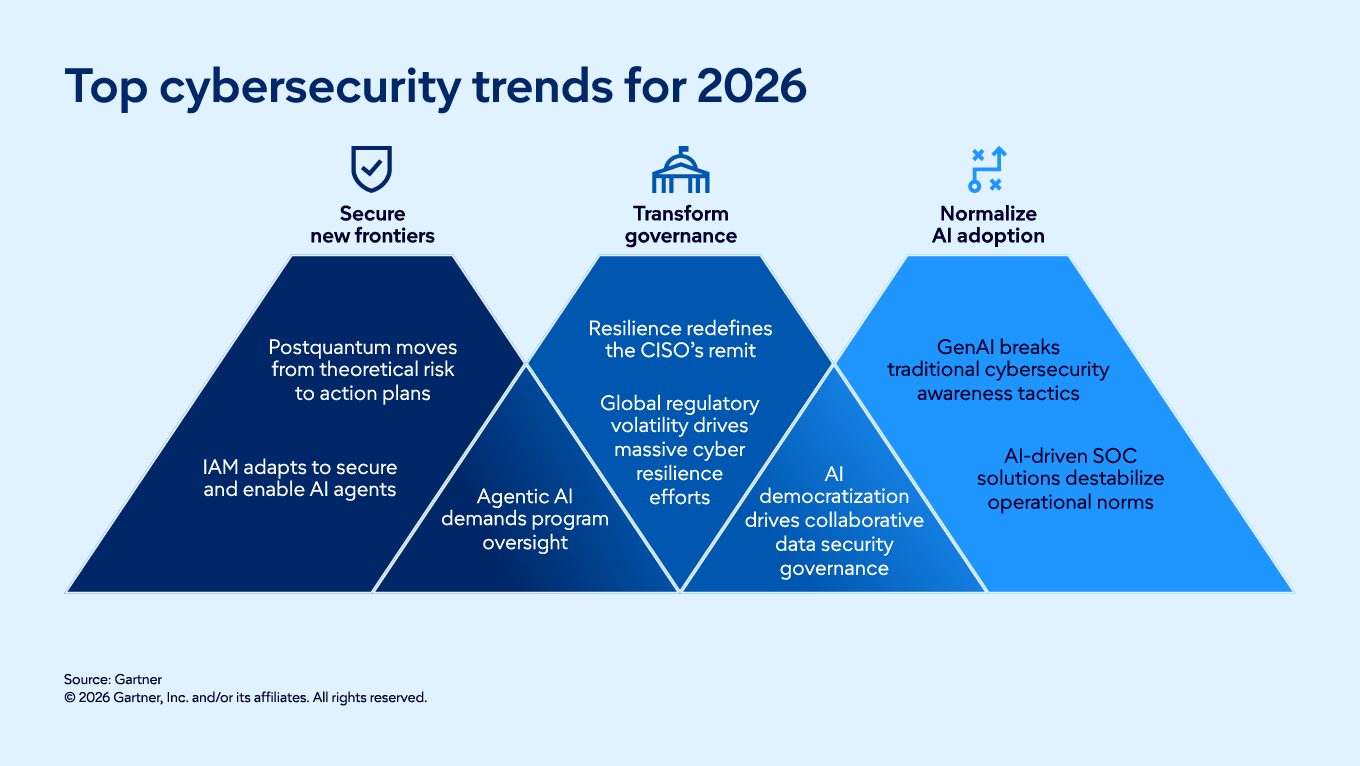
CISOs enter 2026 facing intensified pressure from geopolitical uncertainty, regulatory fragmentation and rapid AI expansion — all of which are reshaping enterprise risk and elevating expectations for more adaptive cybersecurity strategies. Gartner’s top cybersecurity trends reflect this shift, outlining where leaders must focus to secure emerging technologies, modernize governance and normalize AI adoption to build resilient, future‑ready programs.
Top cybersecurity trends shaping CISO priorities in 2026
Cybersecurity leaders face pressure from geopolitics, regulatory volatility, digital decentralization, an accelerating threat landscape and rapid AI adoption. The 2026 top trends roll up into three themes that guide where CISOs must invest to manage risk and build cyber resilience.
Theme 1: Secure new frontiers
IAM adapts to secure and enable AI agents
As AI agents proliferate, CISOs must recognize that uneven IAM maturity calls for a targeted, risk-based strategy, focusing investment where gaps and risks are greatest, and leveraging automation and integration where capabilities are strong. This approach is essential for enabling innovation, ensuring compliance and protecting critical assets in AI-centric environments.
Postquantum moves from theory to action
Advances in quantum computing drive urgent planning for postquantum cryptography (PQC). Many organizations are already prototyping PQC and improving cryptoagility, but visibility gaps persist. Start a cryptographic inventory, establish a cryptographic center of excellence, align vendors to PQC roadmaps and prioritize long‑lived assets for migration.
Agentic AI demands program oversight
No‑code and low‑code tools are enabling “rogue” automations. CISOs must implement a structured framework to map AI agents based on business risk dimensions like data sensitivity and autonomy. Those who do will gain the required oversight to secure and support their organization’s strategic AI initiatives.
Theme 2: Transform governance
AI and cyber resilience redefine the CISO remit
The remit expands with enterprise AI and resilience expectations. CISOs should lead through influence, not unchecked task ownership, center on cyber resilience, reset board expectations, and coordinate with the CIO, CRO and CDAO to scale sustainably.
AI democratization drives collaborative data security governance
Shadow AI is inevitable. Replace control‑heavy, mandated centralized policies with collaborative models that increase business accountability. Monitor behavior and exception patterns, co‑create usable guardrails and regain control of sensitive data shared into AI.
Global regulatory volatility drives massive cyber resilience efforts
Cybersecurity leaders must recalibrate their strategies to foster cross-functional collaboration among legal, business and procurement teams, ensuring that compliance responsibilities are clearly defined and shared. Rapid incident reporting requirements (sometimes within 24 hours) and heightened data sovereignty pressures demand robust, automated processes and strategic vendor decisions.
Theme 3: Normalize AI adoption
GenAI breaks traditional cybersecurity awareness tactics
Cybersecurity leaders must not only rely on technical and governance controls but also adapt their security behavior and culture programs (SBCPs) to drive more secure GenAI-related work practices and behaviors. This proactive, people-centric approach is the only way to help protect and maximize the value of AI investments.
AI‑driven SOC solutions destabilize operational norms
Cybersecurity leaders who overlook the requirements to develop and maintain skill sets in favor of technological advancements in the SOC will have significantly less ability to critically analyze the findings of security tools in the future. Use of AI SOC agents demands a new training regime for all analysts.
Top cybersecurity trends FAQs
What are the top cybersecurity trends CISOs should prioritize in 2026?
The Gartner trends group into three themes: secure new frontiers, transform governance and normalize AI adoption. Each contains trend areas such as IAM for AI agents, postquantum planning, agent oversight, collaborative governance, regulatory resilience, SBCPs and AI‑driven SOC adoption.
How do top cybersecurity trends affect identity and cryptography roadmaps?
CISOs must extend IAM to machine actors, automate credential life cycles and define policy‑driven authorization. In parallel, they should inventory cryptography, align vendors to PQC, build cryptoagility, and prioritize long‑lived data and systems for migration.
How should CISOs normalize AI adoption without increasing risk?
Adopt collaborative governance, create clear GenAI guidance that maps to existing policies, monitor behavior change, classify agents by autonomy and data sensitivity, enforce least‑privilege and human ownership, and upskill SOC teams with human‑in‑the‑loop controls.
Attend a Conference
Accelerate growth with Gartner conferences
Gain exclusive insights on the latest trends, receive one-on-one guidance from a Gartner analyst, network with a community of your peers and leave ready to tackle your mission-critical priorities.

Drive stronger performance on your mission-critical priorities.