The focus is shifting from excitement about AI agents to understanding how agentic AI technologies are maturing.
- Gartner client? Log in for personalized search results.
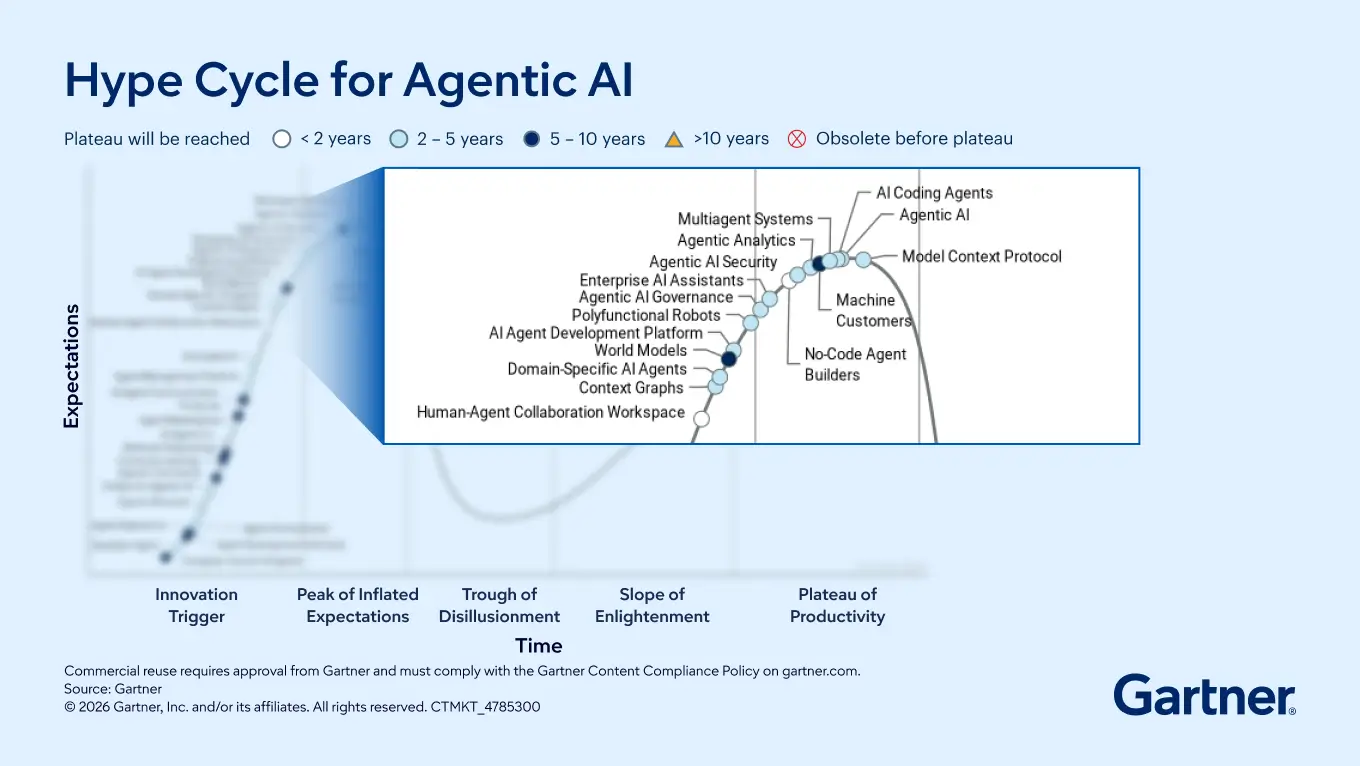
Gartner Hype Cycle™ for Agentic AI report helps leaders make sense of one of the fastest-moving areas in AI.
As interest in AI agents accelerates, organizations face growing confusion about what agentic AI can realistically deliver today — and how to distinguish emerging capabilities from early hype.
The 2026 Gartner Hype Cycle for Agentic AI provides a structured view of how agentic AI technologies, platforms and practices are evolving. By mapping individual profiles across stages of maturity, benefit potential and time‑to‑mainstream adoption, the Hype Cycle helps leaders understand where progress is real, where expectations outpace readiness and how the agentic AI landscape is likely to develop over time.
You might also like this webinar: Scaling Agentic AI: A Leadership Guide for CIOs
Key take-aways from Hype Cycle for Agentic AI
The Hype Cycle highlights a diverse and rapidly evolving ecosystem of agentic AI technologies. Rather than following a single trajectory, agentic AI profiles are distributed across the curve — reflecting uneven maturity, different adoption drivers and a wide range of enterprise use cases.
Agentic AI reaches the Peak of Inflated Expectations
Agentic AI sits at the Peak of Inflated Expectations, reflecting extraordinary market attention and aggressive adoption intent. According to the 2026 Gartner CIO and Technology Executive Survey, only 17% of organizations have deployed AI agents to date, yet more than 60% expect to do so within the next two years — the most aggressive adoption curve among all emerging technologies measured in the survey.
This rapid rise toward the Peak of Inflated Expectations highlights a growing gap between ambition and execution. Many organizations are experimenting with agents to automate discrete tasks, particularly in areas such as software engineering, customer support and operations. However, most deployments remain narrowly scoped, and fully autonomous agents are not ready for the majority of enterprise use cases. The Hype Cycle reflects this tension by showing strong momentum without corresponding maturity across supporting capabilities.
Governance, security and cost management emerge across the Hype Cycle
A defining signal in the 2026 Hype Cycle is the emergence of governance, security and cost‑focused profiles alongside core agentic AI technologies. Rather than appearing as a single cluster, these profiles are distributed across the curve, reflecting different stages of development and adoption.
Technologies such as agentic AI governance, agentic AI security and FinOps for agentic AI indicate rising enterprise concern about accountability, control and economic sustainability as agentic systems become more autonomous and interconnected. Their placement highlights that the need for oversight and discipline is becoming evident early in the adoption cycle — not only after large‑scale deployment.
While enthusiasm for agentic AI is accelerating, many of the mechanisms required to manage risk, trust and cost are still maturing. Understanding where these supporting profiles sit on the curve is critical for interpreting how quickly agentic AI can move from experimentation to dependable enterprise use.
Foundational platforms and practices shape enterprise readiness
Beyond individual agents, the Hype Cycle places significant emphasis on the platforms and engineering practices that enable agentic AI at scale. Agent development platforms, agent management platforms, orchestration technologies and communication frameworks appear as distinct profiles, each with its own maturity path.
In parallel, practices such as the agent development life cycle (ADLC), context graphs and agent experience (AX) highlight the growing need for structured approaches to building, deploying and managing agentic systems. Their placement on the curve reflects early recognition that agentic AI requires new development, operational and governance models — beyond those used for traditional AI or automation.
Together, these profiles show that enterprise adoption of agentic AI depends as much on foundational capabilities as on advances in agent intelligence itself.
Agentic AI innovations mature at different speeds
The 2026 Hype Cycle for Agentic AI spans a wide range of innovations with varying levels of benefit and time‑to‑mainstream adoption. While some profiles point to transformational potential, others represent incremental improvements or longer‑term possibilities.
This uneven distribution reinforces a key insight from the Hype Cycle: Agentic AI is not a single technology category, but an ecosystem evolving at different speeds. Treating all agentic AI innovations as equally mature or immediately valuable risks unrealistic expectations and misaligned investment decisions.
What this means for IT leaders
Hype Cycle for Agentic AI underscores a market characterized by rapid innovation and uneven maturity. For IT leaders, the value of the Hype Cycle lies in interpreting how different profiles relate to one another — not just in tracking individual technologies. Leaders should use the Hype Cycle to:
Assess readiness across agentic AI capabilities, platforms and enablers
Understand how governance, security and cost considerations affect adoption timing
Set realistic expectations for autonomy and enterprise impact
Prioritize investments that support sustainable, scalable use of agentic AI
Agentic AI will continue to evolve quickly. The Hype Cycle provides a framework for understanding where the market stands today — and how agentic AI is likely to progress as foundational technologies mature.
Attend a Conference
Experience Information Technology conferences
With exclusive insights from Gartner analysts on the latest trends, sessions curated for your role and unmatched peer networking, Gartner conferences help you accelerate your priorities.
7 – 9 Dec 2026
Gartner Identity & Access Management Summit
Las Vegas, NV

Drive stronger performance on your mission-critical priorities.