Prepare your enterprise to capture AI opportunities and bolster your cybersecurity, data and AI policies and principles.
- Gartner client? Log in for personalized search results.
Get AI Ready: What IT Leaders Need to Know and Do
4 key initiatives to get your enterprise AI ready
Whether your organization’s ambition is for AI to augment everyday processes or create something game changing, you need a set of foundational capabilities to succeed.
This guide can help IT leaders ready their organizations to:
Define their “AI ambition” and spot AI opportunities
Prepare AI cybersecurity
Get AI ready
Adopt AI principles
See Gartner’s latest AI research in action at our CIO Conferences and Events 2026-2027.
AI ambition must weigh feasibility, opportunity and risk
More than three-quarters of CEOs say AI will have the most impact of any technology on their industries over the next three years. Yet greater than half also say their organizations are fair (at best) at preventing or mitigating risks associated with AI implementation. Narrow the gap — first by defining your AI ambitions.
3 Areas of AI Ambition
AI Opportunity Ambition
AI Deployment
AI Risk
Define your AI opportunities, deployment options and risks
GenAI has enabled machines to transition from being tools to being teammates. This is a big shift that comes with a potential dark side. The C-suite expects their organization’s AI leaders to drive the AI strategy and capitalize on the benefits of AI while avoiding the risks.
The stakes are high, given the combination of AI excitement and disillusionment that exists in every organization — disillusionment because value from AI has been elusive. Just 38% of CIOs and technology leaders rate their progress toward value creation using AI as excellent or good. To help increase the success rate, set the organization’s AI ambition — that is, decide where and how you will use AI. Given that today’s AI can decide, take action, discover and generate, it’s as important to know what you will not do as it is what you will do.
An AI plan must take account of three key elements:
1. AI opportunity ambition
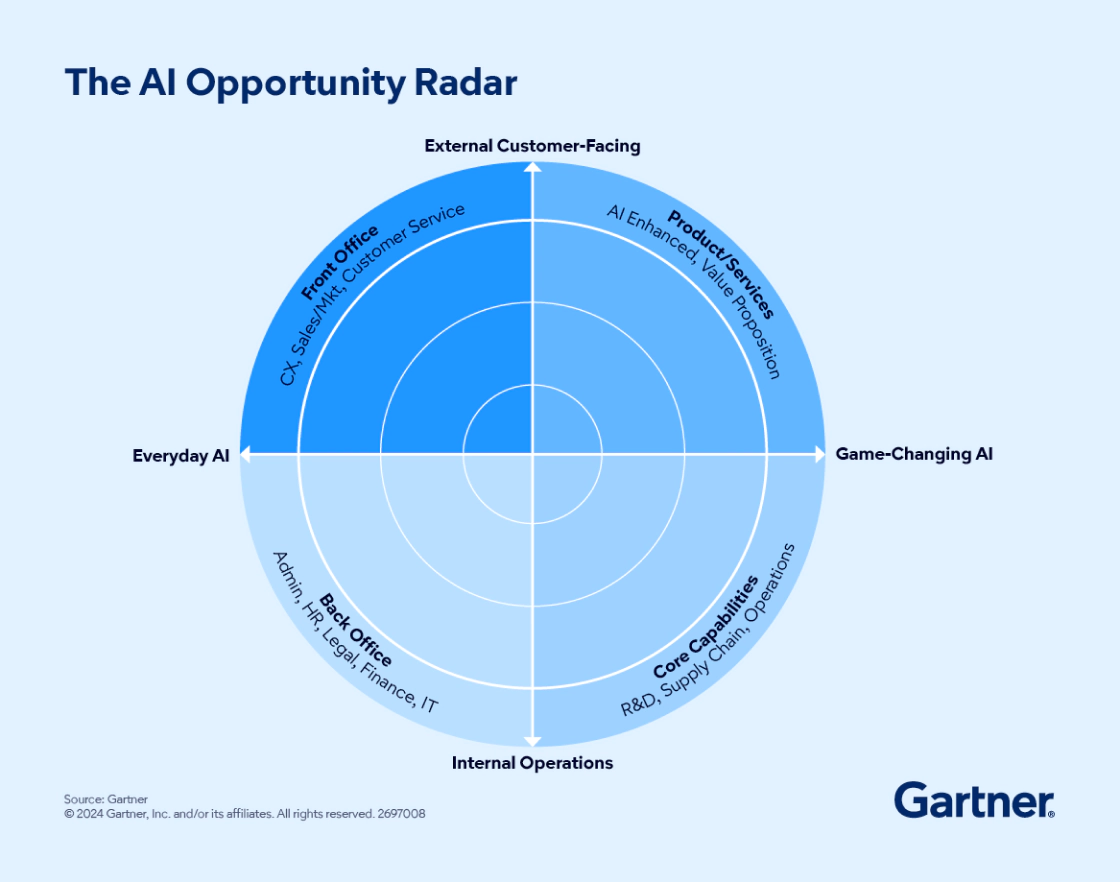
This reflects the type of business gains you hope to realize from AI. Opportunity ambition identifies where you will use AI (e.g., for internal operations or customer-facing activities) and how (e.g., to optimize everyday activities or create game-changing opportunities). Leverage the Gartner AI Opportunity Radar to map your opportunity ambition.
2. AI deployment
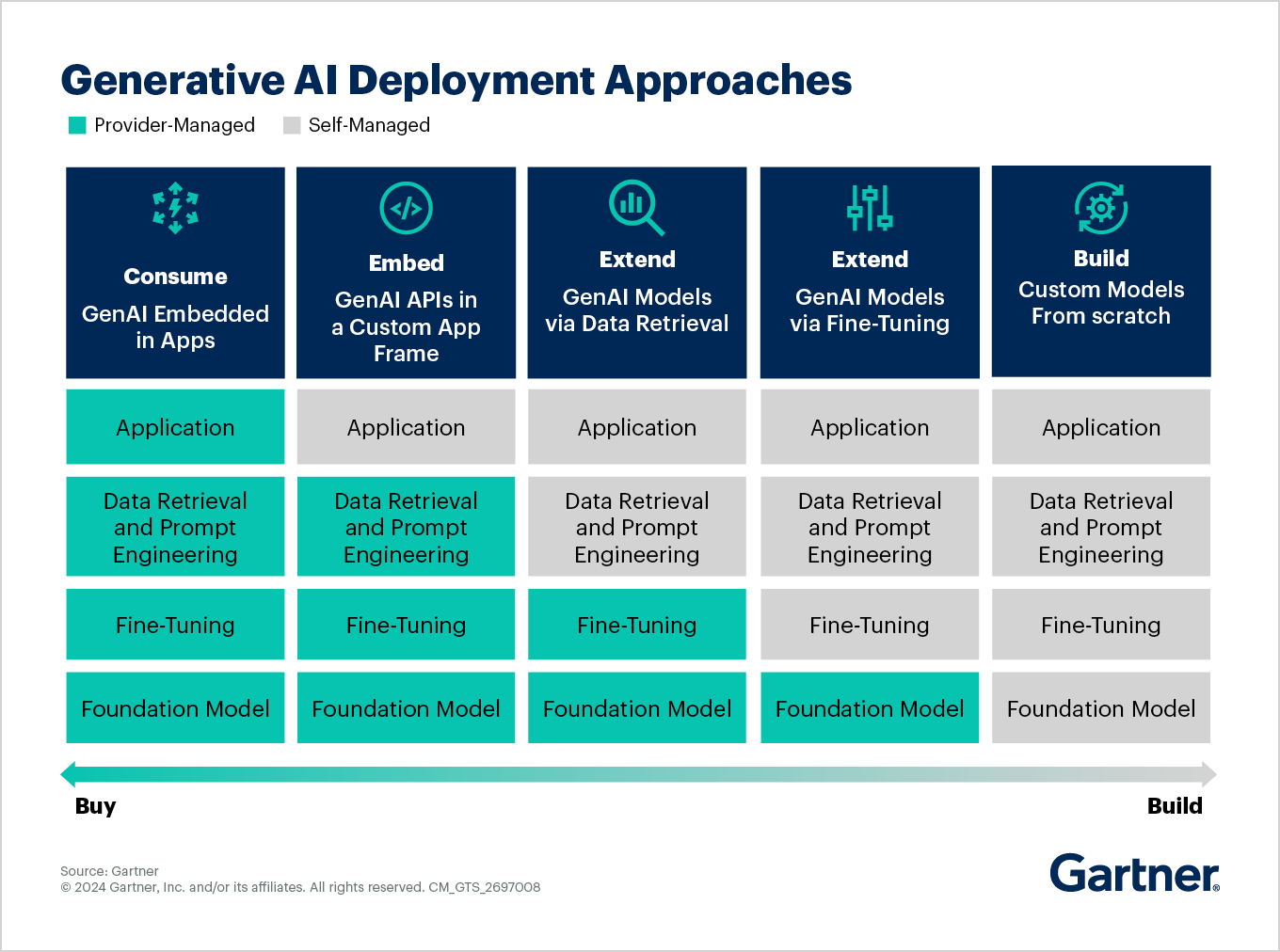
This reflects the technological options available for deploying AI, which can enable or limit the opportunities you hope to pursue. Organizations can deploy AI from public, off-the-shelf models trained on public data; leverage a public model and data adapted with proprietary data; or build in house as a custom algorithm trained on their data. The more customization involved, the higher the investment cost and time to deployment — yet greater customization also enables game-changing opportunities.
3. AI risk
AI risk comes in many forms, including unreliable or opaque outputs, intellectual property risks, data privacy concerns and cyber threats. There are also emerging regulatory risks related to the rules and restrictions that different jurisdictions may place on AI, including those related to copyright. Your organization will need to define its risk appetite as it relates to degrees of automation and transparency.
Engage the executive team to choose AI opportunities to pursue
AI falls into two high-level categories in the organization:
Everyday AI enhances productivity by enabling humans to do the things they already do more efficiently.
Game-changing AI enhances creativity by either enabling you to create results via new products and services or through new core capabilities. Game-changing AI will disrupt business models and industries.
Both everyday AI and game-changing AI have internal and external uses. Yet they offer a completely different return on value and require completely different investment approaches. Defining your AI ambition involves examining which combinations of everyday and game-changing AI and internal or external use cases you will pursue.
Investment expectations will influence these decisions. Currently, 80% of organizations investing in AI focus on the everyday side of the opportunity radar — and game-changing AI is not cheap. Only 7% of finance leaders recognize a high impact from AI use cases beyond more typical (and modest) productivity and efficiency gains.
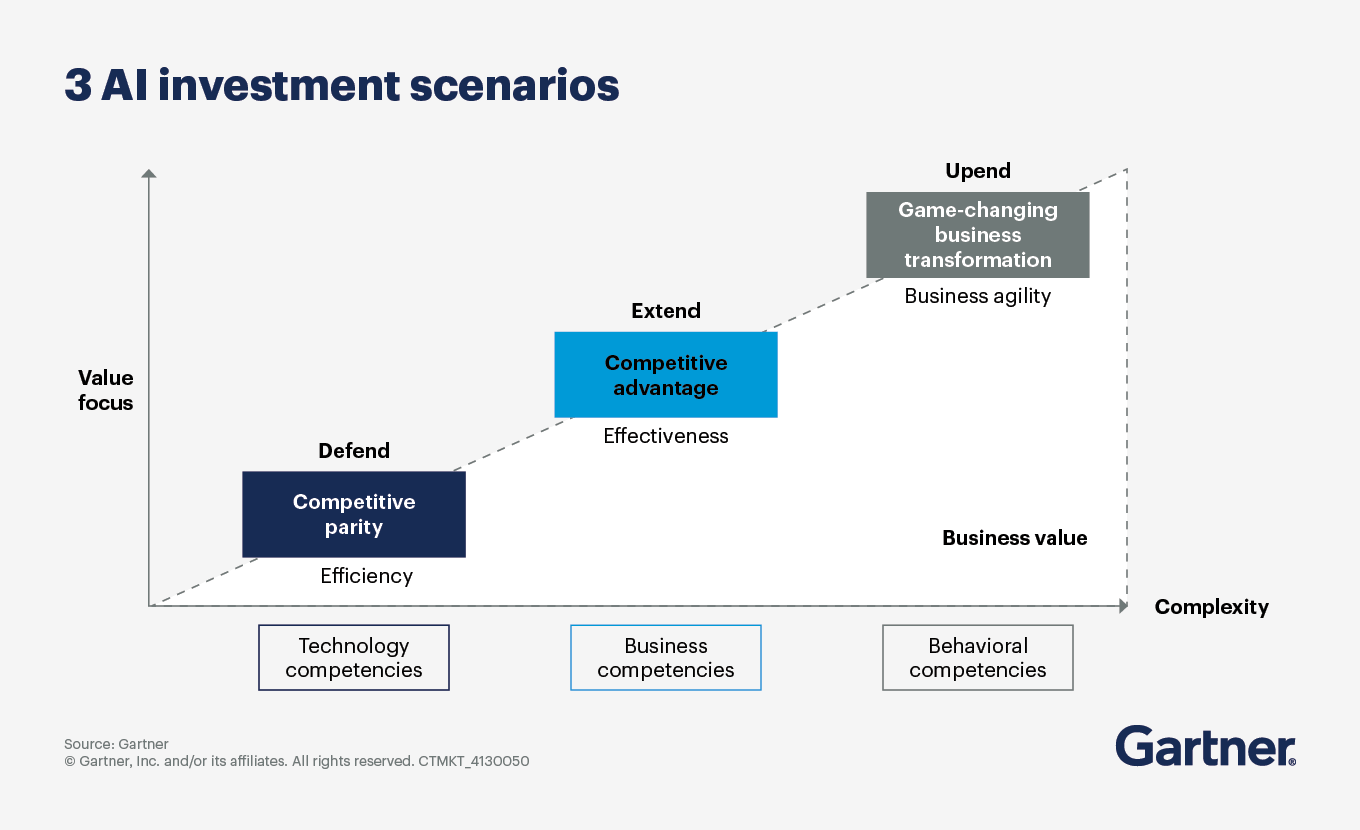
To define realistic AI ambitions, consider the three AI investment business cases with your C-suite:
Defend your position by investing in quick wins that improve specific tasks. Everyday AI tools have a low cost barrier to adoption, but they will not give your organization a sustainable competitive advantage. Investment here allows you to keep up with the status quo. The return comes in the form of “return on employee” — that is, better performance from people.
Extend your position by investing in tailored and custom applications that provide a competitive advantage. These AI investments are more expensive and take more time to deliver an impact, but they are also more valuable. The return is a traditional financial ROI.
Upend your position by creating new AI-powered products and business models. These investments are very expensive, risky and time-consuming, but they have enormous reward potential and could disrupt your industry. These investments produce a return on the future.
As AI leaders work with business peers to define the organization’s AI ambition, ensure they have an accurate understanding of feasibility. For example, you can’t capture opportunities without the requisite technology. You also can’t use AI when those who will use it — internally and externally — aren’t ready for it.
The Gartner AI Opportunity Radar maps AI ambition in terms of both opportunity and feasibility.
Note that the biggest opportunities are likely disruptive innovations that could upend an industry and deliver high economic returns, but they are short on feasibility due to unproven technology and/or unwilling stakeholders.
Understand AI deployment options and trade-offs in speed and differentiation
Gartner sees five common approaches for deploying AI:
Software as a service (SaaS) — This is rapid, subscription-based access to GenAI applications with limited customization.
API — Convenient API access to AI models supports application building, with varying control levels and pricing.
AI platform as a service (PaaS) — These cloud-based platforms provide developers and enterprises with scalable tools, APIs and infrastructure to build, deploy and manage GenAI applications without managing underlying models or hardware.
Cloud infrastructure as a service (IaaS) — IaaS delivers foundational compute, storage and networking resources, optimized for training and running AI models, enabling enterprises to build and scale AI workloads with full control over infrastructure.
Self-hosted (on-premises/edge) — With this approach, organizations deploy and operate AI models and infrastructure, and the organization retains full control over data, customization, security and performance.
Each deployment approach comes with benefits and risks. The key factors influencing these trade-offs are:
- Costs — Each deployment approach applies its own cost model. SaaS applications typically have a fixed price per user. API is based on token usage. PaaS is based on the hourly price of cloud resources. IaaS is also based on the hourly price of cloud resources (but just for the infrastructure). Self-hosting includes the cost of procuring and maintaining hardware, premises, software and workforce deployed on-premises or colocation-based pricing.

- Time to deployment — SaaS and API approaches require the least amount of time to deploy, while cloud IaaS and self-hosted approaches take much longer.
Ability to control security and privacy — Building your own models or customizing models through PaaS or cloud IaaS provides stronger ownership of key assets and more flexibility in terms of the controls you can implement.
Knowledge of and control over model output — SaaS and API options offer the least in the way of control over the model, insight into how the model operates and the ability to limit the model owner’s use of your organization’s data for training purposes. Customizing or building proprietary models might be preferred in high-control environments.
- Ease of deployment — SaaS and APIs have advantages due to their inherent simplicity and time to market. They don’t have a significant negative impact on current workflows.
Adopt the Gartner TRISM framework to manage AI risk
As many as 70% of IT leaders say that security and governance are among the top three concerns preventing widespread AI deployment. To overcome that barrier, organizations must move beyond high-level policies and implement enforceable, actionable controls across business units and technology stacks.
Gartner’s AI trust, risk and security management (AI TRiSM) offers a governance framework for organizations to identify the activities and supporting technologies needed to mitigate AI risks.
The main difference between the Gartner AI TRiSM framework and other risk and security management approaches is the inclusion of compromises or attacks against AI entities and malicious or mistaken activities using AI data. Managing these risks specifically as they relate to AI requires technologies focused on AI governance, AI runtime inspection and enforcement and information governance.
AI governance
AI governance technologies are concerned with:
Visibility and traceability, including cataloging the AI used in the organization, identity governance systems and access rights, documentation such as regulatory reports and explainability, audit trails of all state changes to AI artifacts, maps of AI integration with other processes, ownership and lineage of AI artifacts, data mapping to AI usage and lineage, risks, regulations and controls.
Workflow, including approvals of AI, evidence of use and communications with third-party providers.
Continuous assurances for third-party and home-grown AI, such as security testing, risk and trust control validation related to bias, fairness, leakage, data violations and compliance reporting.

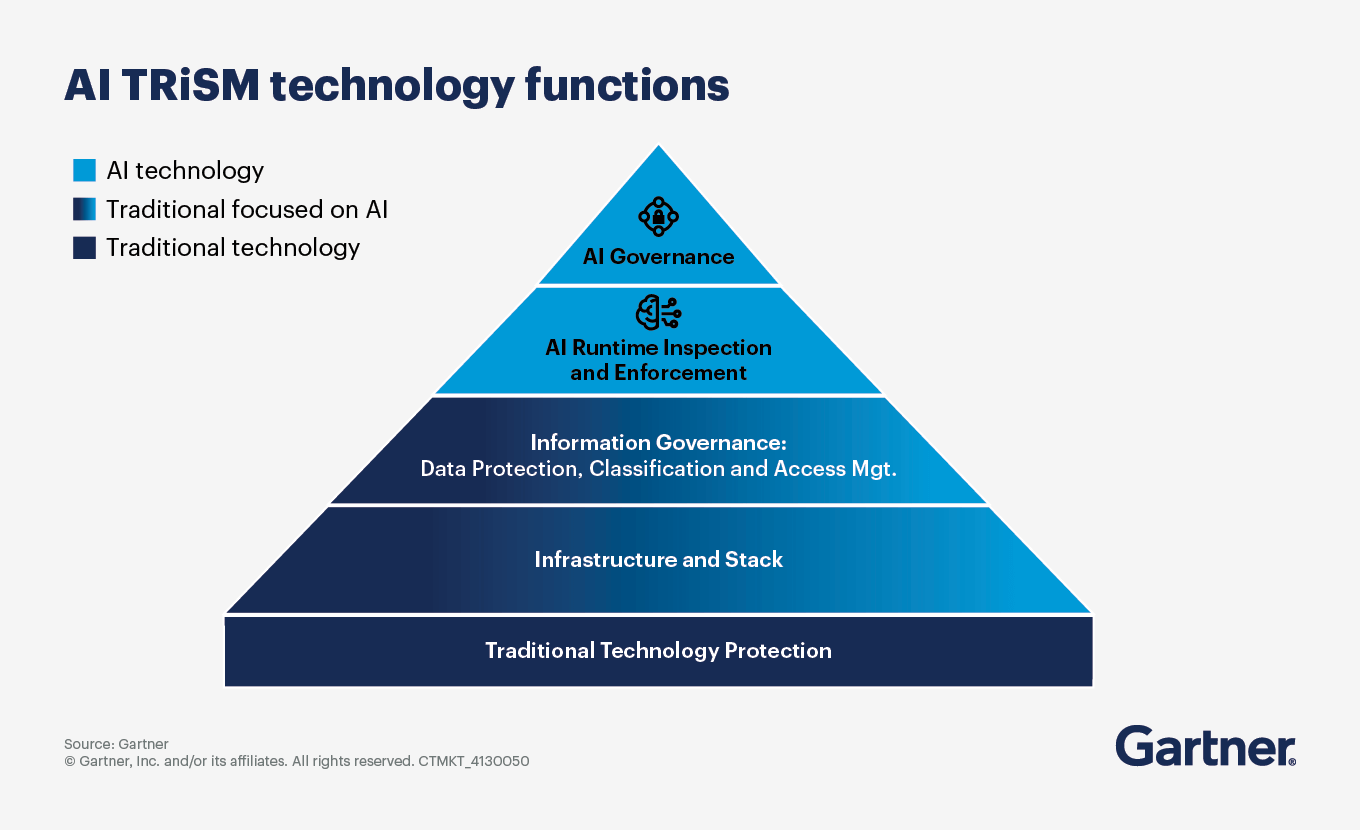
AI runtime inspection and enforcement
AI runtime inspection and enforcement technologies oversee AI models, AI applications and AI agents to detect anomalous activity, ensure compliance with internal and external controls, protect data, manage access, defend against attacks and automatically remediate misalignment or block risks.
Information governance
TRiSM also includes technologies related to information governance, focused on protecting and governing sensitive information. The related technologies help organize data into categories based on its attributes and assign data classifier labels and permissions for data access.
Guardian agents
One emerging technology that is likely to become a core tool in the TRiSM toolbox is guardian agents. These technologies monitor, enforce and adjust the actions of AI agents to ensure integrity, security and compliance. They enable organizations to maintain robust oversight even as AI systems become more autonomous and complex.
Attend a Conference
Experience CIO and IT Executive conferences
With exclusive insights from Gartner analysts on the latest trends, sessions curated for your role and unmatched peer networking, Gartner conferences help you accelerate your priorities.
21 – 23 Sep 2026
Gartner CIO & IT Executive Conference
São Paulo, Brasil

Drive stronger performance on your mission-critical priorities.