AI proliferation means that keeping “humans in the loop” will require support from AI agents.
- Gartner client? Log in for personalized search results.
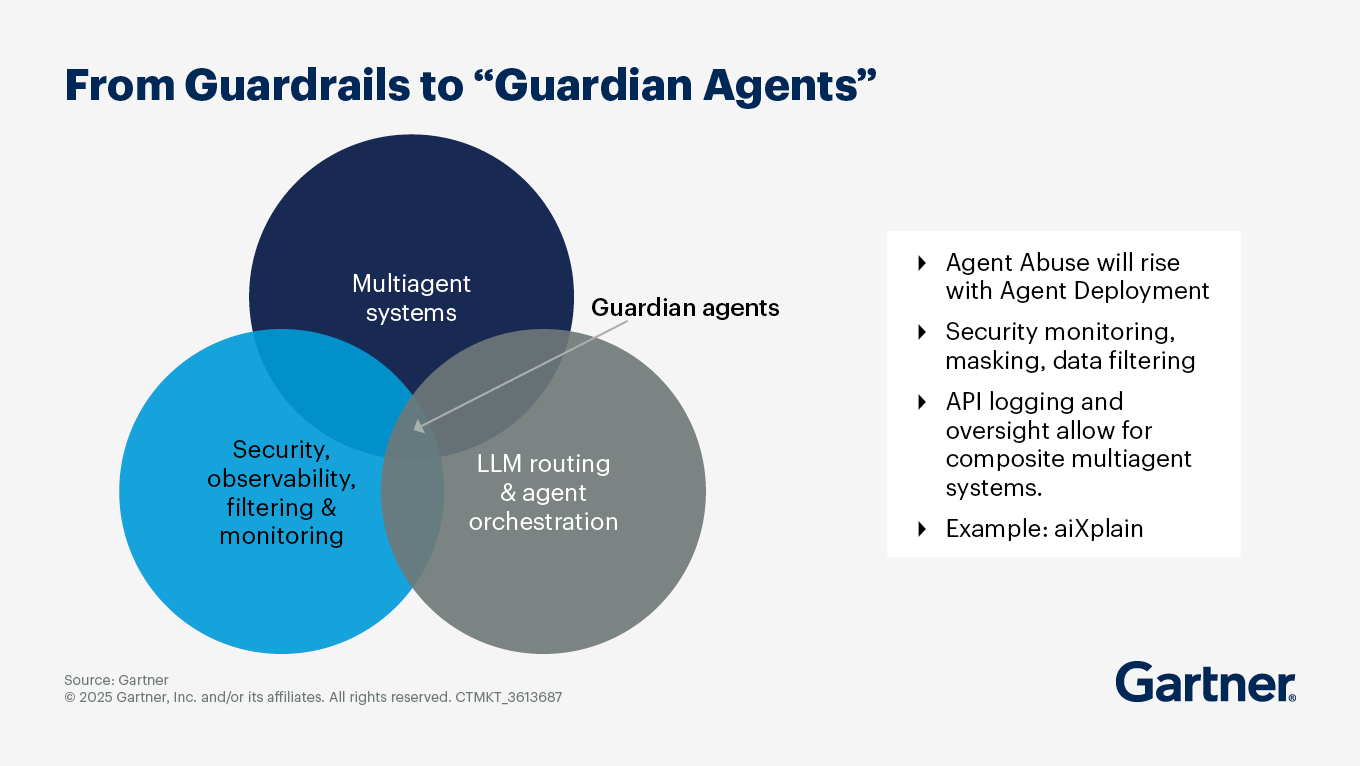
Embrace guardian agents to expand human oversight capacity
If your strategy for keeping AI trustworthy relies primarily on having a human in the loop, it’s time to rethink it. AI is proliferating so quickly that there soon will be too much of it for the humans in the building to oversee. This is where guardian “agents” come in.
Guardian agents are AI designed to monitor other AI. Operating at the intersection between security, observability, filtering and monitoring; multiagent systems; and agent orchestration, AI agents make AI safer and add accountability while reducing the number of things that a human has to review.
From AI guardrails to guardian agents
As the use of AI multiplies, organizations require new methods for ensuring it operates in the best interest of humans. Today, we have AI governance guardrails that define appropriate behaviors and limits. Soon, we will have guardian agents to enforce those limits.
Guardian agents will evolve over three phases
We are already deploying AI agents. Soon, multiagent systems will emerge to cross organizational boundaries and access various data sources. These virtual agents will remember what happened a few minutes or even a few months ago. They will initially collaborate with us. Over time, however, they will have agency to act on their own.
Guardian agents’ multi-phase maturity path will unfold as follows:
Phase 1: Quality control - In this initial phase, guardian agents will ensure that AI systems produce the expected outputs with the expected level of accuracy.
Phase 2: Observation - As guardian agents mature, they will be used to explain the AI they oversee. They will ensure the AI in question does what it was designed to do. They’ll also monitor processes to see how the work is done and provide a front line of defense in case the AI begins producing unexpected outputs.
Phase 3: Protection - Protective guardian agents represent the third level of sophistication, as their job will be not only to assess and alert, but also to detect and shut down rogue AI to prevent adverse outcomes before they occur.
For stronger, faster AI outcomes, use Gartner’s proprietary AI Use Case Insights tool to explore, evaluate and prioritize over 500 proven AI use cases tailored to your industry.
Guardian agents will have broad applications
Almost any business can deploy guardian agents for a broad variety of use cases — far more than people may think when they first learn about them. For example, a bank could deploy guardian agents to find the best loan to meet customer goals or help those customers understand how to manage their accounts. Parents of teenagers could leverage a guardian agent to check in on their newly licensed drivers to make sure they arrived at a planned destination safely.
By 2029, expect guardian agents to disrupt:
Human-in-the-loop monitoring
Self-healing processes
Autonomous systems
AI trust management
Security operations
Take the first steps to deploy your front-line of guardian agents
Technology companies have already begun delivering different types of AI agents for various use cases. There are mentor agents, broker agents and guardian agents to help protect people and ensure quality results.
To prepare for the age of guardian agents:
Expect agent proliferation. Educate yourself on agentic architecture and the role guardian agents will play.
Experiment with your first agentic overseers. Explore ways to turn security and monitoring according to guardrails into guardian agents.
Focus on low-hanging fruit. Start with processes that are not business-critical but require oversight. Align with the world of process management to tie in data, rules, access rights and the events that drive the process you want to manage.
Are you a CIO or IT leader at a midsize enterprise?
See how your peers are navigating AI adoption, vendor decisions and evolving business demands — with tools tailored to your role:
Explore our resources for midsize enterprises
Check out a curated list of Gartner’s most popular research being utilized by your peers
Guardian agents FAQs
What are guardian agents?
Guardian agents are AI designed to monitor other AI. Guardian agents build on the notions of security monitoring, observability, compliance assurance, ethics, data filtering, log reviews and a host of other mechanisms of AI agents to make AI safer and add accountability, while reducing the amount of things that a human must review.
What impact will guardian agents have on organizations?
Almost any organization can deploy guardian agents for a broad variety of use cases. By 2029, Gartner expects that guardian agents will disrupt security operations, human-in-the-loop monitoring, self-healing processes, AI trust management and autonomous systems.
Attend a Conference
Experience Information Technology conferences
With exclusive insights from Gartner experts on the latest trends, sessions curated for your role and unmatched peer networking, Gartner conferences help you accelerate your priorities.
21 – 23 Sep 2026
Gartner CIO & IT Executive Conference
São Paulo, Brasil

Drive stronger performance on your mission-critical priorities.