Without dedicated AI leadership, your organization risks falling behind — permanently.
- Gartner client? Log in for personalized search results.
You Need an AI Leader: Why 91% of High-Maturity Orgs Have One
By Erick Brethenoux | January 29, 2026
AI leaders drive transformation and competitive advantage
In today’s rapidly evolving landscape, your AI requires a boss. The numbers are clear: Gartner finds only 37% of low-maturity organizations have a dedicated AI leader, compared to 91% of high-maturity organizations. This indicates that appointing a dedicated AI leader is the catalyst that turns scattered AI initiatives into enterprisewide competitive advantage.
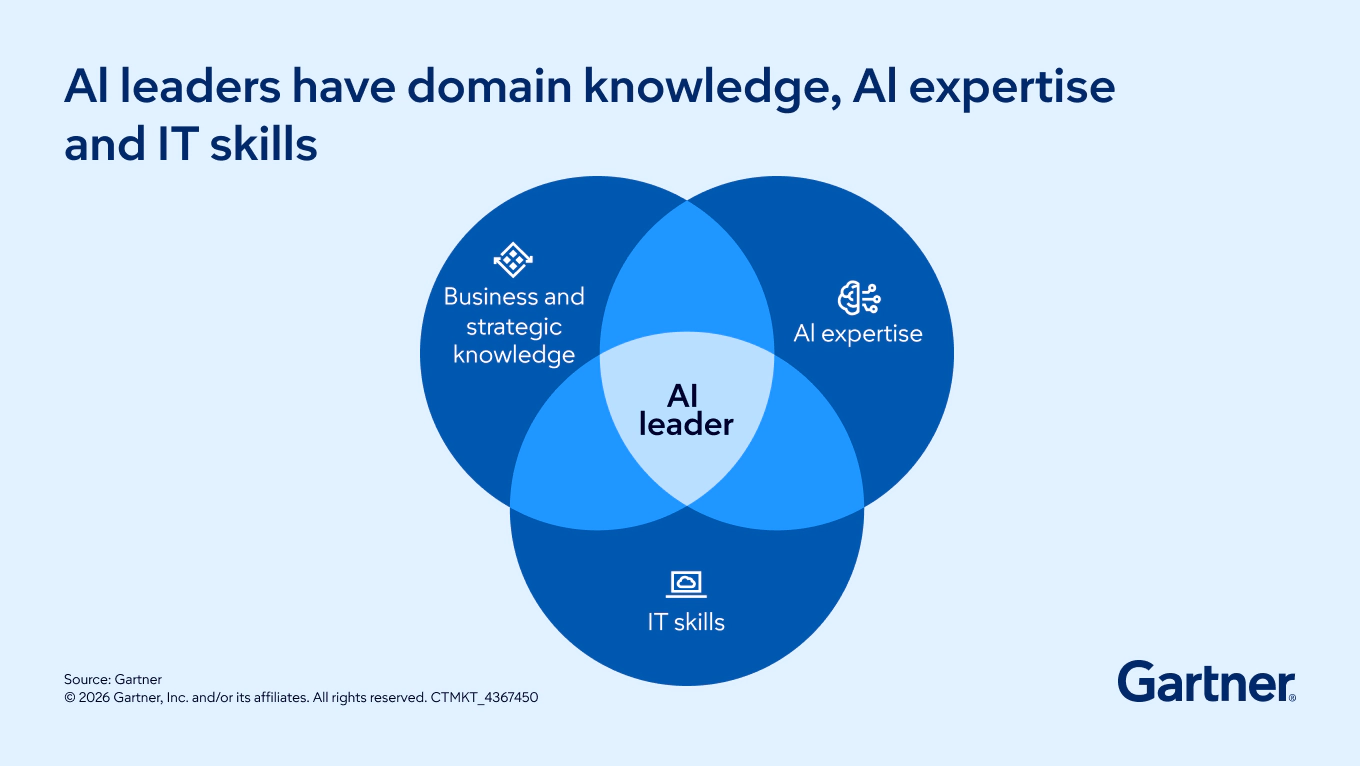
AI leaders are more than technical experts. They combine business acumen, strategic vision and technological expertise — balancing business value with AI innovation across the organization. Without this role, operating models stall and organizations get stuck in the “productivity trap,” unable to scale AI for real impact.
What sets AI leaders apart: Skills, responsibilities, impact and structure
The benefits of having an AI leader go far beyond organizational charts.
Organizations with AI leaders are twice as likely to achieve strong outcomes
28% generate revenue (vs. 13% without)
28% reduce costs (vs. 15%)
28% excel in customer experience (vs. 17%)
Gartner finds operational performance also improves:
44% of generative AI prototypes reach production (vs. 36%)
38% of AI projects stay in production over three years (vs. 21%)
Three competencies define successful AI leaders
AI leaders must possess a rare combination of skills to drive successful AI transformation:
Business acumen:
AI leaders align AI initiatives with strategic objectives, communicating complex issues to the board and translating technical potential into business value. They speak the language of revenue, risk and competitive advantage — not just algorithms.
Technical expertise:
They understand how to apply AI across business units, evaluate vendor solutions and make informed decisions about architecture and platforms. This earns them credibility with both business and IT stakeholders.
Communication:
AI leaders bridge organizational silos, manage expectations and address concerns about AI’s impact on roles. They build consensus and help teams navigate change.
Finding candidates with this blend is challenging but critical. The role demands hands-on experience in AI design, modeling, development, operations and change management.
Five core responsibilities shape the AI leader’s mandate
Transformation:
Set and maintain a vision for how AI drives value, securing executive and business unit buy-in for a unified approach.
Strategy:
Align AI strategy with the company’s vision, evolve operating models, measure value, build teams and establish frameworks for risk and policy.
Implementation:
Lead and/or orchestrate the development and execution of AI initiatives, ensuring scalability, integration and ethical deployment.
Alignment:
Bridge departmental gaps, orchestrate AI technologies to meet strategic goals, manage risk and ensure robust governance.
Technology:
Select and coordinate AI platforms, stay ahead of technology trends, and build effective data management and computing environments.
The reporting structure matters
Where the AI leader reports is crucial. While many report to the CIO or CTO, forward-thinking organizations align reporting with where AI can have the greatest impact — such as to the chief medical officer in healthcare, chief risk officer in financial services or even directly to the CEO. The goal is to place AI leaders where they can drive the most influence and results.
AI leader FAQs
What makes an AI leader different from a CIO or CTO?
An AI leader is focused solely on AI strategy, implementation and transformation. CIOs and CTOs manage broader technology portfolios, while AI leaders bring together specialized AI expertise, business acumen and strategic vision to drive enterprisewide adoption. Assigning AI leadership to existing roles often creates conflicts between maintaining operations and driving innovation.
How quickly do organizations see results from appointing an AI leader?
Organizations with AI leaders see results faster and are twice as likely to achieve strong business outcomes. More than just boosting productivity, AI leaders help drive lasting business differentiation by turning more prototypes into sustained, impactful projects.
What happens if an organization delays appointing an AI leader?
Delaying AI leadership increases the risk of falling behind competitors. Without a dedicated AI leader, organizations remain stuck in scattered, low-impact projects and miss opportunities for transformation. In today’s fast-moving AI landscape, this can mean the difference between leading the market and becoming obsolete.
Attend a Conference
Accelerate growth with Gartner conferences
Gain exclusive insights on the latest trends, receive one-on-one guidance from a Gartner analyst, network with a community of your peers and leave ready to tackle your mission-critical priorities.

Drive stronger performance on your mission-critical priorities.