AI can generate more output than organizations can absorb, making decision speed a critical driver of growth.
- Gartner client? Log in for personalized search results.
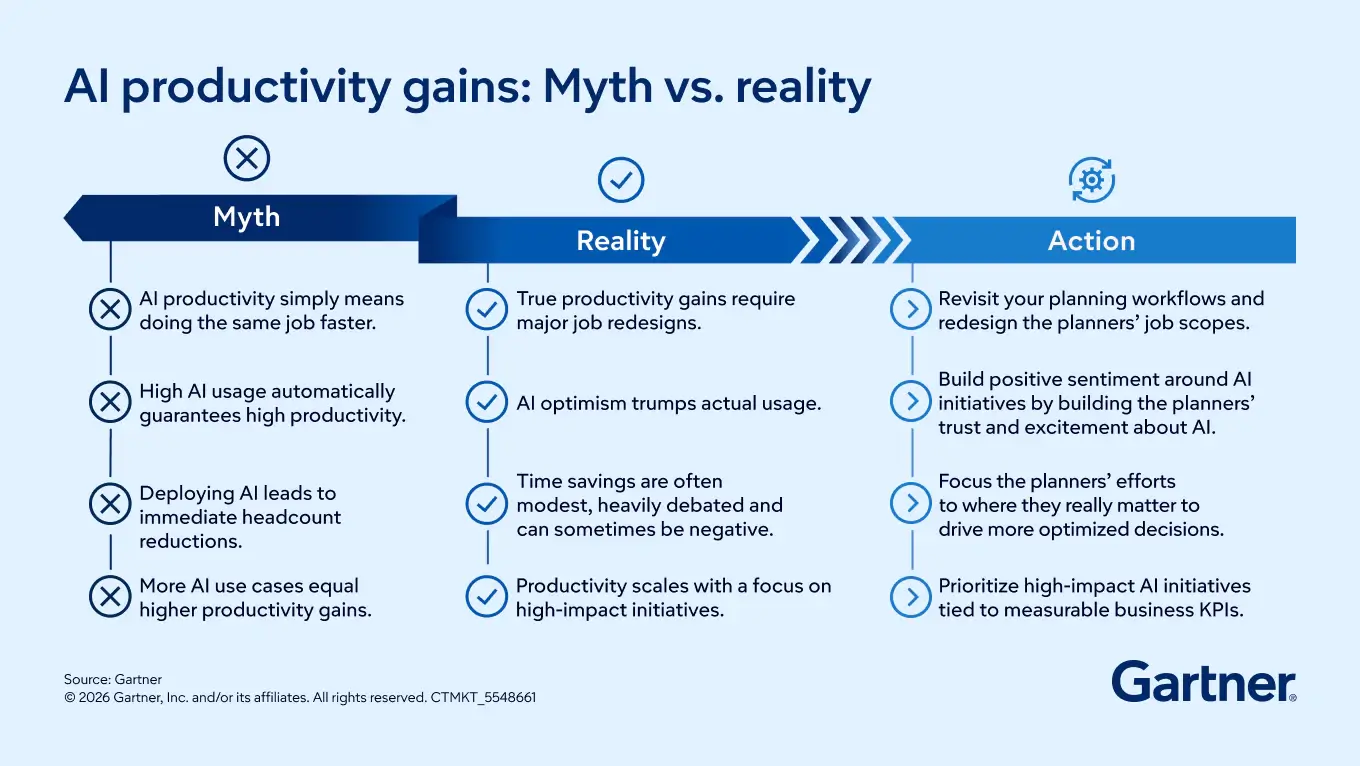
More AI productivity doesn’t guarantee more growth
AI is dramatically reducing the time required to create business output. Research, analysis, code, requirements, presentations and content that previously took days or weeks can now be produced in minutes. But creating deliverables is only one step in execution. Strategic initiatives still require reviews, approvals, prioritization and leadership decisions before they can generate revenue.
This creates a growing disconnect between AI productivity and business results. As teams produce more deliverables, the people responsible for reviewing and approving them do not become proportionally faster. As Ryan Mulcahy, Senior Director Analyst at Gartner, notes, “AI is creating more deliverables than tech CEOs can absorb. The next competitive divide will be determined by decision speed, not AI capability.” This is causing more proposals to accumulate in review queues rather than accelerating execution. And in a surprising shift, the cost of growth moves from labor to waiting. Every hour AI saves on creation makes every day spent waiting for decisions more expensive.
You might also like this webinar: Tech CEO Benchmarks: Priorities, Performance and Growth in a Fast-Moving Technology Market
How leaders can convert AI productivity into revenue growth
Organizations that benefit most from AI productivity focus less on generating work and more on how quickly the business can act on it.
Find where work is waiting
Most organizations track output and activity, but few track waiting time. Cycle-time compression is the top measurable benefit delivered by AI. Additionally, 83% of tech CEOs in the under-$50 million revenue segment report that cycle-time compression generates significant core business value.
To identify bottlenecks, leaders should review recent strategic initiatives such as product launches, go-to-market campaigns, pricing changes and major customer projects. The goal is to compare productive work against time spent waiting for reviews, approvals, decisions or contributor availability.
This analysis often reveals that execution is delayed not by a lack of output, but by a concentration of work around a small number of decision makers or approval checkpoints.
Download Now: Drive Business Impact With a Five-Step Framework for High-Tech Leaders
Diagnose why initiatives stall
Once leaders identify where work is waiting, they must determine why progress slowed. Unclear ownership is one of the several identified common causes as it frequently leaves initiatives without someone responsible for moving them forward. According to Gartner survey data, 46% of tech CEOs cite unclear priorities, ownership or executive sponsorship as a primary constraint slowing AI initiative execution. Another 34% report that work stalls because teams cannot articulate or quantify business value for decision makers.
Other delays stem from missing information, contributor bandwidth limitations and cross-functional friction. AI-generated deliverables may appear complete while still lacking key details, trade-offs or stakeholder alignment required for action. Understanding the root cause is essential because every bottleneck requires a different solution.
Learn More: Make Confident Product and GTM Decisions With Buyer Insights
Make every proposal decision-ready
Many delays occur because proposals reach leaders too early, reach the wrong decision maker or lack the information needed for approval. Organizations should reduce unnecessary reviews, remove routine approvals from leadership queues and ensure every proposal arrives with the context, analysis and alignment required to support a decision. Tech leaders are recommended to make submissions decision-ready by resolving ownership questions, addressing trade-offs and obtaining necessary approvals before leadership review.
They should also establish review windows and response expectations to create urgency around decision making. Leaders shouldn’t just be trying to increase AI productivity. They should also be trying to ensure that more ideas become actions and more actions become business outcomes.
AI productivity FAQs
What is AI productivity?
AI productivity refers to AI’s ability to accelerate the creation of work such as research, analysis, code, plans and content. Tasks that once took days or weeks can now be completed in minutes.
Why doesn’t AI productivity automatically drive growth?
AI productivity increases output creation, but business results still depend on reviews, approvals, prioritization and decisions. When deliverables accumulate in approval queues, execution speed may not improve despite higher productivity.
How can leaders improve returns from AI productivity?
Identify where initiatives are waiting, diagnosing the causes of delays and ensuring proposals reach the right leaders with the information needed for action. Organizations that reduce decision bottlenecks can convert more AI-generated output into measurable business growth.
Attend a Conference
Join Gartner analysts and your peers to accelerate growth
Join the leading technology and service provider peers to get an update on accelerating tech growth in a new era of transformation and technology trends.
8 – 9 Mar 2027
Gartner Product Leadership Conference
Grapevine, TX

Drive stronger performance on your mission-critical priorities.