Leaders that focus on redesigning decisions and governance will gain more from AI than those that simply accelerate adoption.
- Gartner client? Log in for personalized search results.
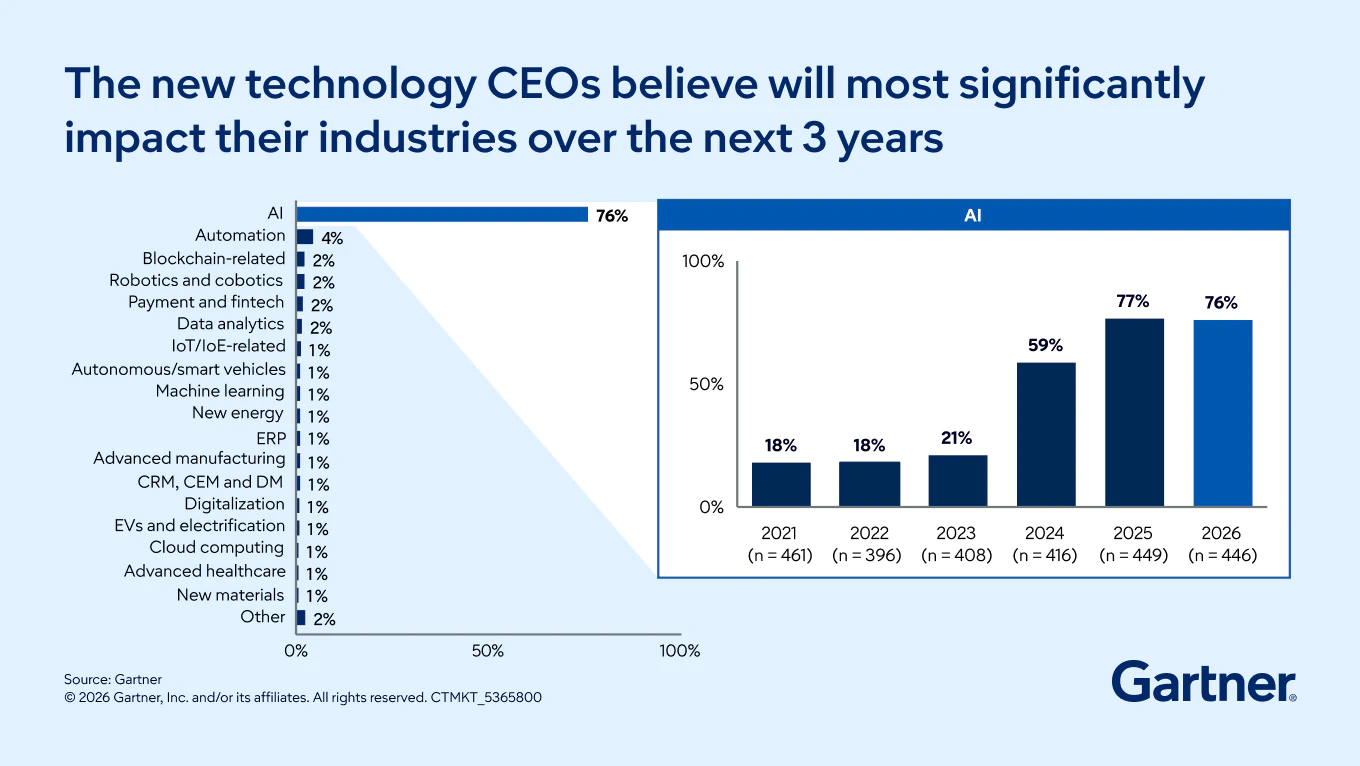
When agreement on AI strategy becomes a blind spot
Seventy-six percent of CEOs identify AI as the technology most likely to disrupt their industry over the next three years, according to the 2026 Gartner CEO and Senior Business Executive Survey. Although that level of agreement appears to indicate strategic clarity, it may also create a significant risk.
It’s not that leaders are overestimating AI’s importance. The danger is that widespread agreement can suppress critical examination of investment timing, organizational readiness and how companies will create meaningful differentiation. “The real danger for an enterprise in today’s AI consensus is not an underinvestment in AI but an overconfidence that technology can compensate for leadership, infrastructure, and operational and technology systems that were never designed for algorithmic speed,” cautions David Furlonger, Distinguished Vice President Analyst and Gartner Fellow.
You might also like this webinar: How to Identify, Fund and Measure High-Value AI Use Cases
AI value depends on more than just technology
The organizations that benefit most from AI will evolve management systems, governance and decision architecture to make AI dependable at scale, rather than simply focusing on investing in the latest models.
AI adoption is exposing organizational weaknesses
Although many organizations are redirecting capital, talent and executive attention toward AI, Gartner finds that 59% of AI pilots fail to reach production, primarily because of organizational, not technical constraints.
Decades of research show that technology delivers enterprise value when paired with organizational complements such as process redesign, redefined decision rights, aligned incentives and strong management practices. AI strategy pursued without these complements often magnifies existing problems. Poor data practices result in faster, less transparent errors. Fragile change management leads to pilots that never scale. Outdated operating models can undermine value capture, compliance and resilience.
The biggest risks may sit outside the technology itself
The AI rush is also creating second-order impacts that many leaders overlook.
As AI investment moves from broadly distributed IT budgets to unprecedented capital commitments, enterprises are shifting to depend on a small number of cloud providers, model developers and chip manufacturers. This concentration can increase exposure to supply disruptions, geopolitical and sovereignty uncertainty and pricing changes.
AI costs are also becoming harder to track as spending moves into cloud and software contracts. At the same time, governance demands continue to grow as organizations face expanding accountability, compliance and risk-management requirements.
The rise in use of public, employee-selected AI tools outside sanctioned environments can increase security, compliance and reputational risks, even when it improves short-term productivity. Environmental constraints and social concerns are also becoming more significant as energy and water requirements for data centers place increasing limits on large-scale AI infrastructure.
Rewire designs as you scale AI investments
As AI capabilities become more widely available, organizations will have fewer opportunities to differentiate through technology alone. Leaders who effectively adapt governance, redesign operating models and clarify decision rights will have the advantage.
Gartner recommends:
- Align AI decisions with your organization’s needs, not industry trends, by reviewing major AI investments with a team representing business, risk, HR and IT.
- Avoid commitment to one vendor by building AI systems you can switch between different models or using flexible APIs, abstraction layers and portable data architectures.
- Treat AI computing resources like a limited business asset and balance performance improvements against cost, sustainability and operational constraints.
The goal is not to adopt AI faster than everyone else. It is to build management systems that can absorb AI while improving resilience, accountability and performance.
AI strategy FAQs
Why does widespread agreement on AI deserve closer scrutiny?
Extreme agreement can create institutional herding or “groupthink.” While AI is an essential technology, widespread consensus may suppress critical examination of investment timing, organizational redesign and sources of competitive differentiation.
What prevents many AI initiatives from succeeding?
According to Gartner, 59% of AI pilots fail to reach production primarily because of organizational constraints. Common issues include weak change management, unclear decision rights, fragmented operating models and insufficient process redesign.
What creates AI competitive advantage?
Future advantage will depend less on access to updated AI models and more on governance, decision architecture, operating-model redesign and management systems that allow organizations to use AI reliably at scale.
Attend a Conference
Accelerate growth with Gartner conferences
Gain exclusive insights on the latest trends, receive one-on-one guidance from a Gartner analyst, network with a community of your peers and leave ready to tackle your mission-critical priorities.

Drive stronger performance on your mission-critical priorities.