Executive leadership faces a new test as AI shortens the shelf life of skills and redefines jobs.
- Gartner client? Log in for personalized search results.
Guiding people through AI change is the real leadership test
By 2030, the half-life of technical skills will drop from eight years to as little as two. By 2031, over 30 million jobs per year will be redesigned — not eliminated — by AI-driven innovation.
“The real challenge for executive leaders isn’t just automating tasks,” according to Arun Chandrasekaran, Distinguished VP Analyst at Gartner. “It’s reinventing talent strategy around agility, continuous learning and human-machine collaboration.”
Organizations that win won’t chase headlines or cut staff. They’ll orchestrate a “talent remix,” blending people, autonomous agents, contractors and digital avatars into resilient teams ready for constant change.
Make it easier for teams to adapt to AI
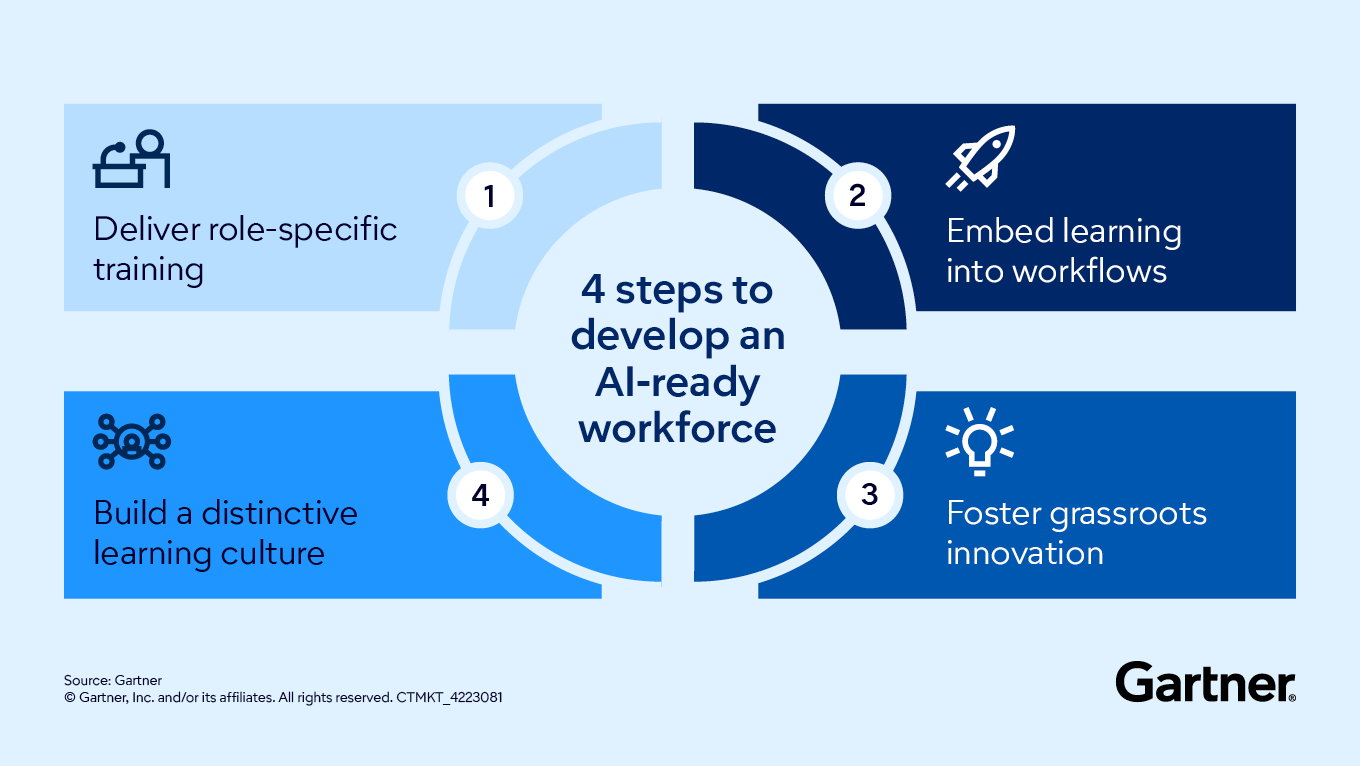
Give your people the support they need to learn, grow and feel ready for whatever comes next without fear, friction or falling behind.
Remix talent to get and stay ahead
Traditional approaches won’t close the gap. Build cross-functional partnerships with HR to map present strengths against future needs and phase out legacy roles before they become obsolete.
Create a “skills intelligence” program that inventories current capabilities and guides targeted upskilling at every level.
Invest in adaptive learning platforms that personalize development for each employee. Early adopters of GenAI simulators accelerate hands-on experience for junior staff, closing “experience starvation” gaps that emerge as AI takes over routine work.
Blend resourcing models (mixing employees, contractors, gig workers, AI-augmented staff and autonomous agents) to help access just-in-time skills as needs change and to keep your organization agile as technology evolves.
Keep humans at the center of team structures
As AI automates information retrieval, data analysis and routine communications, demand rises for leadership, judgment, emotional intelligence and complex problem solving.
“Make these uniquely human capabilities central to hiring criteria even as you deploy role-bots or digital agents,” says Chandrasekaran. “Don’t treat AI agents as equivalent to people or put them on org charts; this undermines morale and signals potential replacement rather than augmentation.”
Prepare now for digital identity complexities
As AI avatars replicate employee knowledge and style, policy guardrails around privacy, consent and use of employee-generated content become urgent issues for executive leadership. Partner proactively with legal and HR leaders now so your organization builds trust while capturing value from digital workers — before regulation catches up.
Rethink layoffs: Avoid costly rehiring traps
Organizations that cut too deeply or too quickly risk expensive rehiring cycles when transitions stall or service quality drops. Instead of defaulting to layoffs, reposition existing FTEs into growth areas supported by agile learning solutions. Executive leaders should partner across IT and HR to redesign jobs and skills for strategic areas aligned with organizational AI ambitions.
AI workforce FAQs
What does “AI in the workforce” mean for executive leadership?
It means leading a strategic shift beyond automation, and architecting a new mix of people and intelligent systems — while keeping adaptability at the core of hiring and development decisions.
How can organizations future-proof their workforce as AI transforms jobs?
Organizations can future-proof their workforce by investing in adaptive learning systems; mapping current versus future skill needs; fostering uniquely human capabilities like judgment/problem solving; leveraging blended resource models; and driving transparent change management across all levels.
Why should executive leaders prioritize both human and AI-driven capabilities?
Leaders should prioritize both human and AI-driven capabilities because competitive advantage comes from combining scalable machine productivity with human creativity — the factors that drive innovation even as technology evolves rapidly.
Attend a Conference
Accelerate growth with Gartner conferences
Gain exclusive insights on the latest trends, receive one-on-one guidance from a Gartner analyst, network with a community of your peers and leave ready to tackle your mission-critical priorities.

Drive stronger performance on your mission-critical priorities.