Domain-specific language models (DSLMs) shine where generic large language models (LLMs) fall short: performance, accuracy, compliance and relevance for specialized enterprise needs.
- Gartner client? Log in for personalized search results.
DSLMs break through the AI value barrier
DSLMs can be a wish come true for unlocking AI value. Compared with LLMs, they offer up to 50% lower development costs, faster deployment and consistently higher reliability in business-critical workflows. That’s why Gartner predicts that DSLMs and DSLM-underpinned application market revenue will reach $131 billion in 2035. This shift is being fueled by rapid advances in open-source and small models that can be fine-tuned efficiently.
Trade up from driving productivity to fueling revenue
DSLMs take generative AI (GenAI) to the next level ─ from improving operational efficiency to targeting revenue drivers like customer experience and product development.
A boon for CIOs …
CIOs who are keen to start reaping real rewards from GenAI should pivot from conducting tactical maneuvers (experimenting with GenAI and LLMs) to making strategic moves (implementing DSLMs for transformative business value). In an environment of tight budgets and pressure to justify investment in AI, DSLMs are just in time. CIOs can select between building DSLMs from scratch or fine-tuning an existing LLM, either closed or open source. Fine-tuning on top of pretrained models typically delivers greater efficiency.
CIOs can maximize the benefits of DSLMs by:
Identifying industry or business function pain points where DSLMs excel vs. generic LLMs
Evaluating the potential cost-efficiencies of using DSLMs, as opposed to generic LLMs, by use case since the cost-to-value ratio can vary significantly
Partnering with DSLM providers with experience in early-adoption industries like financial services, healthcare, manufacturing, education and retail
Finding AI service providers that are prepared to tailor DSLMs to specific industry needs
Building a foundation for agentic automation to boost operational efficiency, establish new revenue streams and improve customer experience
Using DSLMs to address emerging AI regulations by improving data transparency and model explainability
Assessing small, open-source DSLMs as on-premises solutions that support sovereign AI strategies
… with a few caveats
Like all enterprise-level technology deployments, a lot of preparation is required before the “magic” can happen. CIOs should consider the following:
DSLMs are only as good as their data. For the best outcomes, ensure domain-specific data is meticulously sourced, cleansed and governed. Consider outsourcing this effort to DSLM providers who have proven experience generating synthetic data or small, high-quality training sets.
Successful integration and adoption is predicated on strong change management. Make sure you account for the skills and processes required to integrate with legacy systems and update workflows.
Examine retrieval-based architectures (RAGs) as an alternative model to DSLMs, which run the risk of hallucination.
Catastrophic forgetting is also a risk when using a highly specialized model to answer general topics. Use the pretraining dataset to fine-tune the model for broader capabilities.
DSLMs lack standard pricing models, which makes budgeting tricky for enterprises.
Competitive advantage for vendors
DSLMs are a value multiplier for vendors that seek to offer customers better performance, fewer hallucinations and lower risk compared with LLMs. A model tuned with domain-specific data (vs. retrieval-augmented generation) integrates knowledge directly into the model’s parameters, allowing deeper understanding and contextual relevance.
Product leaders should embed DSLMs in product roadmaps to ensure a structured cadence of product rollouts that deliver increasing value for little cost. Providers that are quick on the uptake will reap the rewards of market leadership. Selling points include:
Increased productivity and ROI along with high-performing marketing campaigns for under-resourced CMOs
Immediate solutions to business operational pain points, especially for highly regulated industries that require meticulous attention to financial, marketing or legal processes
Enabling foundation for building domain-specific AI agents that augment highly specialized knowledge work
Vendors that partner with or acquire data service providers can also help customers secure the domain-specific data required to fuel DSLMs in support of their use cases.
Strategic recommendations for vendors
Gartner urges vendors to study the use cases for applying DSLM to early-adopter industries (financial services, manufacturing, retail, education). Untapped opportunities also abound in industries with much lower adoption (healthcare, IT, professional services). Get a foothold with proven use cases in high-adoption industries, then expand into new markets with vertical specialization. Educating clients on how to apply DSLM use cases in their organization is critical to success.
CIOs and their employees continue to express disappointment with GenAI’s productivity ROI. Providers can showcase DSLM as a game changer that challenges the assertion that GenAI delivers too little benefit for too high a cost by targeting specific pain points and demonstrating profitable returns. Demonstrate DSLMs’ ability to drive real productivity and efficiency by automating data and document processing, delivering relevant insights and eliminating manual work.
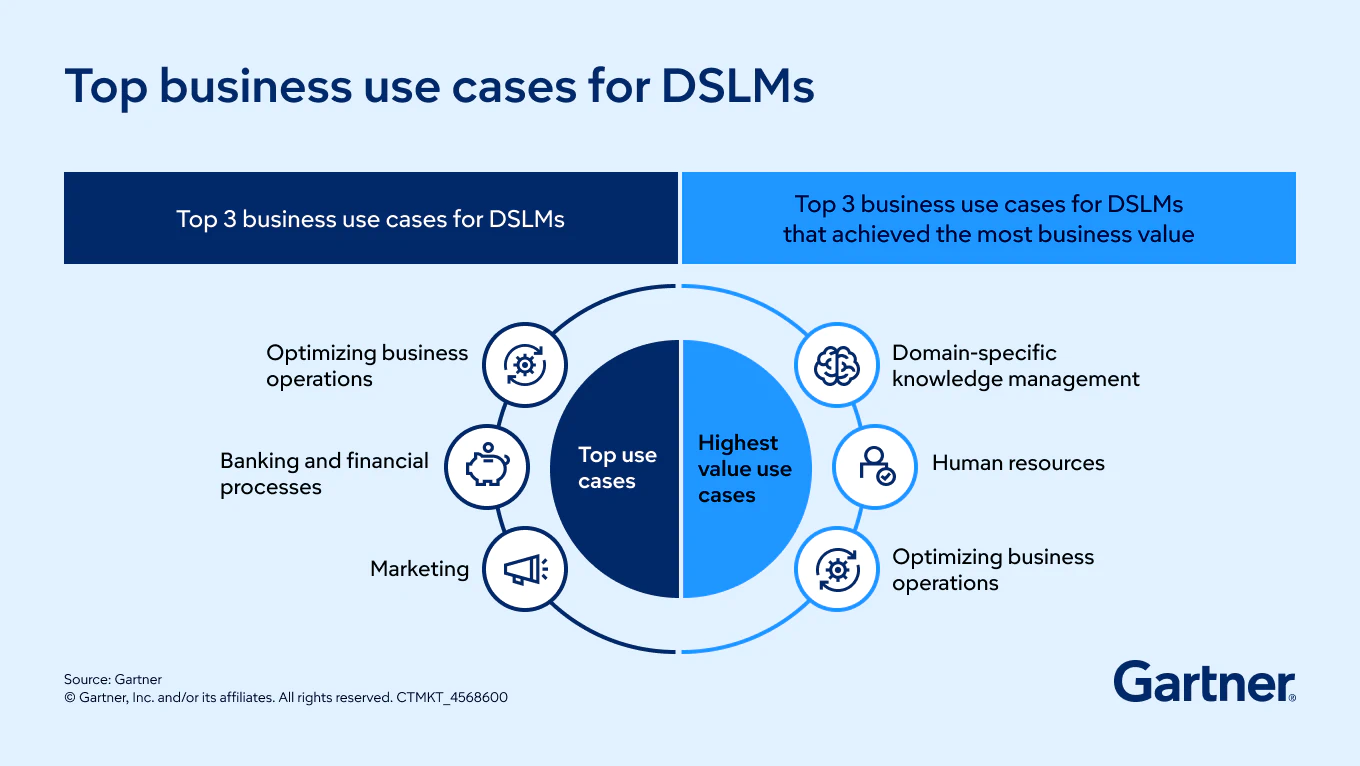
Once you can reset CIOs’ assumption that GenAI is an effective efficiency tool, demonstrate the power of DSLM-driven GenAI in external, customer-facing solutions that improve employee and customer experience and product development processes. The top seven business cases are:
Domain-specific knowledge management
HR processes
Optimizing business operations
Legal process automation and compliance
Marketing
Customer service
Supply chain operations
Domain-specific language models FAQs
How is a DSLM different from an LLM?
Domain-specific language models are optimized to apply AI to specific domains, such as verticals like banking or manufacturing, functions like marketing or sales, and tasks like marketing content creation or account health assessment. Unlike LLMs, they are trained on datasets specific to these domains, allowing them to perform tasks with greater relevance and accuracy.
What are the limits of a DSLM vs. an LLM?
Gartner consistently observes that right-sized models, fine-tuned with specific and relevant data, outperform large language models. These models excel when aligned to the task at hand, but performance outside these tasks would trend back toward their baseline performance far below that of an LLM.
Attend a Conference
Join Gartner analysts and your peers to accelerate growth
Join the leading technology and service provider peers to get an update on accelerating tech growth in a new era of transformation and technology trends.
8 – 9 Mar 2027
Gartner Product Leadership Conference
Grapevine, TX

Drive stronger performance on your mission-critical priorities.