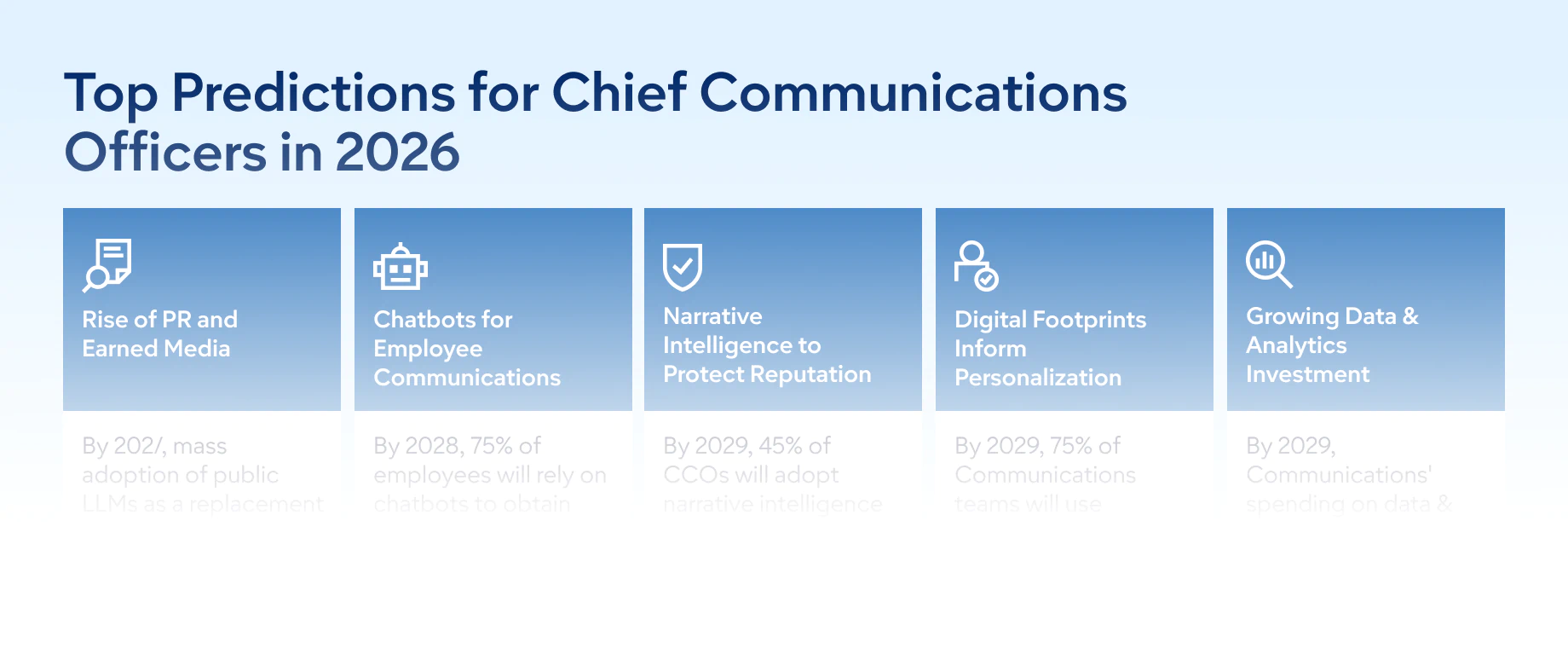
CCOs face accelerating misinformation and disinformation, a rapid pace of change, and AI-induced transformation of their function and the broader workforce. Use Gartner’s five predictions to prepare to manage the disruptions and opportunities that Communications will face in the next four years.
- Gartner client? Log in for personalized search results.
Top Predictions to Inform 2026 Comms Strategies
Introduction
Prediction 1
By 2027, mass adoption of public LLMs as a replacement for traditional search will drive a 2x increase in PR and earned media budgets.
Key Findings:
AI search engines favor citing earned, shared, and organic owned content over paid. According to a recent vendor study, more than 95% of links cited are nonpaid mentions and coverage, with 27% originating directly from earned media.1
AI-powered chatbots ChatGPT (+608%) and Perplexity (+262%) experienced exponential year-over-year traffic increases between 1H24 and 1H25, while traditional search engines Google (-1%) and Bing (-1%) are trending slightly down, despite retaining the traffic advantage.2
When looking across their entire Communications budget in late 2024, CCOs were already most likely to consider increases to PR and earned media budgets. The areas with the highest likelihood for budget increases in 2025 were public relations (36% of CCOs anticipating an increase), corporate brand (34%), public website (26%), and external social media (23%).3
While traditional SEO efforts are best served by marketing, the growing demand for answer engine optimization (AEO) to build visibility and reputation requires Communications-specific skills to balance stakeholder trust and platform requirements.
Market Implications:
Gartner expects mass adoption of public LLMs as a replacement for traditional search due to audience receptivity and the growing comfort with and utility of tools like ChatGPT. To surface desired narrative and corporate brand positions in AI answer engines, those tools must have visibility into what they deem an authoritative source. Which third-party sources are cited by AI answers can vary by industry, but the makeup is typically high-domain news outlets, government and NGO content, encyclopedic content, and academic research.
Press releases tend to get the fewest number of citations. When AI searches specifically imply recency (e.g., What is XYZ corporation’s most recent stance on sustainability), almost half (49%) of citations are news.1 This reinforces the need for proactive earned media efforts that facilitate ongoing earned coverage of your desired narratives.
As organizations adapt to new audience search behaviors, PR and earned media budgets must increase to ensure optimal AI search visibility. Reallocating paid budgets to PR and earned media is likely a logical option for most organizations, but it will require investment trade-offs, as well as a clear perspective on measurement and the intended impact on audience behaviors.
Recommendations:
Audit the most commonly used AI answer engines among your target stakeholder groups. Benchmark the sources cited in answers to likely questions and queries, and how well your desired narrative comes through.
Use PR and earned media budgets to drive the coverage necessary for optimal answer engine visibility. Make the business case to cross-functional partners in marketing to reallocate at least some spending from paid media to owned and earned media to ensure visibility in the new search reality.
Commit to building a responsive and proactive earned media function that meets the recency demands of AI search engines. This is particularly key during times of crisis and issue management and organizational shifts like mergers or acquisitions. Invest in building and nurturing relationships with influential third-party sources to ensure optimal quality and quantity of narrative coverage.
Establish new measurement and benchmarking protocols for tracking the progress of increased earned media coverage on AEO. Include competitive and industry tracking to inform strategy and positioning efforts. Upskill and train the team on how AI search engines source and evaluate content.
Prediction 2
By 2028, 75% of employees will rely on chatbots to obtain relevant internal communications, replacing traditional communications channels.
Key Findings:
Employees are open to using AI, with 75% stating they already use AI tools at work and 55% saying they do so regularly.4 Additionally, managers are supportive of this: 85% of managers believe their team’s work could be meaningfully improved with AI.5
The increasing volume of traditional communication channels exacerbates information overload. Employees who report high information overload are 52% less likely to report high intent to continue working at the organization and 30% less likely to report high strategic alignment.6 Employee chatbots offer an effective solution to the information overload and information burden challenge.
Company hierarchies are predicted to flatten as organizations that integrate AI into their core operations reimagine workflows to leverage AI’s capabilities. This will reduce the number of managers and require CCOs to prioritize employee channel strategies that incorporate AI.7
Chatbot capabilities are evolving, integrating generative AI (GenAI), dynamic conversation management, and multiagent orchestration systems. As these capabilities mature, employees will increasingly rely on chatbots as their primary source for on-demand and relevant internal communications.
Market Implications:
With growing appetite for conversational AI and organizations flattening their hierarchies and reducing manager headcount, CCOs will seek out alternative channels to contextualize organizational and strategic information for employees. Namely, CCOs will rely less on traditional channels, such as newsletters, intranets, and even managers, who remain employees’ preferred channel for receiving information.6 Instead, chatbot innovations and capabilities will rise to meet this demand and transform how both push and pull communications are managed, alleviating information overload (especially during change).
Chatbots will improve information accessibility and provide personalized, relevant communications. For pull communications, employees will ask questions and get personalized, curated answers. For push communications, chatbots will send customized push alerts to specific employee segments. The embrace of chatbots means that CCOs should consider scaling down less-engaged channels (e.g., newsletters) in favor of dedicating their efforts toward the development and integration of conversational AI systems.
That said, CCOs can’t disregard the safeguards they will need to put in place to mitigate the risks of hallucinations, misinformation, and a fragmented information landscape that come with AI. CCOs will need a greater emphasis on information quality and hygiene, as well as on optimizing intranet content for AI searchability. CCOs must also partner with IT, HR, and legal to establish robust governance to ensure that chatbots’ responses are accurate.
CCOs will also be heavily involved in the change management efforts to help employees adjust to this shift away from managers and other legacy channels as their primary sources for information. This will require both assisting employees to adopt a mindset change and partnering with HR on targeted upskilling designed to build comfort with conversational AI-led communications. CCOs will need to measure employees’ strategic alignment and their rate of adoption and satisfaction with the chatbots.
Recommendations:
Revise the internal channel mix by prioritizing chatbots and retiring investments in traditional channels to manage information overload. Begin to shift the information cascade away from managers and prepare employees for a more self-service approach to internal communications.
Prioritize investments in conversational AI that integrate with modern intranets. Evaluate potential technology investments on their ability to enhance information accessibility, personalization, and engagement for employees as well as safeguard against potential AI risks.
Establish robust governance structures with IT, HR, and legal to monitor chatbot knowledge bases and their outputs for information accuracy, corporate narrative adherence, and broader ethical considerations. Create escalation protocols to ensure human intervention when necessary.
Partner with HR to plan a change management initiative that encourages employee adoption of chatbots, focusing on building skills that support the use of chatbots to retrieve and receive information. Measure success through employee adoption and satisfaction with chatbot-led internal communications.