Blockchain brings unique capabilities for enabling digital and automation ambitions. Learn how.
- Gartner client? Log in for personalized search results.
Blockchain: What It Is, How It Works, Why It Matters


Unlock the real value of blockchain technology
Many blockchain providers struggle to prove value in real-world applications, leading to failed projects and waning trust from customers and partners. But it doesn’t have to be this way. Download this research to discover:
Three real-world use cases where blockchain is solving key business challenges
Tangible examples of blockchain delivering measurable outcomes
Proof that, when applied effectively, blockchain can drive significant benefits
The business value of blockchain: Anyone, anywhere commerce
Explore the fundamentals of blockchain technology — what it is, why it matters and how it’s transforming industries.
- Why Blockchain?
- Blockchain Use Cases
- Blockchain Value in Action
Blockchain technology enables frictionless peer-to-peer digital transactions
Digital technologies have streamlined many business interactions, but numerous information-heavy processes still require exchanging private data between entities. Unfortunately, these exchanges often rely on outdated, insecure and error-prone methods. Many organizations attempt to address these issues by limiting transactions, implementing manual controls or involving intermediaries. However, these strategies add time, cost and complexity, while limiting business opportunities.
Blockchain, a fundamental technology of Web3, offers a potential solution. Initially designed for peer-to-peer payments, blockchain has evolved to facilitate secure information exchange. Despite its reputation for transparency over privacy, advancements such as Layer 2 zero-knowledge proofs are emerging to add privacy features, though these are not yet widely adopted. Blockchain’s main function remains facilitating payments, and while newer assets like non-fungible tokens (NFTs) have expanded its scope, it still lags behind traditional platforms in versatility.
What is a blockchain?
Blockchain is a digital ledger comprising cryptographically signed, irreversible blocks of records shared among participants in a peer-to-peer network. Each block is time-stamped and linked to previous ones, allowing anyone with access rights to trace transactions or changes. One defining feature of blockchain is its transparency — every transaction is visible to all participants. While this is beneficial for some use cases, it can be a drawback for others. In response, newer blockchain platforms have developed privacy mechanisms, though these are still evolving and not yet common.
Blockchain’s key value lies in enabling secure transactions in environments where trust (data security) is difficult or costly to establish. It allows individuals and organizations to transact safely without intermediaries such as banks, insurance companies or logistics providers. Additionally, blockchain supports “smart contracts,” which automate business processes by encoding rules for transactions and asset management into the blockchain system.
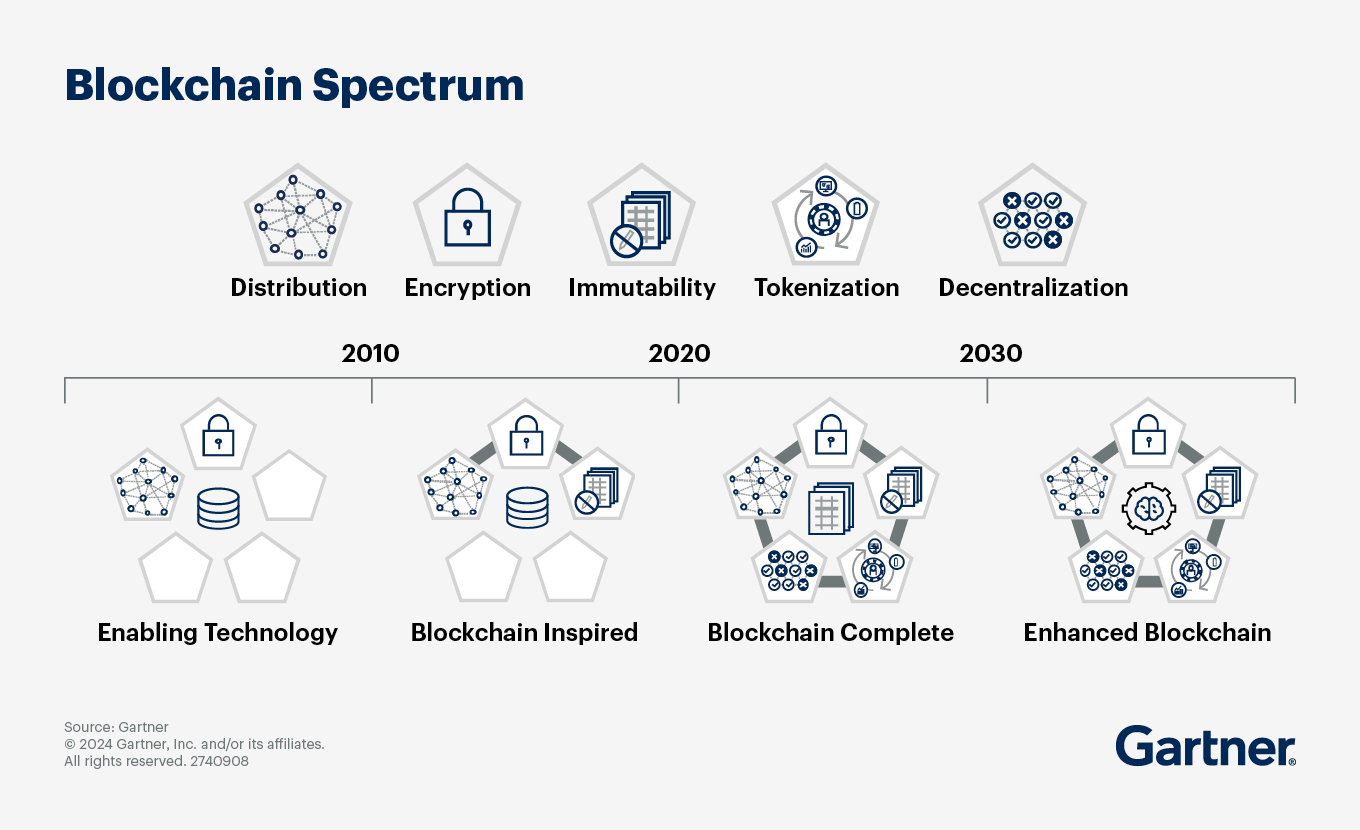
Gartner identifies five key characteristics of a complete blockchain solution: distribution, encryption, immutability, tokenization and decentralization. Notably, consensus algorithms, which drive decentralized decision making, are essential to true blockchain platforms but are not used in all cases.
Many organizations opt for “blockchain-inspired” solutions, which incorporate some but not all of these features. This approach is often sufficient for specific use cases and can be simpler to implement. In fact, most enterprise use cases don’t require full blockchain functionality and are better off without the added complexity of true blockchain platforms. Over time, as the technology matures, organizations may evolve these solutions into more complete blockchain systems with decentralized applications (dapps) to further automate business processes.


The slow adoption of blockchain is due to two primary factors:
Business and technical design alignment. Blockchain solutions must integrate business agreements and processes with technical protocols, which is a complex and often challenging process.
Slow-maturing technology. Blockchain is not a single technology but a collection of evolving protocols, many of which are incompatible. With over 150 different blockchain foundational protocols, choosing the right one is critical yet difficult.
Although most enterprise blockchain projects would likely perform better without blockchain, many organizations continue to experiment and innovate, especially for high-priority use cases.
Four key blockchain use cases can deliver value across industries and functions
Over the past seven years, most enterprise blockchain projects have failed, and customers and partners alike have lost faith in blockchain technology. In many cases, these blockchain projects failed to deliver value because the use cases did not require blockchain technology in the first place. Therefore, it is key for CIOs and CTOs to identify core use cases where blockchain can uniquely add value to their organizations.
Blockchain use cases typically fall into a combination of four key categories:
Business model decentralization
These initiatives rely on a blockchain foundation to achieve decentralization of business model and/or technology functions. They usually depend on all five blockchain elements.
Digital asset market
These initiatives establish new markets that facilitate the creation (or representation) and trading of new tokenized digital assets using smart contracts.
Efficiency play
These initiatives attempt to improve efficiencies in existing business processes within a company or at an industry level. They tend to preserve the current business models and the actors within. They can be led by a dominant player in an ecosystem or through informal or formal alliances (such as consortia or association).


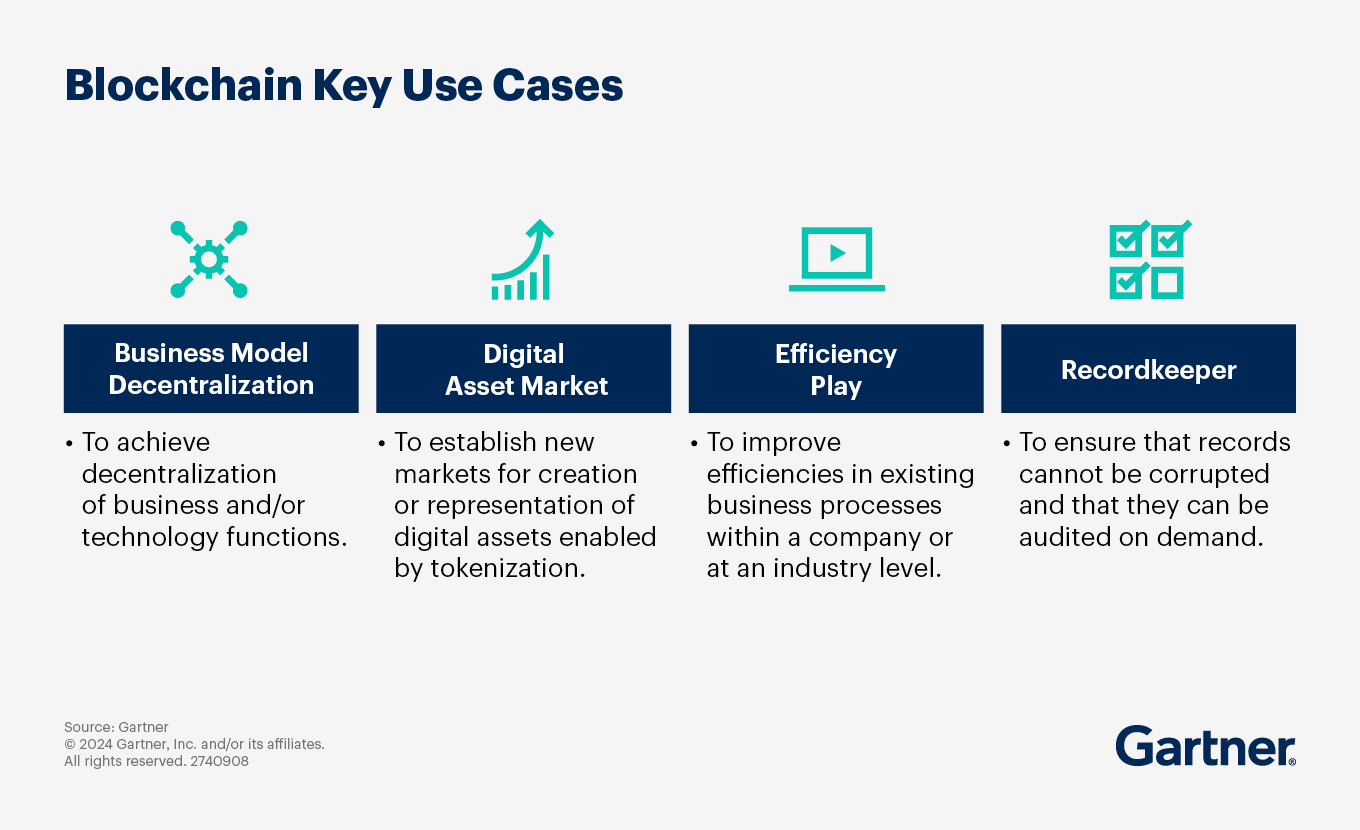
Recordkeeper
These initiatives aim to ensure that records cannot be corrupted and can be audited on demand. Government entities are well-suited for these types of initiatives. They require distribution, encryption and immutability, but not necessarily decentralization or tokenization.
These include trades in financial transactions, insurance claims, securities, capital markets, trade finance, supply chain management, logistics and transportation, healthcare, and public services and records. As a result, industries as far reaching as finance, insurance, manufacturing, real estate, healthcare, government and others can realize value from leveraging blockchain technology.
Blockchain for supply chain track-and-trace and data exchange is delivering ROI
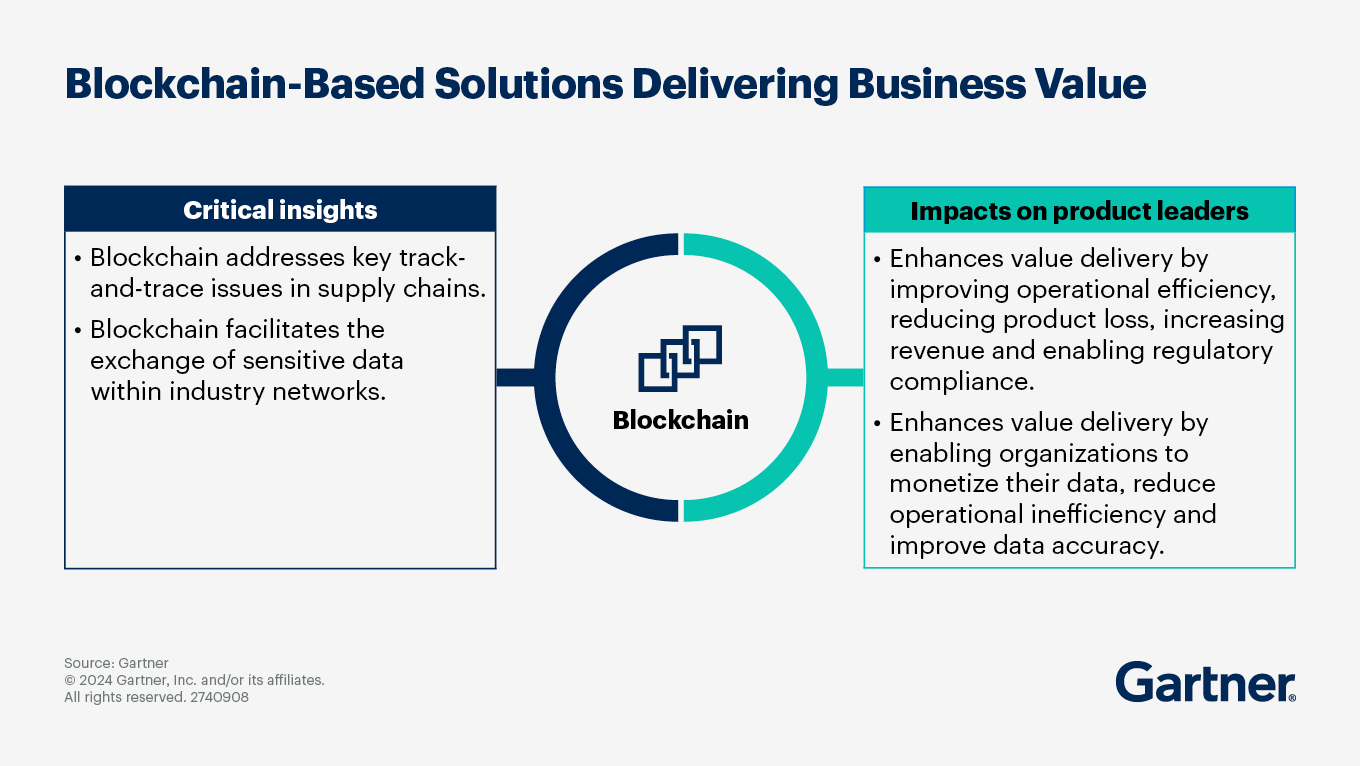
Based on Gartner’s Case-Based Research, blockchain solutions are already delivering business value in supply chain tracking and tracing and in data exchange marketplaces (two examples of efficiency and digital asset market use cases).
Supply chain tracking and tracing
Supply chains are characterized by a lack of trust and data sharing, which creates operational inefficiencies and results in product and revenue loss. They also lack end-to-end visibility, which inhibits transparency and compliance. Blockchain technology addresses these challenges by providing:
Data immutability for the sharing of verified data among stakeholders
Encryption for secure data sharing in a trustless network
A ledger for tracking assets and transactions end to end
A system of record for automatic data processing
A distributed system for verifying transactions without a centralized authority
For example, the World Federation of Hemophilia (WFH), an NGO, partners with pharmaceutical companies to donate medicines to developing countries. In May 2021, WFH partnered with the British Standards Institution and Trace Labs to pilot a track-and-trace blockchain solution in India to address concerns around product diversion and product loss in the supply chain.
The implementation used Trace Labs’ AidTrust data management solution powered by OriginTrail’s Decentralized Knowledge Graph. Donated products are equipped with QR codes, which are scanned at the distribution center and at the receiving hospital. This supply chain transparency:
Enables products to be authenticated as real (and not counterfeit)
Provides visibility on medicine stock levels
Pinpoints diversion or waste issues (such as expired products)
Currently used at 90 distribution centers across India, AidTrust has tracked 4 million medical units and reduced product loss by 100%.
Data exchange marketplaces
Organizations within a network are often inhibited from exchanging information by a lack of trust, data security and privacy concerns, and information validation. Blockchain technology solves for this problem by providing:
Distributed ledgers for data privacy that validate information against the blockchain instead of revealing that information
Data immutability for trusted information exchange
Encrypted and tamper-proof data for information security
These technology features enable organizations to exchange sensitive data. For example, in 2018, Synaptic Health Alliance (a healthcare insurance consortium) partnered with Kaleido (a blockchain and digital asset platform) to create a data marketplace to maintain accurate healthcare provider directories. Healthcare insurance providers are legally required to provide and maintain these directories for patients. Prior to using blockchain, providers maintained their own separate directories, which were costly, time-consuming and often contained out-of-date information.
The blockchain platform has created an ecosystem where each provider can securely share and exchange their credentials. Synaptic members are able to:
Find and update up to 88% of data faster than they could have on their own
Reduce outreach calls to providers for data updates by up to 25%
Ensure high-quality data
Reduce resources needed to update data
One of the Synaptic members, MultiPlan, experienced a 500% annual ROI from its participation in the data exchange marketplace.
Attend a Conference
Join Gartner experts and your peers to accelerate growth
Join the leading technology and service provider peers to get an update on accelerating tech growth in a new era of transformation and technology trends.
9 – 10 Mar 2026
Gartner Product Leadership Conference
Grapevine, TX

FAQ on blockchain
What are the benefits of blockchain?
Blockchain is a critical tool for enabling commerce in contexts where there is either a lack of trust or challenges with verifying it (such as an inability to confirm identity or ownership, or to validate information). One of the key benefits of blockchain technology is to allow any individual or commercial entity in the world to safely interact or transact with any other, without needing a bank, insurance company, government, logistics provider or other intermediary between them.
How can blockchain support sustainable business practices?
The use of blockchain to create and prove the operation of sustainable supply chains is an emerging trend directly linked to regional regulatory drivers and green consumerism. In the sustainability space, blockchain is used to:
Prove “green” supply chain practices (both upstream and downstream) to government regulators
Enable differentiation and “green” marketing
Ensure current and future regulatory compliance
Provide product transparency to customers (for example, by providing a QR code that shows what types of recycled materials were used in the manufacturing of a purchased product)
Drive stronger performance on your mission-critical priorities.