STAMFORD, Conn., September 16, 2026
Redesigning Supply Chain and Procurement Jobs for the Era of AI
October 29 2026
STAMFORD, Conn., September 16, 2026
Four globally disruptive AI trends are set to transform warehousing, according to Gartner, Inc., a business and technology insights company. Gartner analysts said warehousing has reached an inflection point for AI implementation, driven by three converging forces: labor constraints making automation non-negotiable, capital models shifting to lower-risk entry points, and AI and autonomy technologies reaching operational maturity.
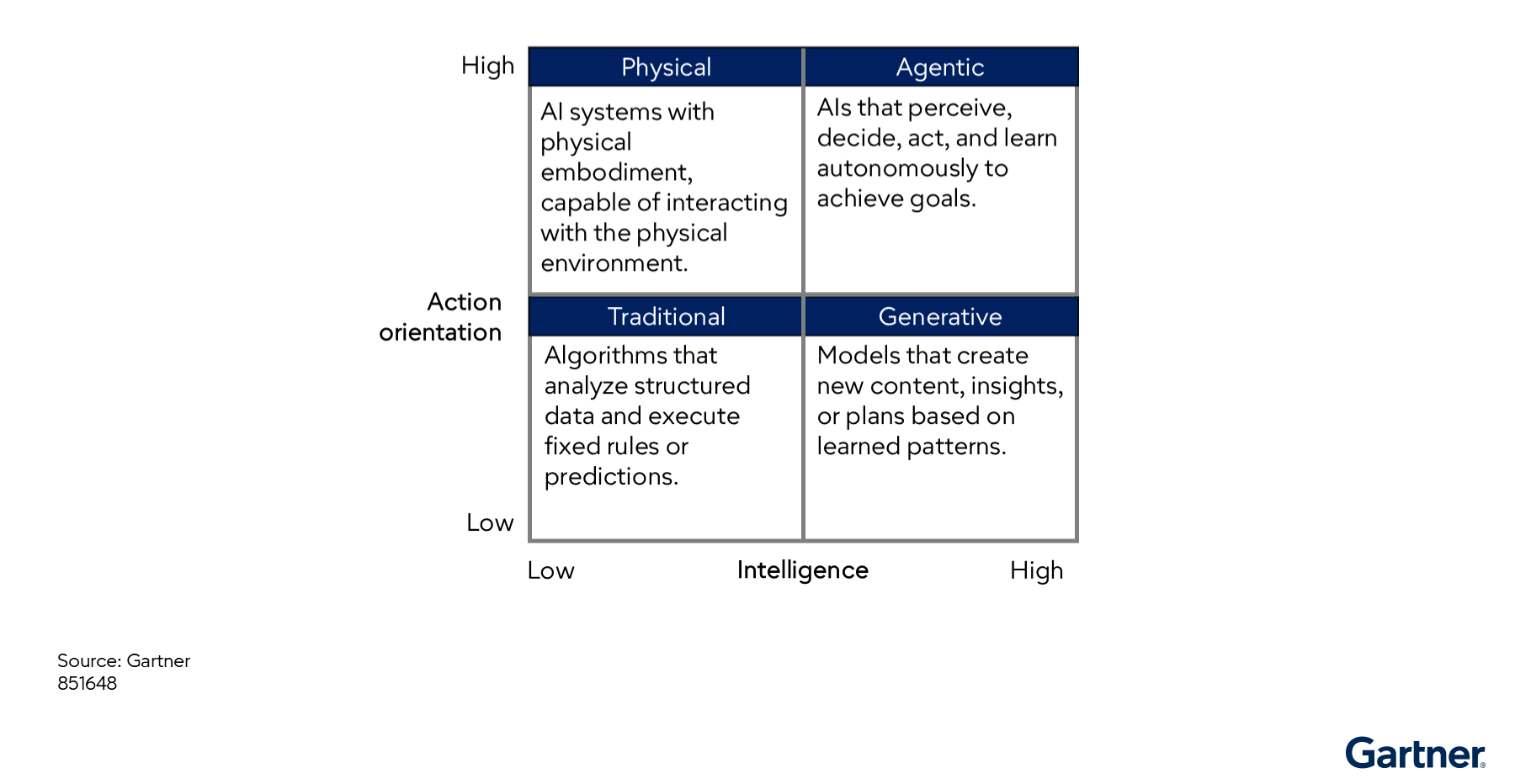
Gartner’s research identified four AI trends that each align to a distinct dimension of AI maturity and application (see Figure 1). Future success will depend on balancing two dimensions of AI — “action orientation” and “intelligence sophistication” — across the four core categories. The four AI trends include:
“These four AI trends are interconnected and reflect the evolution of a more intelligent, adaptive and resilient warehouse environment,” said Federica Stufano, Senior Principal Analyst in Gartner's Supply Chain practice. “As labor pressures persist and AI technologies mature, organizations are moving beyond experimentation toward operational deployment. Their success will depend on building trust through transparent AI decision making, enabling effective collaboration between workers and intelligent systems, and applying these technologies in ways that address specific operational challenges.”
Source: Gartner (September 2026)
Enhanced optimization-oriented traditional AI is advancing beyond rule-based and statistical models by leveraging richer real-time data and more sophisticated algorithms. Modern demand forecasting, labor planning, route optimization and inventory management applications continuously adapt to changing warehouse conditions, improving cost savings, resource utilization and return on investment while maintaining the transparency and repeatability that have made traditional AI effective in warehouse environments.
Operational-driven generative AI uses advanced machine learning models to synthesize actionable content, plans and operational insights from unstructured and semi-structured data. These capabilities enable the generation of dynamic standard operating procedures, work instructions, exception-handling protocols and decision support tools that can be embedded directly into warehouse operations, improving agility and supporting faster decision making.
Suggestive and semiautonomous agents bridge the gap between manual operations and full autonomy by analyzing data and recommending or partially executing multistep workflows while maintaining human oversight. These agents help improve task assignments, exception handling, resource allocation and operational responsiveness, allowing warehouse organizations to increase productivity while keeping operators involved in critical decisions.
Physical AI agents combine AI, robotics and advanced sensor technologies to automate manual warehouse activities. These systems can perform tasks such as picking, packing, sorting and material handling, with high levels of precision and consistency, increasing throughput, enhancing workplace safety and helping organizations address ongoing labor challenges while scaling operations more effectively.
“Supply chain leaders should take a pragmatic approach to AI in warehousing by tackling proven use cases, such as labor forecasting and slotting, and expanding into generative AI and agents where it can improve decision-making and workforce productivity,” said Stufano. “Maintaining human oversight while continuously evaluating new use cases will be critical to realizing AI's full potential across the supply chain."
Gartner clients can read more in: The Top 4 AI Trends Transforming Warehousing. Nonclients can learn more in: CSCO Roadmap for Building a Supply Chain AI Foundation.
Gartner is an indispensable partner to C-Level executives and technology providers as they implement AI strategies to achieve their mission-critical priorities. The independence and objectivity of Gartner insights provide clients with the confidence to make informed decisions and unlock the full potential of AI. Clients across the C-Level are using Gartner's proprietary AskGartner AI tool to determine how to leverage AI in their business. With more than 2,500 business and technology experts, 6,000 written insights, as well as more than 4,000 AI use cases and case studies, Gartner is the world authority on AI. More information can be found here.
The Gartner Supply Chain Practice provides actionable, objective insights for supply chain leaders and their teams, so they can respond to disruption and innovate for the future through leading-edge supply chain management practices.
Additional information is available at https://www.gartner.com/en/supply-chain. Follow news and updates from the Gartner Supply Chain Practice on LinkedIn and X using #GartnerSC. Visit the Gartner Supply Chain Newsroom for more information and insights.
Justin Lavelle
Gartner
justin.lavelle@gartner.com
Barbara Ruane
Gartner
barbara.ruane@gartner.com
Gartner (NYSE: IT) delivers actionable, objective business and technology insights that drive smarter decisions and stronger performance on an organization’s mission-critical priorities. To learn more, visit gartner.com.


