Shifts in global trade and workforce demographics, coupled with the widening scope and capabilities of AI, are heightening manufacturing expectations within supply chain organizations. For chief supply chain officers (CSCOs), efforts to improve customer value and drive growth won’t succeed if they rely on a static manufacturing strategy.

Enterprise investments in automation, industrial Internet of Things (IIoT) and AI aim to solve this issue, but two-thirds of manufacturers aren’t aggressively redesigning their manufacturing strategies.1

CSCOs have a unique opportunity to play a pivotal role in evolving the manufacturing operating model and ensuring it keeps pace with both enterprise and supply chain strategy. It starts with mapping manufacturing capabilities to supply chain objectives (see Figure 1). By aligning manufacturing strategies with key business outcomes, you can start to transform the manufacturing operating model into a platform for future competitiveness.
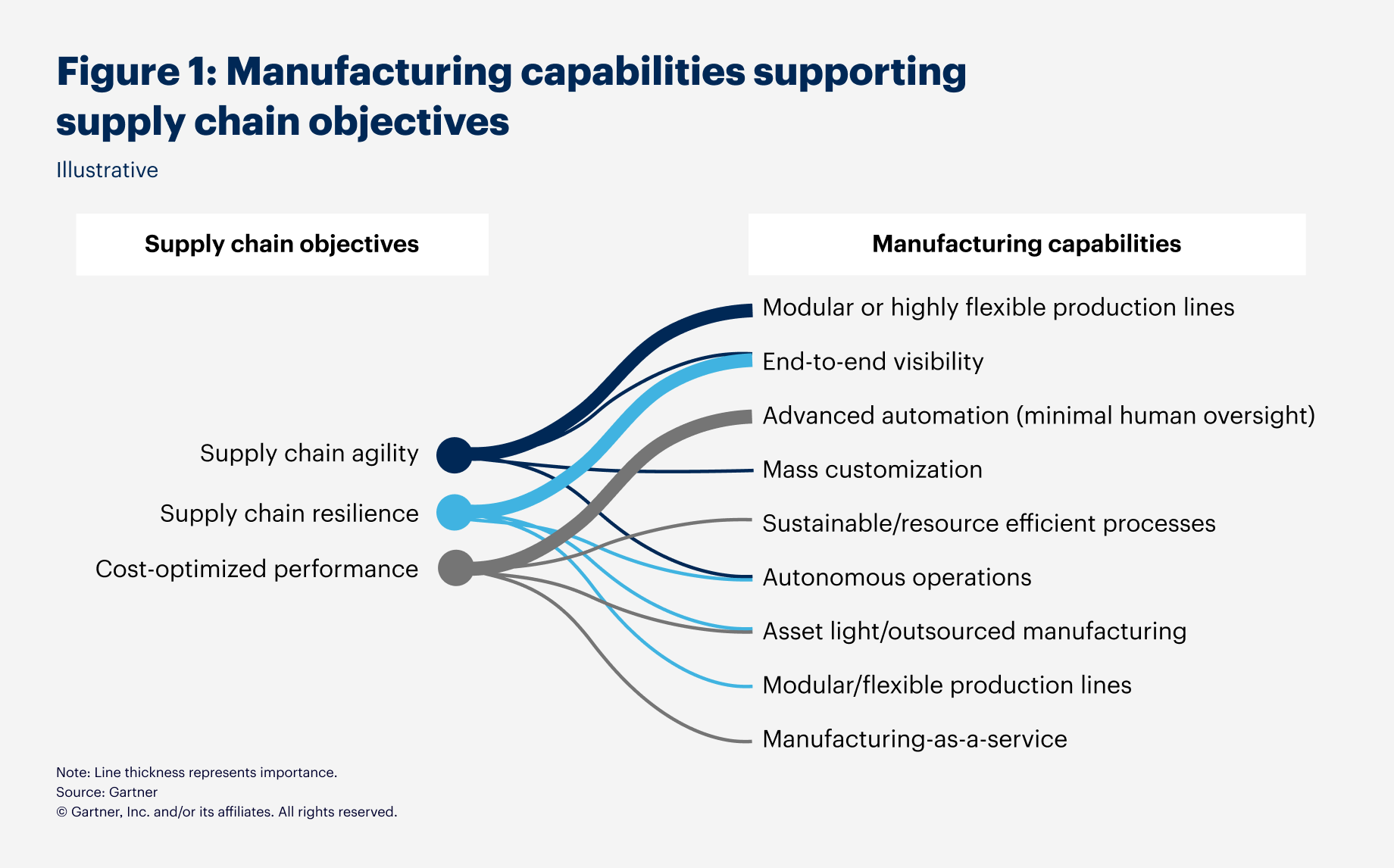
Below are the manufacturing capabilities, resources, value streams and governance essential to successful execution.

Capabilities align manufacturing execution to business strategy

A capability represents a core, scalable strength that enables consistent performance. Capabilities are strategic enough for the C-suite and actionable enough for manufacturing leaders.

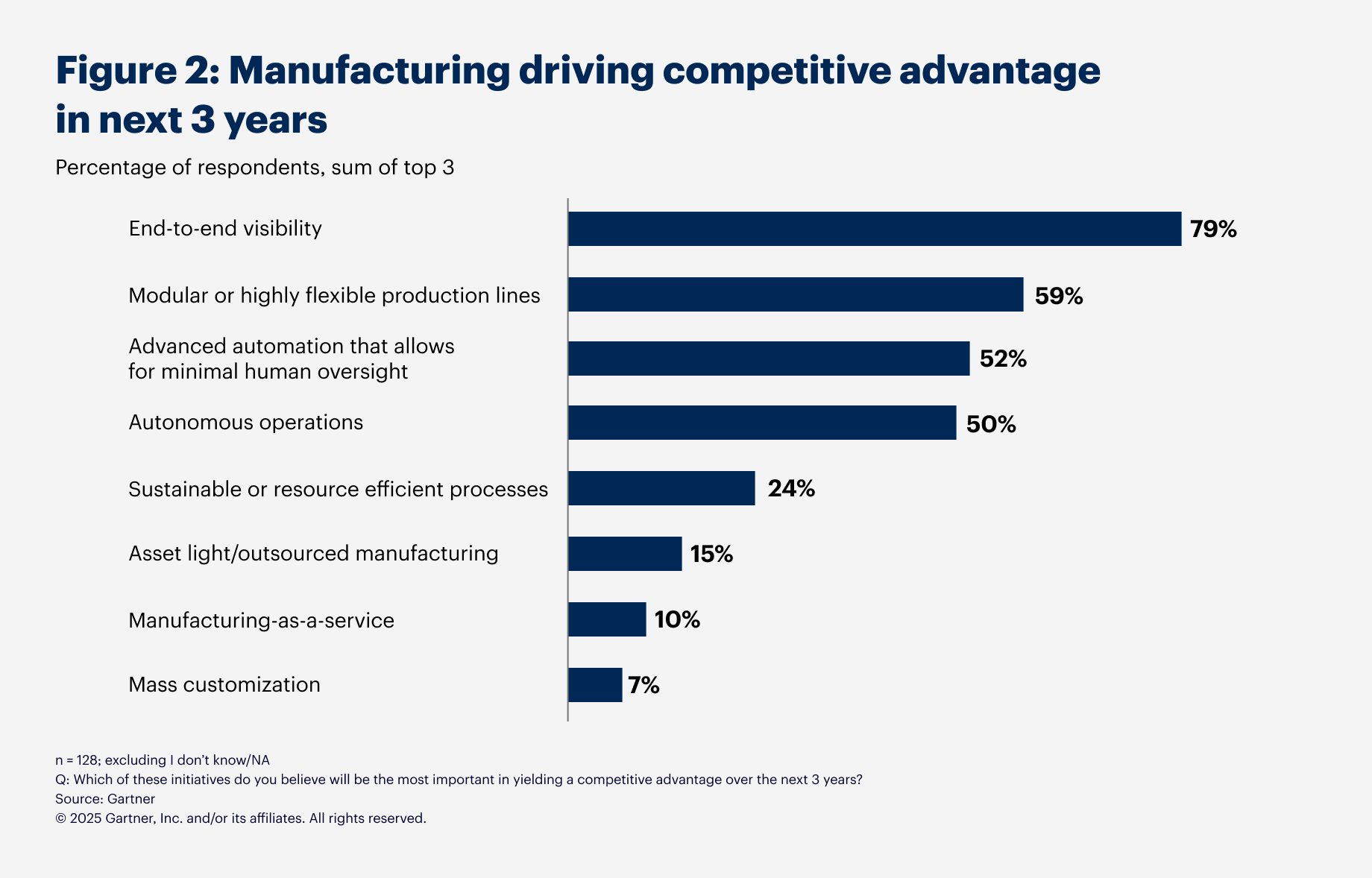
CSCOs looking to cement manufacturing’s contributions to business and customer impact must use their C-Level influence to secure and implement investments that enable end-to-end visibility across manufacturing operations, modularity and autonomous operations (see Figure 2). Then, CSCOs should benchmark their approach against peers to surface blind spots and add urgency to conversations with internal stakeholders or investment cases.

Aligning value streams, resources and governance

Value streams

Respondents in the 2025 Gartner Future of Manufacturing Operations in Supply Chain Survey were twice as likely to report value streams as the operating model component most critical for aligning manufacturing initiatives with their enterprise’s supply chain strategy.1

To align manufacturing’s value streams (the key flows of work, data, materials and financials across plan, source, make and deliver) to support supply chain agility and resilience, CSCOs should:

1. Streamline communication channels across supply chain functions and facilitate regular cross-functional planning sessions to improve integration between manufacturing and other functions. 

2. Prioritize upgrading and modernizing the sites and markets most critical to margin preservation and future growth.

3. Elevate “make vs. buy” decisions to determine whether insourcing or outsourcing manufacturing activities is appropriate.

4. Disengage with suppliers that create constraints through reluctance or inability to deliver on your long-term objectives.

5. Establish, expand and enhance ecosystem partnerships to limit risk and unlock mutual value.

Resources

The core resource components of the manufacturing operating model are physical capacity, people, technology (applications and infrastructure), and utilities.

To align resources, Gartner recommends CSCOs:

1. Engage the current workforce. People-centric investments accelerate time to competence, enhance skill sets and improve the overall employee experience — which ultimately drives hard-dollar savings. Equip employees with the necessary tools, training and support that enable a shift from guesswork to informed, insights-driven decision making.

2. Match resource deployment to business agility. Align resource funding to a digital investment roadmap that segments sites by role, cost structure and automation maturity to avoid one-size-fits-all spending. Start with quick-win pilots. Then, deconstruct end-to-end value streams to identify whether human or machine augmentation delivers the greatest agility. Reinvest those gains into long-term objectives.

3. Unify scalability across manufacturing and supply chain. Future-oriented organizations are more likely to collaborate with plants to identify, define, fund and deploy use cases and technologies. For most organizations, scaling pilots is a continuous obstacle riddled with change fatigue and pushback. CSCOs can break this cycle by implementing a structured innovation process, ensuring digital investments drive agility, resilience and cost optimization across manufacturing and the supply chain. This approach aligns strategic goals, clarifies problems and helps prioritize initiatives with the highest organizational impact.

Governance

Governance — the convergence of capabilities, value streams and resources — is critical to aligning the operating model. 

To align structures, roles and decision-making processes, CSCOs should:

1. Reset expectations for plant managers. Lessen traditional command-and-control oversight in favor of AI use for data-driven decision making and performance optimization. Plant managers must foster a culture of continuous learning, support ongoing talent development and encourage teams to embrace both disruptive technologies and innovative practices.

2. Modernize the production system. Deploy a structured foundation of best practices that integrates lean, continuous improvement initiatives. At the same time, leverage emerging technologies and foster team skills development through defined roles and performance-linked incentives that ensure sustained operational excellence.

3. Reallocate decision rights. Decentralize decision ownership and build digital competencies by using AI to augment — rather than replace — humans. This enables effective interpretation of data and actions by role, with an understanding of long-term impact of decisions on supply chain objectives.

Footnote:

1 2025 Gartner Future of Manufacturing Operations in Supply Chain Survey.

This document is based on “Supply Chain Executive Report: Reimagining the Manufacturing Operating Model.” Clients may access the full Supply Chain Executive Report on the client portal; click here.