From code completion to autonomous, agent-driven software development
- Gartner client? Log in for personalized search results.
Leading in Enterprise AI Coding Agents Requires More Than Product Momentum
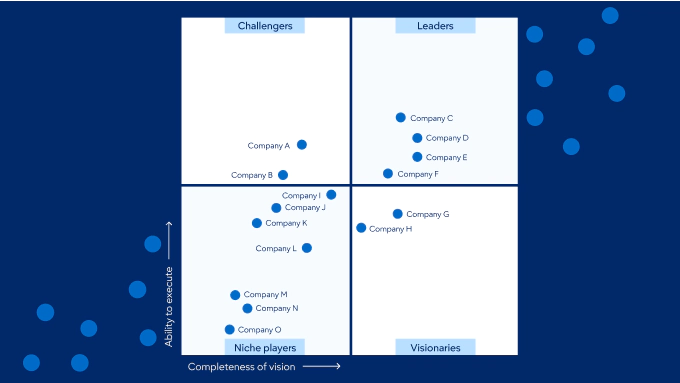
A rapidly evolving market moves beyond code completion
The market for enterprise AI coding agents is entering a new phase of expansion and competitive realignment. What began as AI-assisted code completion has rapidly evolved into agent-driven systems that orchestrate development tasks across the software delivery life cycle.
Vendors now compete not only on code generation quality, but on their ability to coordinate complex workflows, integrate across engineering environments and support higher developer productivity. As adoption accelerates, enterprise AI coding agents are capturing a growing share of enterprise software engineering spend, with the market estimated at roughly $9.8 billion to $11.0 billion annualized as of April 2026.
Market growth is accelerating — and becoming more complex
Since mid-2025, the market has expanded rapidly as enterprise adoption broadens and pricing models evolve. Vendors are shifting from seat-based subscriptions to usage-based pricing, reflecting the compute demands of agentic workflows.
Several dynamics define the current landscape:
Broader product scope. The category now includes coding assistants, AI-native IDEs, terminal-based agents and agentic platforms.
Rising spend per developer. Parallel execution and background processing are increasing usage and consumption.
Tiered vendor landscape. A small number of large vendors lead the market, while a growing second and third tier contribute meaningful revenue, particularly in enterprise deployments.
These forces are increasing both the scale and structural complexity of the market.
Competition is reshaping the stack
A defining shift in 2026 is the movement of frontier model providers into direct competition with application-layer vendors. Organizations that once supplied underlying models are now delivering full-featured coding agents, blurring traditional ecosystem boundaries.
Two approaches are emerging:
Vertically integrated offerings, which combine model and agent to optimize performance and automation
Model-agnostic platforms, which emphasize flexibility, workflow integration and model choice
This distinction is beginning to blur as application vendors develop proprietary models and model providers expand into application experiences. The long-term balance of power remains uncertain. If frontier model performance continues to advance rapidly, integrated approaches may gain advantage. If lower-cost models reach “good enough” performance, differentiation may shift toward workflow orchestration and developer experience.
Agentic workflows are redefining development
Enterprise AI coding agents are increasingly defined by their ability to plan, delegate and execute tasks in parallel. The market is shifting from single-threaded assistance to orchestrated, multiagent workflows.
This evolution is changing how development work is managed:
From prompts to orchestration. Developers manage concurrency, visibility and control of agent behavior.
Parallel execution. Tasks are decomposed into streams handled simultaneously.
Flexible environments. Work spans local sessions and background or cloud-based execution.
As a result, AI coding agents are moving from assistive tools to systems that function as collaborators and execute meaningful portions of development work. This shift introduces new challenges around visibility, control and governance, particularly as workflows scale.
Value is proven, but ROI economics are evolving
As code generation matures, vendors are expanding into adjacent areas of the software development life cycle, including code review, testing and design. This positions AI coding agents as broader software delivery platforms that reduce bottlenecks and handoffs, and unify fragmented workflows.
At the same time, productivity gains are becoming more measurable. Gartner insights show that 90% of engineering leaders report improvements, with a net average productivity gain of 19.3%.
However, the economic model is becoming more complex:
Usage-based pricing introduces variability in cost structures.
Agentic workflows drive higher consumption through parallel and background execution.
ROI measurement is shifting from whether value exists to how efficiently it’s realized.
This creates a central tension in the market. While productivity gains are increasingly clear, enterprises must align tooling, workflows and governance to ensure sustainable returns. Organizations that adopt agents without clear operating models risk higher costs without proportional value.
Evaluate major tech vendors and markets with tools like Gartner Magic Quadrant™ and Critical Capabilities — and exclusive insights.