Who to Meet First — and Why — When You Start in a New Executive Role

By Jordan Turner | 3-minute read | March 05, 2024

Big Picture

Form connections and build relationships to make an immediate impact

As a new executive, identifying who to engage with first is key in your journey to make an immediate impact. The right stakeholders can:

  • Provide further insight into the inner workings of the organization

  • Clarify your team’s strengths and opportunities

  • Help you refine your priorities and share your successes

But you won’t have time to talk to every potential stakeholder during your first few months in a new role. To decrease your time to impact, it’s critical to target and build relationships with those who will have a direct impact on your future success.

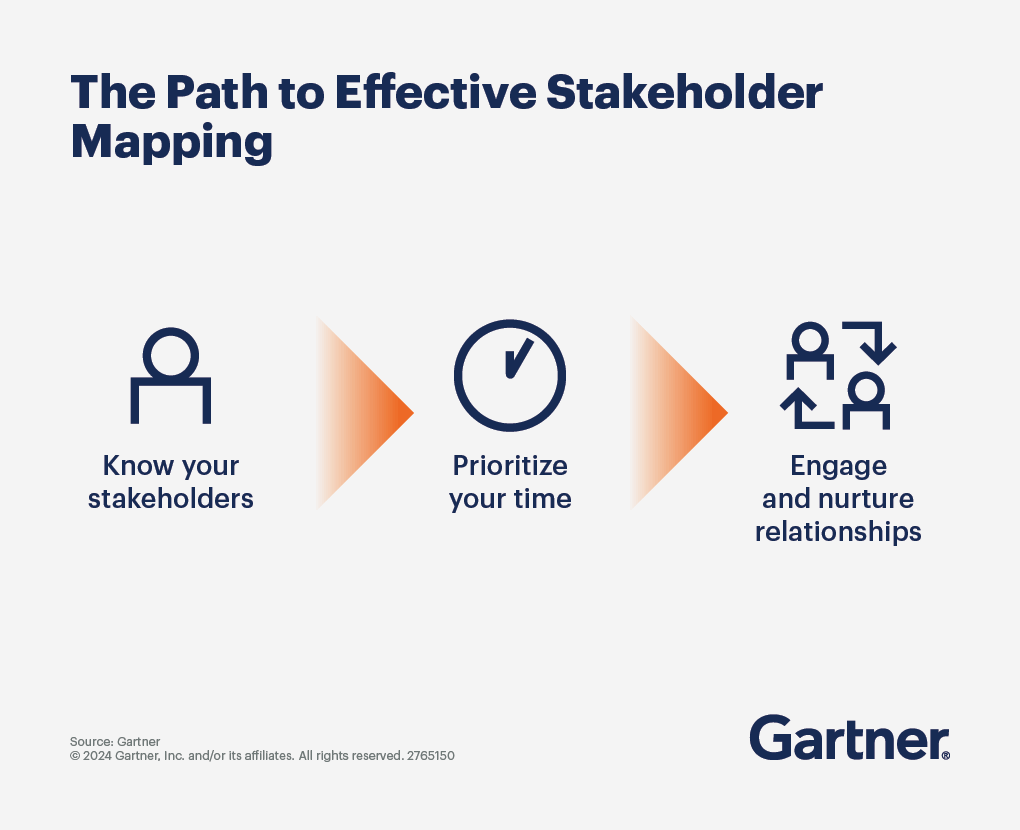
Know your stakeholders

  • To identify the individuals with whom to potentially build relationships, map the stakeholder universe. Include leaders who provide information, services and technology, or other resources to your function and those who are customers of your products, services, programs and policies. Also tap into direct reports, your CEO and board and informal contacts (think: mentors, coaches and allies).

  • When creating the map, be careful to avoid:

    • Missing stakeholders: Refine the list by using early conversations with key stakeholders to ask, “Who else should I be talking to?”

    • Too many stakeholders: Group stakeholders into types (e.g., key customers, suppliers of financial or people resources) and prioritize based on your current understanding of each group and their impact on your future success.

    • The wrong stakeholders: Continually test whether you are speaking to the right people; listen to what they say and observe what they do to determine if they’re decision makers, influencers or both.

Prioritize your time

  • Focus on the most important people — those you will rely on to get work done or who are best positioned to help you fill skills gaps. Use an action prioritization framework to prioritize your time. Ask yourself:

    • Do they own or influence any significant strategy or objective?

    • Do they own or influence any significant risk or issue?

    • Will you interact with them frequently?

    • Do they have the potential to be a key ally?

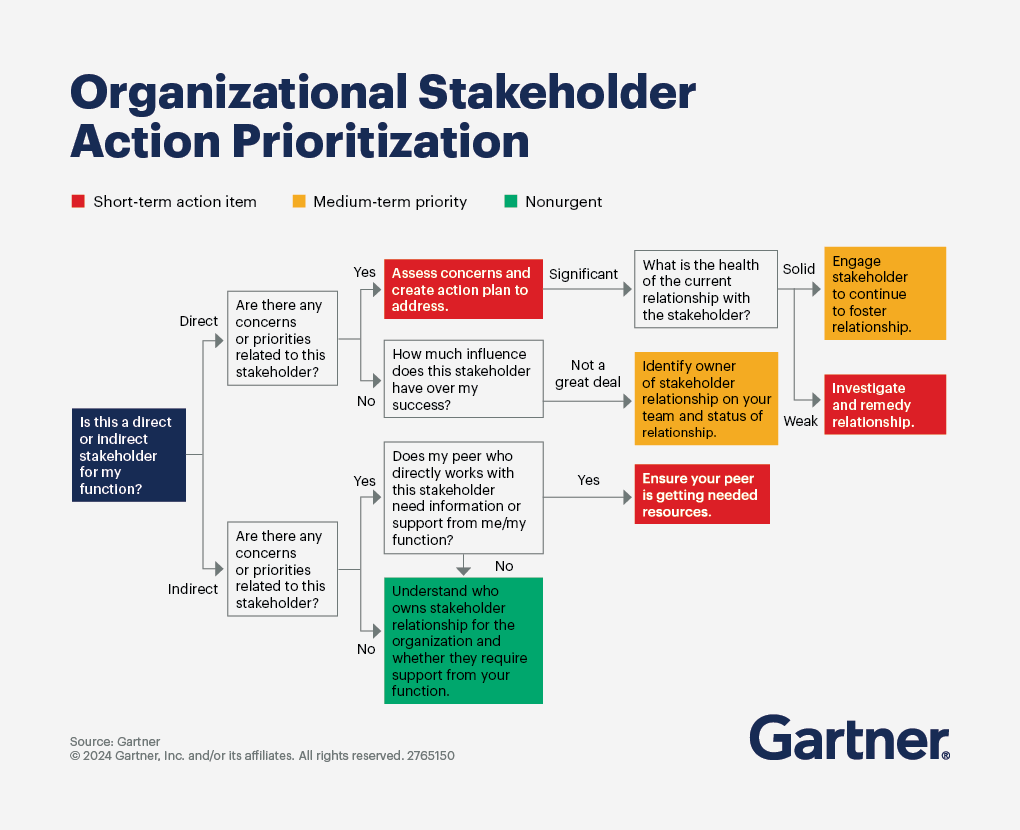
  • Prioritizing your time goes beyond deciding who to set up initial conversations with. You will also need to determine how to spend time with each stakeholder. Answer a series of questions to identify short-term action steps with each stakeholder, as well as medium-term and nonurgent items (see image below).

Engage and nurture

  • Once you’ve identified and prioritized, keep your new stakeholder network engaged. Develop and nurture your relationships by regularly sharing updates, asking tailored questions and seeking feedback. This will increase trust, making it easier and more effective to work together. 

  • Quickly recognize which key stakeholders may be challenging to engage with and which serve as allies and mobilizers. The latter:

    • Ask thought-provoking questions about you and your function.

    • Openly share guidance about the company priorities and culture to help you avoid landmines.

    • Seek win-wins in your partnership by talking in terms of we/us rather than I/me or they/them.

    • Provide valuable insights.

The story behind the research

From the desk of Blakeley Hartfelder, Gartner Senior Director, Research

“Effective stakeholder management is a key success factor for executive leaders in transition. However, research shows that because few organizations have built-in processes to facilitate leadership transitions, transitioning executives must create their own support networks to navigate their transition.”

3 things to tell your peers

1

To be successful in your new executive role, take time to identify, prioritize and engage a variety of enterprise stakeholders.


2

While executive leaders spend time with many stakeholders during onboarding, not all stakeholders contribute equally to their success. The ability to prioritize time with the right people is crucial.


3

Spend time nurturing relationships with allies and mobilizers — those that have strong influence and networks, as well as a willingness to share guidance and insights.

Share this article

Blakeley Hartfelder develops resources HR executives can use to effectively and efficiently attract, engage and manage the talent they need to drive their businesses forward. Specifically, in her role, she creates and manages others to produce research studies and whitepapers, identifies best practices in HR functional management and partners directly with HR leaders from across the globe to help them grow their careers and their businesses. Her current work focuses on helping CHROs understand how to create strategies, operating models and budgets to drive business results effectively and efficiently.

Drive stronger performance on your mission-critical priorities.