STAMFORD, Conn., December 9, 2025
- Gartner client? Log in for personalized search results.
Gartner Survey Shows Leadership Turnover Is Harming Supply Chain Performance
AI and Future-of-Work Trends Demand New Generation of Leaders; Current Leadership Roles Viewed as Unattractive
More than half (54%) of supply chain leaders report that leadership turnover has moderately to completely disrupted their function’s ability to operate over the past three years, according to a survey from Gartner, Inc., a business and technology insights company.
This disruption, combined with the impact of artificial intelligence (AI) and the evolving nature of work, is exposing weaknesses in legacy supply chain leadership development strategies and forcing chief supply chain officers (CSCOs) to take a more proactive role in building a viable bench of future-ready leaders.
Gartner surveyed 227 supply chain leaders in June 2025 across industries and regions, aimed at identifying leadership development strategies that enable CSCOs to have employees fully capable and prepared to assume head of function roles.
“Effective supply chain leadership has to shift from an overreliance on individual superstars, who our research has found are less collaborative, to leaders who are motivated and equipped to amplify the performance of their teams and organizations,” said Tess Frenzel, Senior Principal Analyst in Gartner’s Supply Chain practice. “CSCOs who are able to adapt their leadership strategies to build these types of leaders and design the roles and development programs to help them succeed will improve supply chain performance, despite the disruption inside and outside of their organizations.”
Gartner’s survey data paints a concerning picture of the reality for today’s supply chain leader:
- Only 22% of supply chain leaders exhibit collectively motivated behaviors that correlate to stronger organizational business outcomes, with the majority exhibiting individually motivated performance.
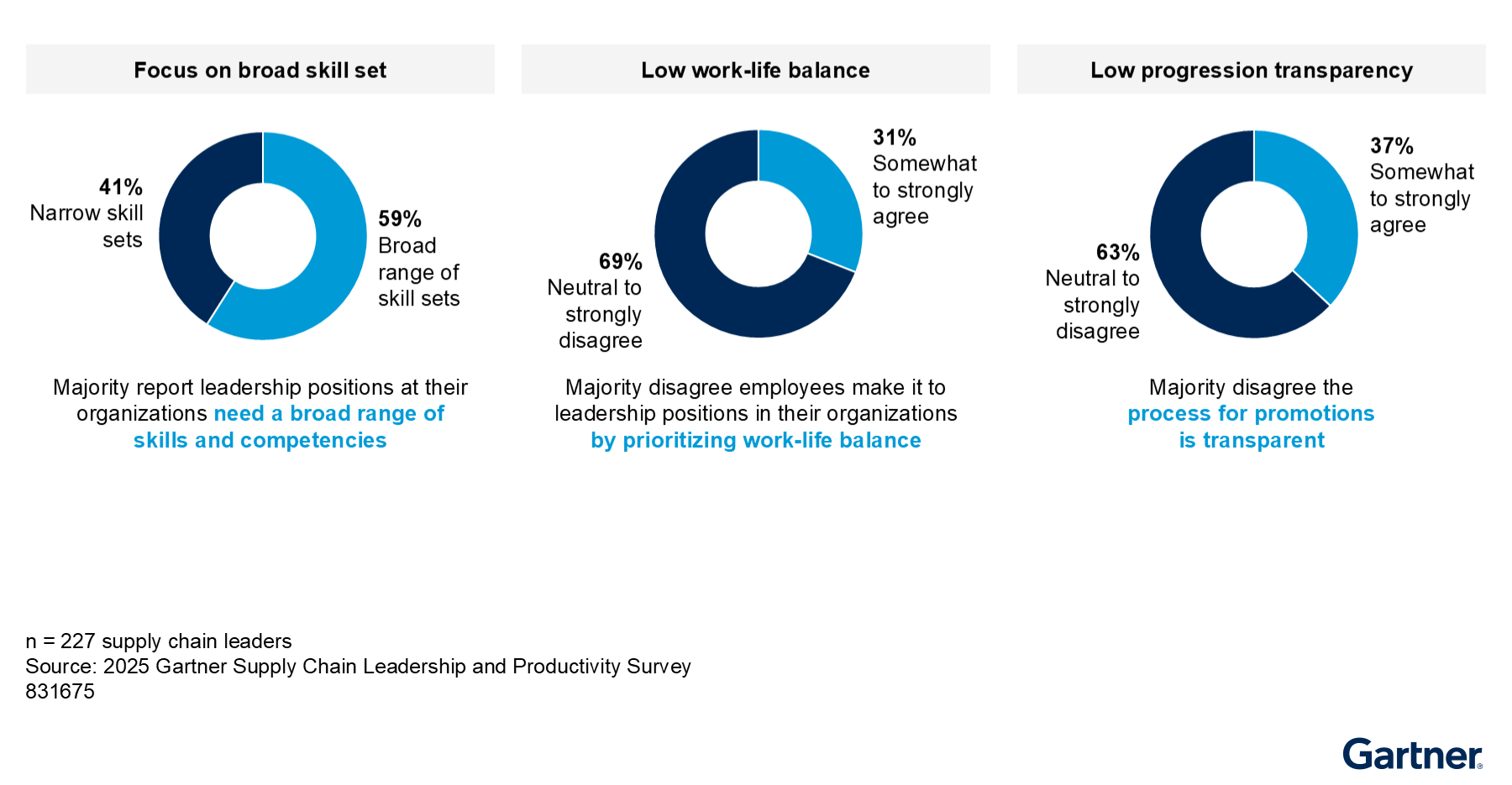
- Supply chain leadership positions continue to expand in responsibility and scope, with 59% reporting positions at their organization require a broad range of skills and competencies.
- Less than half (49%) of leadership development programs are rated as effective, highlighting a need for more dynamic, tailored approaches that keep pace with the rate of technological change.
Additionally, supply chain leaders have a negative view of the path required for higher leadership positions, with few reporting work-life balance as part of the path to leadership (31%) and less than half (37%) agreeing that the process for promotions is transparent (see Figure 1).
Figure 1: Supply Chain Leaders' Perception of Leadership Role Qualities
Source: Gartner (December 2025)
Building Future-Ready Supply Chain Leaders
As AI transforms how individual tasks are completed, and future work trends emphasize new competencies, the ability to collaborate, adapt, and lead collectively becomes the greatest differentiator. CSCOs who break from legacy-driven processes and proactively recalibrate their leadership development strategies around these imperatives will build stronger, more resilient teams prepared to drive performance and innovation in an era of constant disruption.
Gartner’s research on supply chain leadership development identified three critical shifts for CSCOs seeking to build a future-ready leadership bench:
- Develop and Reward Collectively Motivated Leaders: High turnover and siloed incentives undermine continuity and collaboration. CSCOs must shift to rewarding leaders who amplify team and cross-functional performance and not just deliver individual results.
- Combat Role Overexpansion: Overly broad leadership roles erode effectiveness and increase disruption risk. Clearly defined, scoped roles aligned to strategic priorities and work-life balance are essential for sustainable performance.
- Unlock Agile Leadership Development: Traditional, static development programs are failing to keep pace with change. CSCOs must leverage new technologies, partnerships, and embedded learning to accelerate leadership growth and adaptability.
Gartner clients can read more in Supply Chain Executive Report: Build the Next Generation of Leaders. Nonclients can learn more in the upcoming webinar: Build the Next Generation of Supply Chain Leaders.
Gartner is the world authority on AI
Gartner is an indispensable partner to C-Level executives and technology providers as they implement AI strategies to achieve their mission-critical priorities. The independence and objectivity of Gartner insights provide clients with the confidence to make informed decisions and unlock the full potential of AI. Clients across the C-Level are using Gartner's proprietary AskGartner AI tool to determine how to leverage AI in their business. With more than 2,500 business and technology experts, 6,000 written insights, as well as more than 1,000 AI use cases and case studies, Gartner is the world authority on AI. More information can be found here.
About the Gartner Supply Chain Practice
The Gartner Supply Chain Practice provides actionable, objective insights for supply chain leaders and their teams, so they can respond to disruption and innovate for the future through leading-edge supply chain management practices. Additional information is available at https://www.gartner.com/en/supply-chain. Follow news and updates from the Gartner Supply Chain Practice on LinkedIn and X using #GartnerSC. Visit the Gartner Supply Chain Newsroom for more information and insights.
Media contact
Justin Lavelle
Gartner
justin.lavelle@gartner.com
Barbara Ruane
Gartner
barbara.ruane@gartner.com


Latest releases
About Gartner
Gartner (NYSE: IT) delivers actionable, objective business and technology insights that drive smarter decisions and stronger performance on an organization’s mission-critical priorities. To learn more, visit gartner.com.