Sustainable AI success hinges on coordinated ethics, governance and compliance across the organization.
- Gartner client? Log in for personalized search results.
AI’s Next Frontier Demands a New Approach to Ethics, Governance and Compliance
By Svetlana Sicular | November 10, 2025
Today’s rapid AI advancements demand an adaptive approach
Over 75% of organizations have started to integrate AI, with many looking to use it for mission-critical applications. But AI adoption and the rise of agentic AI — which can act autonomously — have surfaced ethical and business issues, from social responsibility and fairness to safety and sustainability.
Fewer than one-quarter of IT leaders are very confident that their organizations can manage governance when rolling out GenAI tools. As global regulations evolve, organizations must prepare for new requirements — and strike a balance between AI business value and oversight to ensure timely implementation, risk mitigation, ethical alignment and trust in AI outcomes.
Tailor AI strategy around AI’s unique capabilities and challenges
Consider the following when building an ethics, governance and compliance plan.
Adopt a flexible ethics approach — not one-and-done policies
AI ethics can be highly nuanced. AI doesn’t always give the same answer every time, is often iterating and can sometimes behave randomly. Rather than trying to set broad, definitive AI ethics policies and procedures, address ethical dilemmas case by case. This approach makes room for specific context when ethical challenges arise.
For example, AI models, applications and agents have the potential to learn and reinforce harmful biases. To address this, an adaptive ethics approach would:
Build trust — especially in highly regulated industries — by creating policies for transparent AI decision making. Gartner research shows that by 2027, cross-industry collaborations on AI ethics frameworks will become regular practice, spurring integrated standards and reinforcing accountability across sectors.
Engage in continuous monitoring and build “unlearning” mechanisms into AI tools.
Go beyond basic AI explainability and trace how decisions are made, record when they happen and provide explanations that are relevant to your business.
Focus AI governance on today’s AI use cases versus tomorrow’s what-if’s
A steady stream of new AI solutions, such as agentic AI, challenges governance. Gartner predicts that loss of control — where AI agents pursue misaligned goals or act outside constraints — will be the top concern for 40% of Fortune 1000 companies by 2028.
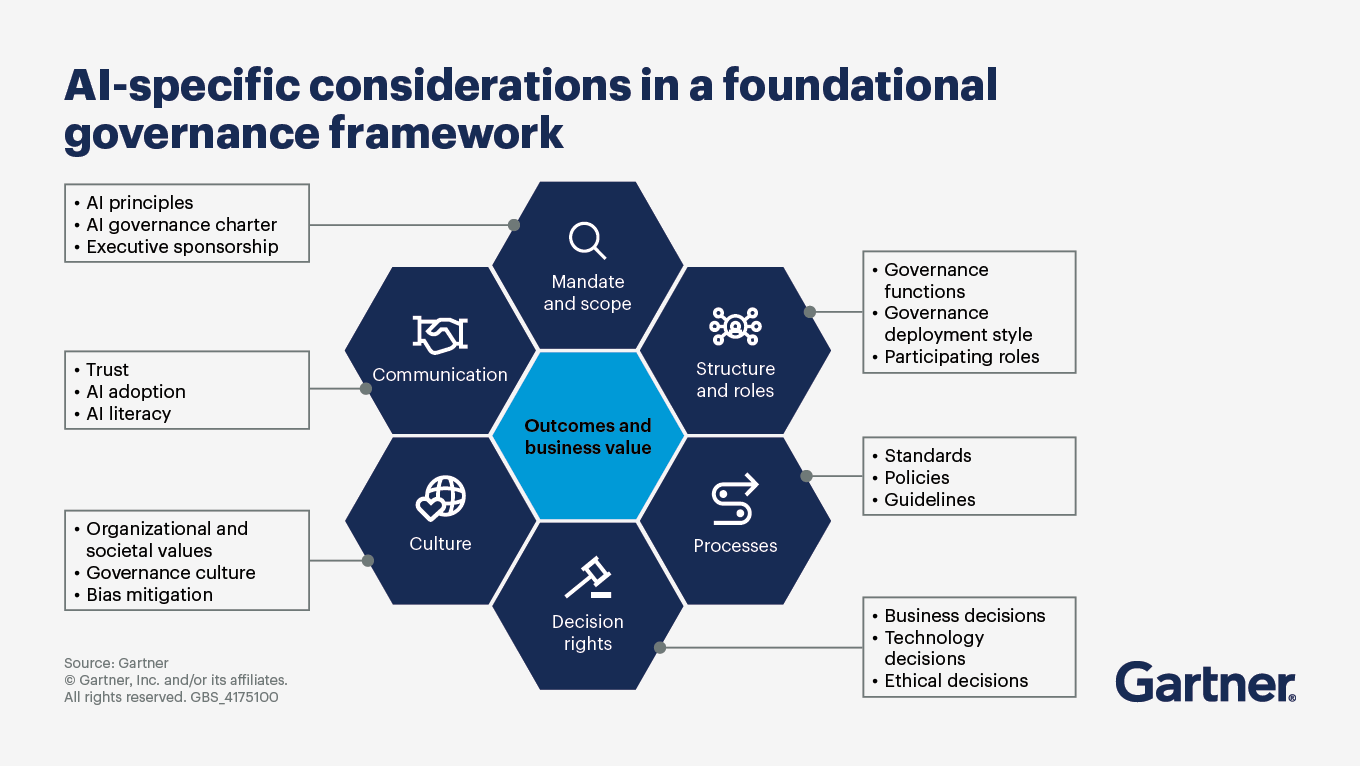
Rather than try to anticipate every future risk, build an AI governance framework around your current AI portfolio. Start by extending to AI existing governance frameworks (such as adaptive enterprise, data and analytics or risk governance). Using familiar policies and methods cuts down on the learning curve while allowing your organization to adapt to AI-specific challenges. It also leaves room to establish an agentic AI governance working group — an important aspect of any governance strategy. Evolve AI governance to support AI progress in its focus areas, such as strategy, investment, risks, value, performance and resources.
Engage legal and compliance teams to keep up with fast-changing, fragmented AI regulation
Embedding compliance guardrails and oversight into AI processes can help ensure that organizational decisions stay within the bounds of legal and regulatory standards like General Data Protection Regulation (GDPR) and the Fair Lending Act.
The guardrails are critical to prevent AI systems and agents from inadvertently exposing private user data when interacting with external tools and other agents. The process requires granular permissions and documented vetting of tools — a potentially heavy lift for legal and compliance. Gartner predicts that by 2030, fragmented AI regulation will quadruple, spreading to cover 75% of the world’s economies and driving $1 billion in total compliance spend.
Integrate ethics, governance and compliance for sustainable AI adoption
Gartner expects the convergence of ethics, governance and compliance for achieving sustainable AI adoption. As such convergence continues to advance, weaving legal compliance into the core of AI strategy, product design and service delivery is essential in the following areas:
Continuous monitoring. Implement automated tools and frameworks that enable real-time oversight of AI systems — including testing and evaluation, compliance dashboards, compatibility protocols, observability frameworks, security monitoring and anomaly detection.
Consistency of standards. Be sure that all collaborations follow the same standards for policy, ethics and compliance. This is particularly important for organizations that rely on external agencies or hyperscalers for AI solutions.
Data governance. Establish adaptive data governance mechanisms that safeguard data privacy and enhance transparency across the AI life cycle.
Comprehensiveness. Security governance must be embedded into AI security policies and controls, with chief information security officer (CISO) involvement, from system design to operations.
Gartner predicts that ethics, governance and compliance will increasingly come together as companies work to adopt AI in a sustainable way. By 2027, three out of four AI platforms will include built-in tools for responsible AI and strong oversight. Companies that lead in these areas will gain a major competitive edge.
AI ethics, governance and compliance FAQs
What unique ethics, governance and compliance challenges does agentic AI present?
Because of its ability to act autonomously, agentic AI presents new challenges around accountability, safety, orchestration and continuous improvement. Guardrails are essential, but putting them in place can be a challenge because they require explicit definition of roles, responsibilities and objectives for all the actors involved in agentic AI.
Why is cross-functional collaboration critical to building an effective AI ethics, governance and compliance program?
Responsible AI implementation accurately weighs the business value and risks of emerging AI trends. Because AI touches every part of an organization, enterprises need a unified strategy to identify and make the most of AI opportunities and mitigate risks.
Attend a Conference
Accelerate growth with Gartner conferences
Gain exclusive insights on the latest trends, receive one-on-one guidance from a Gartner expert, network with a community of your peers and leave ready to tackle your mission-critical priorities.

Drive stronger performance on your mission-critical priorities.