Wondering why AI hasn’t delivered the huge productivity boost you expected? Change your approach.
- Gartner client? Log in for personalized search results.
AI in software engineering needs a broader strategy
Most software teams expected AI to deliver dramatic productivity gains. But over half of developers say it’s improved team output by 10% or less — and some see no impact at all.
The gap isn’t about the tools. It’s about how they’re used. Gartner research shows that organizations with higher AI adoption, especially those applying AI across the software development life cycle (SDLC), report stronger productivity outcomes. These teams reinvest time savings into improving software quality, expanding team capacity and tackling high-value, low-efficiency work.
Apply AI across the SDLC to unlock full value
Many organizations limit AI to coding tasks. But the biggest gains come when it’s applied across the SDLC: from planning and design to testing and maintenance.
To unlock full value, software leaders must shift from isolated automation to strategic integration. That means connecting micro-efficiencies to business outcomes and using AI to amplify developer creativity, not just speed up delivery.
Link efficiency to business outcomes
AI can help teams move faster, but speed alone doesn’t guarantee impact. The most successful teams use AI to accelerate decision-making, improve delivery of customer-facing features and reduce friction across workflows.
This approach links task-level efficiencies to broader value stream outcomes. It’s about using your saved time to deliver better solutions.
Reinvest time savings into quality
Initial studies suggested developers could code 55% faster with AI. But newer research shows a more nuanced picture. A 2024 study found only a 26% boost in task completion, and the DORA Report showed a 1.5% drop in throughput for every 25% increase in AI adoption.
To counter diminishing returns, leaders must reinvest time savings into improving code quality, security and maintainability. Even short intervals — 20 to 30 minutes — can be used effectively when AI accelerates quality-focused tasks.
Target high-effort tasks to compound gains
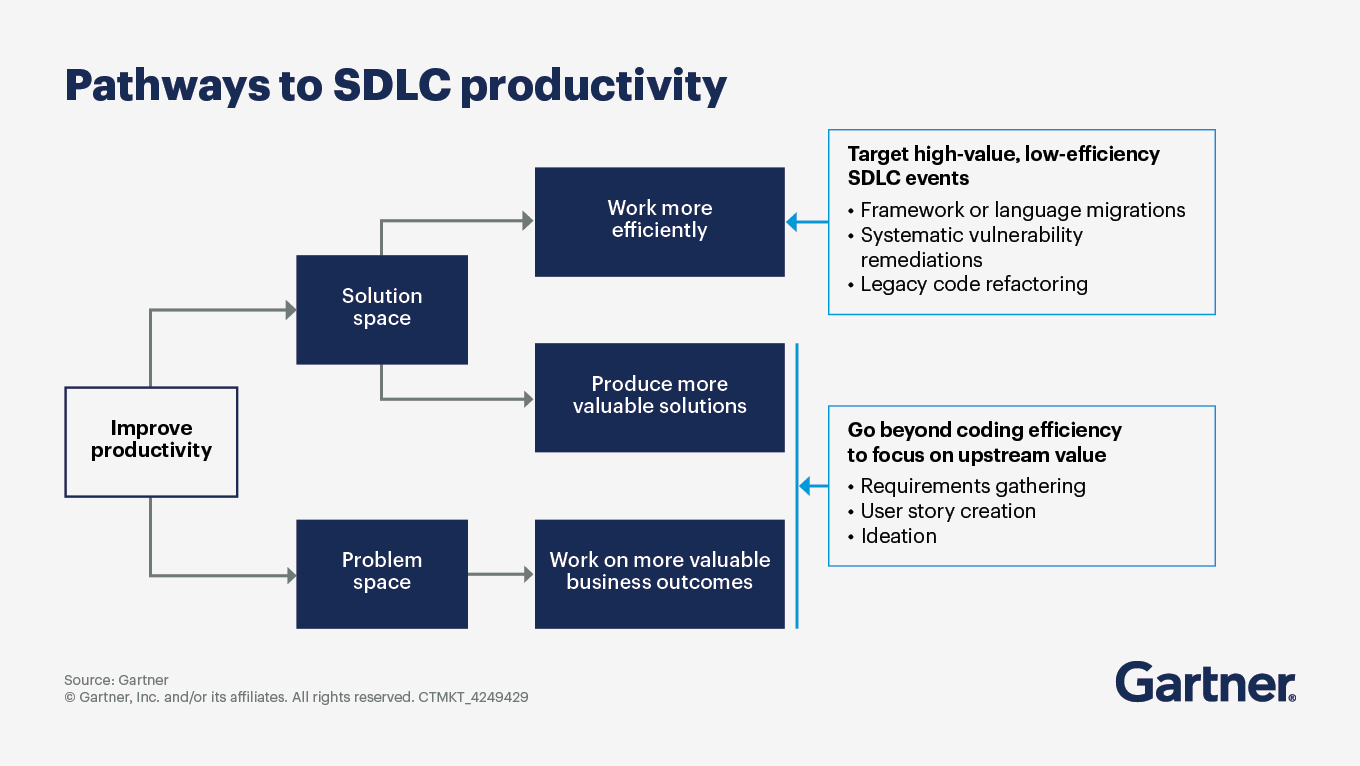
AI delivers the biggest time savings when applied to complex, disruptive SDLC events — those that interrupt planned work and demand deep concentration.
Examples include outdated framework migrations, systematic security remediations, legacy code refactoring and architectural technical debt cleanup. When AI helps teams tackle these challenges, it doesn’t just save time — it unlocks capacity and cognitive space for innovation.
Go upstream to unlock even greater value
Organizations with more than 50% AI adoption report higher time savings in early-stage development activities: gathering requirements, creating user stories and ideating. These upstream tasks shape the direction of development and determine whether teams build the right solutions. AI can help validate user demand, explore alternative approaches and ensure alignment with business needs.
Gartner predicts that by 2028, teams that consistently apply an ensemble of AI-powered tools across the SDLC will achieve 25–30% productivity gains — up from the 10% delivered by code-generation-focused approaches in 2024.
AI in Software Engineering FAQs
What’s the best way to apply AI across the SDLC?
Use AI to tackle high-value, low-efficiency events like refactoring and upstream ideation. Reinvest time savings into quality and innovation to unlock system-level gains.
How can AI provide benefits for software testing?
AI augmentation can improve test planning, prioritization, creation, maintenance, data generation, visual testing and defect analysis.
How can software engineering leaders keep developers’ skills up to date in the age of AI?
Connect learning and earning to prioritize business and talent outcomes. Use manifesto values and principles to guide high-impact learning delivery.
Attend a Conference
Accelerate growth with Gartner conferences
Gain exclusive insights on the latest trends, receive one-on-one guidance from a Gartner analyst, network with a community of your peers and leave ready to tackle your mission-critical priorities.

Drive stronger performance on your mission-critical priorities.