Achieve rapid financial gains by focusing your AI investments where they have the biggest effect.
- Gartner client? Log in for personalized search results.
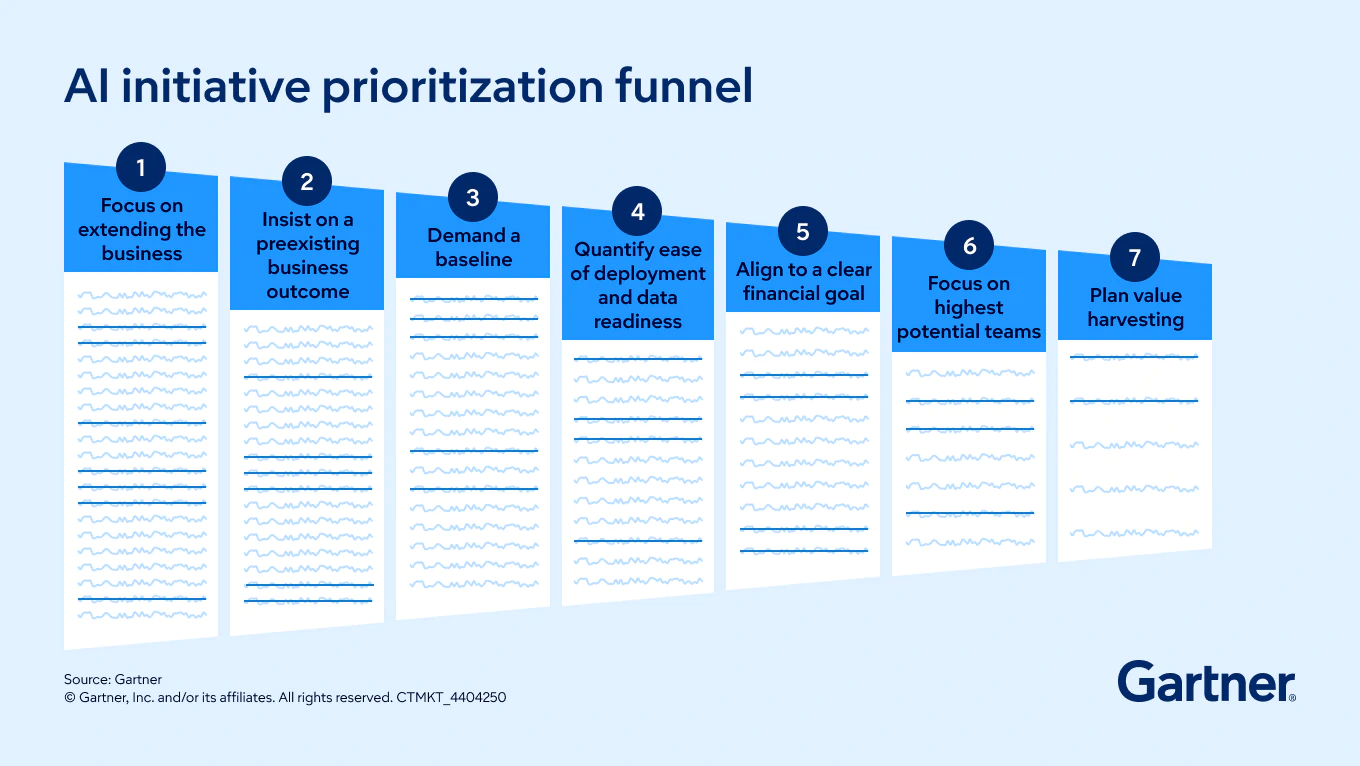
Use the AI project prioritization funnel to create financial impact now
CxOs implementing and scaling AI face intense pressure to deliver not only productivity gains but also measurable financial results. And while AI investments are everywhere, only some produce financial value; the bucket that does so in the near-term is even smaller.
If you’re staring down a spreadsheet of 150+ ideas for AI projects, use the Gartner AI project prioritization funnel to help you pare that long list down to the three to five projects that will move the needle.
7 steps to choose AI initiatives that yield quick return
Ruthlessly prioritize at each stage and eliminate projects that fail to meet criteria. This progressive narrowing ensures your team focuses only on initiatives with the highest likelihood of success.
Step 1: Focus on “extending” the business
Categorize every AI initiative by strategic intent: defend, extend or upend.
Defend: Boosts individual productivity but rarely yields positive financial ROI
Extend: Transforms existing divisions and teams for competitive differentiation — these are your best bets for near-term financial impact
Upend: Changes company’s competitive strategy and disrupts markets, but the odds of success are low and timelines are long
Keep only the “extend” initiatives. They are the sole reliable path to near-term ROI.
Step 2: Anchor each initiative to a core business outcome
Every AI project must tie to a preexisting business outcome or metric (e.g., sales conversion rate) that the executive team understands and values. These outcomes may or may not be specifically measured as formal KPIs. If the link to financial impact isn’t clear and defensible, strike the initiative from your list.
Step 3: Establish a baseline
If a metric mattered before an AI project was conceived, you’ll have a baseline to measure success. Avoid initiatives that lack historical data, as they leave you without a way to credibly demonstrate ROI.
Step 4: Determine ease of deployment and data readiness
Ask practical questions like:
Can you buy the AI, or must you build it?
Is your enterprise data AI-ready?
Does the initiative require organizational change?
Projects with high execution burdens should be struck from your list. They may be valuable, but you are less likely to execute them (and create value) in the near term.
Step 5: Align to a clear financial goal
Is your organizational priority cost reduction or revenue growth? All companies want both, but usually one is more important than the other at the present moment. Most AI projects that deliver value do so in one area, not both. Remove from consideration any initiative that doesn’t align with your organization’s primary value goal.
Step 6: Focus on teams with the highest productivity impact
Identify departments and teams that will benefit most from AI — and how. Targeted investment can influence:
Work quantity, specifically for finance, anti-fraud, HR and software engineering
Work quality, specifically for software engineering, HR and finance investment
Work scope, specifically for finance investment, HR and software engineering
Increased insights, specifically for data and analytics, finance and corporate strategy
Increased decision confidence, specifically for IT operations, HR and cybersecurity
Step 7: Zero in on the easiest benefit to harvest
Detail what organizational change is required to turn AI productivity gains into actual financial value, such as reducing headcount, redeploying people to higher-value tasks or cutting third-party contracts. Choose projects where generating near-term financial value requires just a few linear, straightforward steps. Start small, prove success, then scale.
AI project prioritization FAQs
How many AI initiatives should CxOs pursue for financial impact?
Gartner recommends narrowing down to three to five high-impact projects for measurable, short-term results.
What’s the biggest mistake in AI project selection?
Chasing too many ideas without a clear, defensible link to financial value or lacking a plan for value harvesting are common errors.
Attend a Conference
Accelerate growth with Gartner conferences
Gain exclusive insights on the latest trends, receive one-on-one guidance from a Gartner analyst, network with a community of your peers and leave ready to tackle your mission-critical priorities.

Drive stronger performance on your mission-critical priorities.