These trends and technologies will reshape the market and demand new strategies.
- Gartner client? Log in for personalized search results.
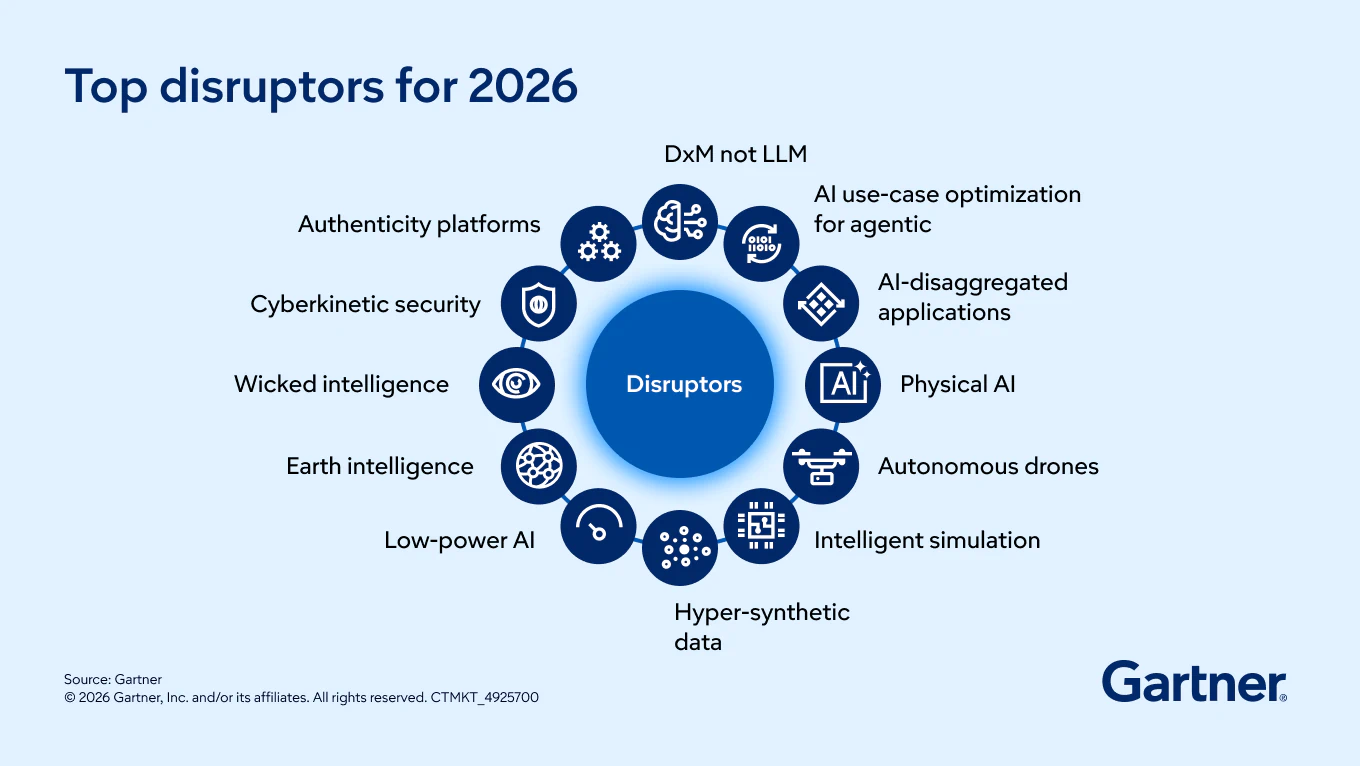
Today’s emerging technologies will soon become basic requirements for product leaders
The next five years will see a wave of emerging technology disruptors that will redefine how businesses operate, compete and innovate. Product leaders can no longer afford to ignore these trends, because these technologies will impact every enterprise, in every industry, to varying degrees. Early adopters will gain a competitive edge but, over time, these disruptors will become the new standard for business operations.
4 macro trends are defining the new era of AI and automation
The most significant technology shifts are happening at the intersection of AI, automation and physical systems. Four macro trends are driving this transformation: domain-specific AI, physical AI, applied intelligence and simulation, and the weaponization of AI. Understanding how these trends connect will help product leaders focus their investments for the greatest impact.
Domain-specific AI will outperform generalist models
The era of generalist solutions is ending as organizations realize that large language models (LLMs) are not a one-size-fits-all solution.
Gartner predicts that by 2030, 90% of GenAI-enabled solutions will use domain-specific models to improve accuracy and sustainability. Identifying the right use cases for agentic AI is critical — by 2029, over 50% of enterprise agentic AI initiatives will underperform on ROI due to misapplied solutions.
The emergence of an AI-based smart layer will fundamentally change enterprise applications, allowing specialist models to bypass traditional software and deliver tailored, ephemeral applications for every business need.
Physical AI and autonomous drones are reshaping industries
AI is moving out of the digital realm and into the physical world, with robots, drones and intelligent infrastructure leading the way.
Gartner predicts that by 2028, in industrial environments, physical AI will automate up to 50% of manual tasks that current technologies cannot achieve.
The next year will see rapid advances in autonomous drones as regulations catch up with technology, enabling widespread deployment beyond visual line of sight. Gartner also predicts that by 2032, more than 23 million drones will be in daily commercial use, and by 2030, low-power edge AI will make it possible for devices like smartwatches to run trillion-parameter AI models without relying on the cloud.
Wicked intelligence and simulation will solve complex challenges
AI’s greatest potential lies in tackling “wicked problems” — complex challenges that exceed human cognitive capacity.
Gartner expects that by 2030:
Technology providers will invest more in wicked intelligence than in artificial general intelligence (AGI).
Earth intelligence will generate more than $3 trillion in value, impacting every activity on the planet.
Hypersynthetic data will become the gold standard for enterprise simulation, surpassing real data in trustworthiness and utility.
Intelligent simulation will dominate decision intelligence and begin transforming both business and consumer applications.
Weaponization of AI and the need for authenticity platforms
All emerging technologies introduce new risks alongside opportunities, and generative AI is no exception. Malicious actors are using AI to create convincing fake content, overwhelming traditional filters and human judgment. As autonomy extends into the physical world, attackers can remotely operate machines, putting people and infrastructure at risk.
Cyberkinetic security is becoming essential, with Gartner expecting that at least 50% of new security investments for autonomous systems will prioritize these measures by 2028.
Enterprises also face growing challenges from disinformation, including fake video calls and targeted misinformation campaigns. By 2030, enterprises will spend more than $25 billion authenticating digital content, making authenticity platforms a critical investment to restore trust and protect business operations.
What to do next to win in the AI vendor race
Maintaining a competitive edge in the AI vendor landscape requires more than adding AI features to existing products. Product leaders must develop new offerings and evolve portfolios with integrated AI capabilities that prioritize customer needs, accelerate adoption and support scalable business models. Winning the AI vendor race depends on data‑driven insights, composable architectures and compelling go‑to‑market strategies that deliver superior client outcomes.
The steps in that journey include:
- Refining and implementing profitable AI use cases, connecting AI implementation strategies directly to tangible business results to reduce risk, accelerate value realization and maximize ROI
- Anticipating shifts in the market, profiling buyer personas and decision‑making behaviors to tailor product strategy, packaging and go‑to‑market approaches as competitive dynamics evolve
- Understanding customer needs and revenue opportunities, using market and peer insights to uncover unmet demand, validate opportunities and prioritize AI investments that drive growth
- Differentiating from competitors, translating customer and market insights into distinctive product capabilities, messaging and value propositions that clearly separate offerings in crowded AI markets
Emerging technologies for product leaders FAQs
What are the most important emerging technologies for tech product leaders?
Key technologies include domain-specific AI, physical AI, autonomous drones, wicked intelligence, Earth intelligence, hypersynthetic data, intelligent simulation, cyberkinetic security and authenticity platforms.
How will physical AI and autonomous drones change business operations?
Gartner predicts that physical AI will automate up to 50% of manual industrial tasks by 2028, while over 23 million drones will be in daily commercial use by 2032, revolutionizing logistics, monitoring and operational efficiency.
Why is cyberkinetic security critical for the future of emerging technologies?
As autonomous systems proliferate and the global attack surface grid grows, cyberkinetic security will be essential to protect physical assets and maintain business continuity. Cyberkinetic security uses behavior analysis and preemptive security techniques to mitigate physical attacks.
Attend a Conference
Accelerate growth with Gartner conferences
Gain exclusive insights on the latest trends, receive one-on-one guidance from a Gartner analyst, network with a community of your peers and leave ready to tackle your mission-critical priorities.

Drive stronger performance on your mission-critical priorities.