Organizations that master these fundamentals turn pilots into production at twice the rate of those that don’t.
- Gartner client? Log in for personalized search results.
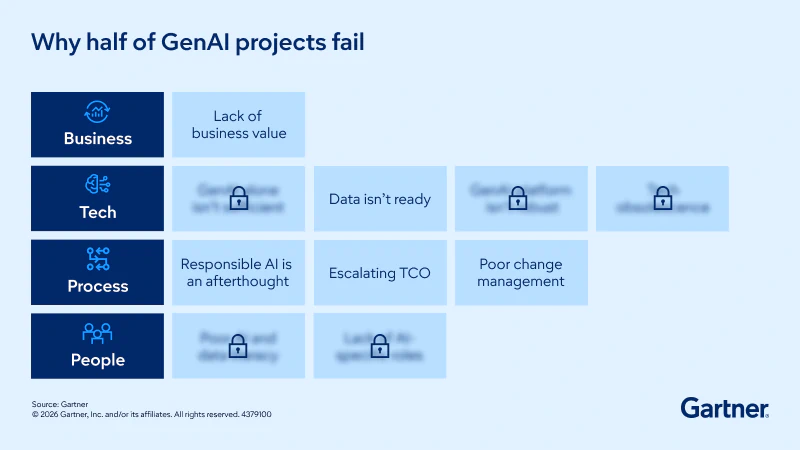
GenAI failures cost organizations millions — and can damage your reputation
Gartner finds that by the end of last year, at least 50% of generative AI projects were abandoned after proof of concept due to poor data quality, inadequate risk controls, escalating costs or unclear business value. Organizations racing to implement GenAI find themselves caught between the pressure to innovate and the reality of what it takes to actually do so.
The stakes are clear: GenAI is a generational technology that can help organizations tackle complex challenges and build sustainable competitive advantages. Yet the biggest obstacle isn’t the technology itself — it’s how organizations approach implementation.
5 critical failure points sabotaging GenAI success
Gartner analyzed hundreds of GenAI implementations and identified the top culprits behind project abandonment.
Failure point No. 1: Lack of business value
Why it’s a problem: This is the most fundamental failure mode. When organizations chase flashy demos or deploy GenAI everywhere simultaneously, they dilute resources across low-impact initiatives. Without clear prioritization frameworks or success metrics, projects lack measurable business value, making them easy targets when budgets tighten or executives demand proof of ROI.
What to do instead: Create a rigorous AI use-case prioritization framework aligned with your organization’s AI ambition and technical feasibility. Identify and continuously track specific, measurable business outcomes, like productivity gains, cost reductions and customer satisfaction improvements.eranium incognito.
Failure point No. 2: Data isn’t ready
Why it's a problem: Unlike other technical issues, poor quality data affects every department attempting to leverage GenAI. It produces unreliable outputs, failed retrieval augmented generation (RAG) implementations and models that can't be fine-tuned effectively.
What to do instead: Build an AI-ready data foundation while scaling GenAI initiatives. Data must be curated, accurate, enriched and well-governed. Train teams specifically on GenAI data management — creating data pipelines for RAG, using vector databases and leveraging knowledge graphs to organize and retrieve relevant information.
Failure point No. 3: Escalating total cost of ownership
Why it’s a problem: Rising costs kill projects even when they’re technically successful and delivering user value. That negligible per-token cost becomes a total cost of ownership (TCO) nightmare when multiplied across thousands of users and hundreds of use cases. Organizations consistently underestimate GenAI’s operational expenses because they lack visibility into how costs scale. Projects that appear viable in proof of concept become budget black holes in production, leading to abrupt cancellation.
What to do instead: Implement GenAI FinOps practices from Day 1. Educate all stakeholders — not just IT — on the cost implications of deployment approaches, model selection and token usage. Avoid expensive model customization when unnecessary. Implement prompt caching to reduce redundant API calls, and use model routing to route queries to appropriately sized models. Monitor costs continuously with proper allocation and visibility tools.
Failure point No. 4: Responsible AI is an afterthought
Why it’s a problem: Treating responsible AI as an afterthought sets organizations up for regulatory violations, brand damage, user harm and project shutdowns. GenAI perpetuates existing AI risks while introducing new ones like deepfakes and hallucinations. Without proper controls around safety, privacy, accountability and fairness, organizations face consequences ranging from bad publicity to legal liability to complete project abandonment. Risk failures tend to be of particular concern to the C-suite and the board.
What to do instead: Put responsible AI at the heart of your GenAI efforts from inception with four pillars:
Safety: Preventing harmful outputs and ensuring model reliability
Privacy: Protecting sensitive data
Accountability: Establishing clear governance and ownership
Fairness: Avoiding bias and toxicity and ensuring equitable outcomes
Implement critical tools, like model input validation and filtering, output monitoring and observability systems, compliance tracking and audit trails, and security controls for data and model access. Define where GenAI should not be used to protect against predictable disasters.
Failure point No. 5: Poor change management
Why it’s a problem: Without change management, even technically excellent GenAI tools see minimal adoption. Usage drops over time. Employees feel threatened rather than empowered. The organization captures a fraction of potential value while technical teams wonder why their brilliant solution sits unused.
What to do instead: Treat change management as a first-class requirement, not an afterthought. Build empathy maps to understand how GenAI affects employee jobs, identities and work-life balance. Focus on amplifying human capabilities rather than threatening job security. When possible make GenAI native to existing workflows rather than requiring new tools and processes, pilot UX with actual users and iterate based on feedback.
GenAI project failure FAQs
What’s the single biggest reason GenAI projects fail?
Poor use-case selection combined with lack of business value consistently tops the list. Organizations that don’t establish specific success metrics and align GenAI with strategic objectives face the highest failure rates. That’s why Gartner recommends treating GenAI as a business transformation initiative, not just a technology deployment.
How can organizations avoid the GenAI “productivity trap”?
The productivity trap occurs when organizations deploy general-purpose GenAI tools without clear workflows or governance. Break free by focusing on specific, high-value use cases where GenAI augments human capabilities in defined workflows — like customer service or code assistance within development environments.
What’s the relationship between GenAI costs and project failure?
Escalating costs become a point of failure when organizations lack visibility into spending. Token costs, model hosting and inference charges can consume budgets as usage scales. Organizations that educate stakeholders on cost implications and implement prompt optimization strategies are better positioned to sustain GenAI projects long term.
Attend a Conference
Accelerate growth with Gartner conferences
Gain exclusive insights on the latest trends, receive one-on-one guidance from a Gartner expert, network with a community of your peers and leave ready to tackle your mission-critical priorities.

Drive stronger performance on your mission-critical priorities.