How advances in physical AI are reshaping supply chain decisions, from data capture to network design
- Gartner client? Log in for personalized search results.
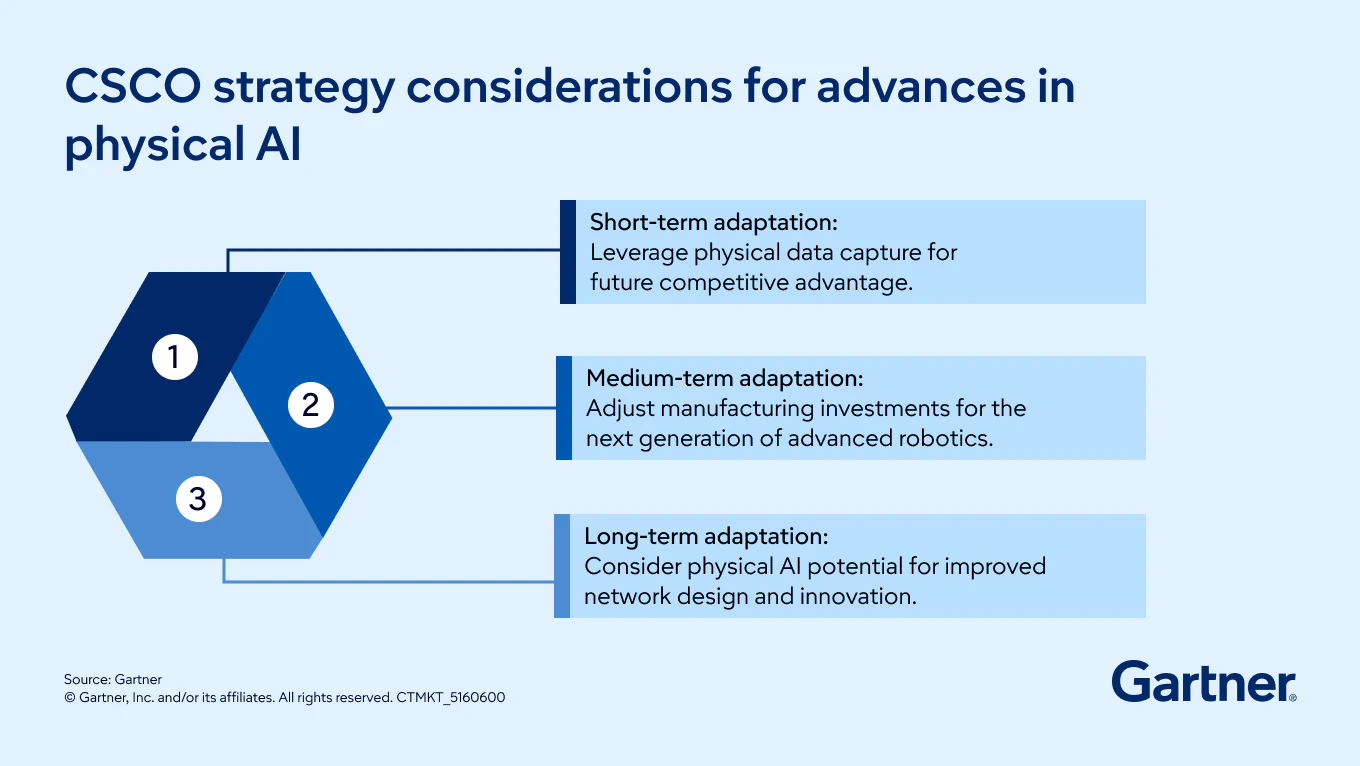
Physical AI is reshaping supply chain strategy
Physical AI enables AI-powered systems to interact with and operate in the physical world. Advances in physical AI will influence key supply chain decisions, from data collection and robotics investments, to network design and innovation. CSCOs should assess the short-, medium- and long-term implications to effectively integrate physical AI into their broader supply chain strategy.
You might also like this webinar: Building AI as the Foundation for Supply Chain Competitive Advantage
Physical AI implications for supply chains
Physical AI will create new opportunities and risks at each stage of adoption. CSCOs should break down physical AI’s impact by time horizon. Here’s how to focus your strategy:
Short-term: Start with smarter data capture
While current physical AI applications already create value, data collection within manufacturing sites and warehouses remains an underinvested opportunity for CSCOs. Manufacturing operations should be viewed as proprietary data assets that can become a source of competitive advantage as AI adoption accelerates. According to Gartner Director Analyst Tess Frenzel, “Collecting this proprietary data will help supply chains unlock more advanced intelligent simulation and digital twins, while also positioning the supply chain for more successful deployments of future autonomous robots.”
Potential risks:
Hardware limitations: Advanced sensors, actuators and battery constraints can make physical AI systems costly to deploy and scale.
Data collection and storage costs: Physical AI generates large volumes of data, requiring a clear storage strategy to balance performance and long-term costs.
Medium-term: Incorporate adaptability into robotics investment considerations
Physical AI will make robotics more flexible and adaptable. Traditional robots were often limited to a single task and difficult to repurpose when business needs changed. Physical AI can enable robots to learn new tasks through software updates rather than hardware replacements. Advances in AI-enabled tactile systems will also allow robots to understand touch, texture, shape and force in addition to visual inputs. This will expand the range of warehouse activities that can be automated, including complex picking and packing tasks. As a result, organizations can improve operational agility while getting more value from their robotics investments.
Potential risks:
Perception and interaction challenges: Physical AI must safely navigate unpredictable real-world environments and those capabilities are still maturing.
Cybersecurity risks: As physical AI adoption grows, stronger collaboration between supply chain and IT teams is essential to protect connected systems.
Efficiency and flexibility trade-offs: Physical AI increases automation flexibility, but often at a higher cost than traditional automation solutions.
Long-term: Rethink network and facility design
Physical AI could enable smaller, highly autonomous facilities that reduce the need for traditional production footprints. As automation expands, network design decisions may shift from labor availability to customer proximity, which will help organizations improve responsiveness and resilience. This could also reduce transportation requirements and support sustainability goals. At the same time, advances in world models and digital twins will allow companies to test scenarios, evaluate investments and optimize operations with greater confidence. By improving the ability to simulate future outcomes, physical AI can accelerate innovation and decision making. While these changes are still emerging, leading CSCOs are already assessing their potential impact on future supply chain strategies.
Potential risks:
Commercial viability challenges: High upfront costs and uncertain returns can slow investment in smaller, autonomous facilities.
Computational costs and model limitations: Advanced world models and digital twins require significant computing power and may struggle to predict outcomes in highly uncertain scenarios.
What’s next in supply chain strategy
By virtue of its rich data assets and highly repeatable processes, the supply chain is inevitably moving toward an AI-driven future. Leading CSCOs will pursue a two-pronged approach by delivering AI-enabled value today through narrow, practical use cases while also building the blueprints that establish the foundations for tomorrow’s AI-driven supply chain. This is critical to delivering on the mission-critical priority of architecting the AI-driven supply chain.
The steps in that journey include:
Becoming part of the enterprise‑level AI conversation by overcoming peers’ underestimation of supply chain’s strategic role through increased AI literacy, stronger cross‑functional competencies and partnerships that drive joint‑win deployments
Building a supply chain AI roadmap that balances long‑term transformation and near‑term ROI by assessing AI maturity, identifying and prioritizing use cases, anticipating risks and aligning investments to measurable outcomes
Building an AI‑ready workforce by preparing leaders and frontline teams for the uneven impact of AI across functions, redesigning workflows, roles and organizational structures, and linking upskilling, hiring and partnering to supply chain business needs
Developing an AI‑enabled trading partner ecosystem through shared data frameworks, integrated workflows and transparent governance that supports trust, collaboration and joint value creation across the end‑to‑end network
Enabling AI‑driven workflow and process change by understanding how AI transforms business processes, decision making and operating models through decision augmentation and automation
Establishing a robust data foundation for AI by applying AI‑powered tools to improve data quality, adopting modern architectures such as lakehouses and data fabrics, and using natural‑language interfaces to accelerate insight generation and decision support
Reconciling the desired AI future state with the existing supply chain technology stack by defining integration strategies, evaluating vendor capabilities and making informed build‑versus‑buy decisions across plan, source, make and deliver
For more on how Gartner helps drive success on this and other mission-critical priorities for CSCOs, speak to us today.
Supply chain physical AI FAQs
What is physical AI?
Physical AI combines AI with physical systems to perform tasks and make decisions in real-world environments. Its impact on supply chains, manufacturing and operations makes it increasingly important for CSCOs.
What are examples of physical AI in supply chains today?
Examples include autonomous mobile robots (AMRs) that use sensors, AI models and control systems to perform transportation and materials handling tasks with minimal human intervention.
How could physical AI change robotics investments?
Physical AI can make robots more adaptable by enabling them to learn and perform new tasks through software updates, rather than dedicated hardware requirements for each activity.
Attend a Conference
Experience Supply Chain conferences
With exclusive insights from Gartner analysts on the latest trends, sessions curated for your role and unmatched peer networking, Gartner conferences help you accelerate your priorities.
3 – 5 May 2027
Gartner Supply Chain Symposium/Xpo™
Orlando, FL

Drive stronger performance on your mission-critical priorities.