Technology alone won’t deliver AI value. Supply chain planning (SCP) leaders must prepare planners with the skills, mindset and confidence needed to succeed in an AI-enabled environment.
- Gartner client? Log in for personalized search results.
The AI readiness gap in supply chain planning
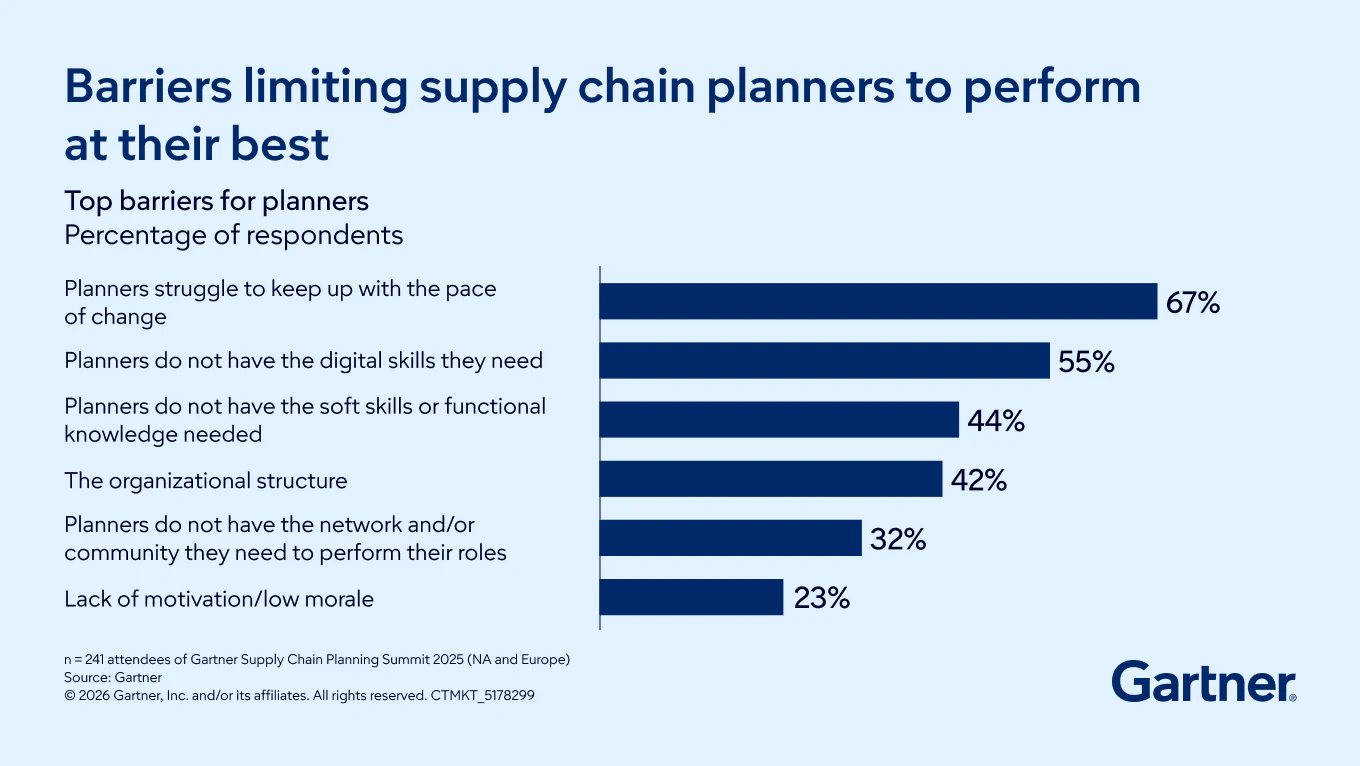
Organizations are investing heavily in supply chain planning technology, with planning expected to be a primary source of AI-driven value. Yet despite growing spending on AI training, 54% of chief supply chain officers (CSCOs) say that skills gaps in the talent pool are the biggest hindrance to supply chain priorities. Adding to the challenge, only 40% of SCP and inventory leaders report being satisfied with their jobs, while change readiness, digital skills and soft skills remain key barriers to planner effectiveness. To realize the value of AI-enabled planning technologies, organizations must intentionally build planners’ skills and capabilities.
You might also like this webinar: Building AI as the Foundation for Supply Chain Competitive Advantage
Enabling talent readiness for supply chain planners
According to Gartner Senior Director Analyst Cristina Carvallo, “Knowledge alone is not sufficient to drive value from AI-enabled planning technologies.” To be effective, SCP leaders must deploy a comprehensive strategy to build planners’ willingness, ability and confidence.
Building the willingness to change
Only 49% of planning and inventory management leaders fully understand the skills and competencies needed to grow into other roles within their organization, highlighting the need for greater clarity around how planning careers will evolve in an AI-enabled environment. While many SCP transformation strategies emphasize “autonomous planning,” planners may view this as a threat to their future role, which can hinder their engagement. In reality, planners will continue to play a central role in decision making, with 84% of CSCOs expecting autonomous agents to make autonomous decisions affecting less than 10% of cost of goods sold (COGS). As AI takes on a greater role in automating, augmenting and supporting decisions, the planner’s role will evolve alongside it. Critical steps include:
Identifying which capabilities must be preserved
Determining which new skills need to be developed
Mapping those skills as the first step in building readiness
Building the ability to execute
Building new skills still requires a balanced approach, with only 10% of learning coming from formal training, 20% from relationships and peer learning, and 70% from hands-on experience. To be most effective, SCP leaders must intentionally embed learning into daily work by redesigning workflows, creating opportunities for collaboration and giving planners practical ways to learn by doing. Key actions include:
Leveraging technologies such as GenAI, AI-driven planning environments and digital collaboration tools to scale these efforts
Implementing practices such as disruption management pods, postmortem decision reviews and capturing institutional knowledge to further accelerate skill development
Focusing on building new skills, protecting critical capabilities and addressing behaviors that could undermine AI transformation
Building the confidence to succeed
Gartner indicates that nearly seven in 10 supply chain leaders say planners’ ability to keep pace with change is one of the top barriers to peak performance. To help planners adapt to new tools and ways of working, SCP leaders must create an environment that encourages learning, experimentation and continuous improvement by:
Redesigning roles to reduce manual work and increase focus on value-added activities, equipping managers to support rather than micromanage their teams, and aligning rewards and recognition with innovation
Fostering a culture where lessons learned from mistakes are openly discussed and used as opportunities for growth, and taking a holistic approach to readiness to help planners build the courage and confidence needed to succeed in an AI-enabled planning environment
What to do next
By virtue of its rich data assets and highly repeatable processes, the supply chain is inevitably moving toward an AI-driven future. Leading CSCOs will pursue a two-pronged approach by delivering AI-enabled value today through narrow, practical use cases while also building the blueprints that establish the foundations for tomorrow’s AI-driven supply chain. This is critical to delivering on the mission-critical priority of architecting the AI-driven supply chain.
The steps in that journey include:
Becoming part of the enterprise‑level AI conversation by overcoming peers’ underestimation of supply chain’s strategic role through increased AI literacy, stronger cross‑functional competencies and partnerships that drive joint‑win deployments
Building a supply chain AI roadmap that balances long‑term transformation and near‑term ROI by assessing AI maturity, identifying and prioritizing use cases, anticipating risks and aligning investments to measurable outcomes
Building an AI‑ready workforce by preparing leaders and frontline teams for the uneven impact of AI across functions, redesigning workflows, roles and organizational structures, and linking upskilling, hiring and partnering to supply chain business needs
Developing an AI‑enabled trading partner ecosystem through shared data frameworks, integrated workflows and transparent governance that supports trust, collaboration and joint value creation across the end‑to‑end network
Enabling AI‑driven workflow and process change by understanding how AI transforms business processes, decision making and operating models through decision augmentation and automation
Establishing a robust data foundation for AI by applying AI‑powered tools to improve data quality, adopting modern architectures such as lakehouses and data fabrics, and using natural‑language interfaces to accelerate insight generation and decision support
Reconciling the desired AI future state with the existing supply chain technology stack by defining integration strategies, evaluating vendor capabilities and making informed build‑versus‑buy decisions across plan, source, make and deliver
For more on how Gartner helps drive success on this and other mission-critical priorities for CSCOs, speak to us today.
Supply chain planning talent readiness FAQs
What is talent readiness in supply chain planning?
Talent readiness refers to preparing planners with the willingness, ability and confidence needed to perform effectively as AI becomes a larger part of SCP and decision making.
Will AI replace supply chain planners?
While AI is expected to transform supply chain planning, planners will continue to play a central role in decision making. Gartner indicates that 84% of CSCOs expect autonomous agents to make decisions affecting less than 10% of COGS, meaning most planning decisions will still involve planners.
What skills will planners need in an AI-enabled environment?
As AI becomes more integrated into planning processes, organizations will need to evaluate which existing capabilities remain critical and which new skills must be developed. Gartner identifies change readiness, digital skills and soft skills as important areas of focus.
Attend a Conference
Experience Supply Chain conferences
With exclusive insights from Gartner analysts on the latest trends, sessions curated for your role and unmatched peer networking, Gartner conferences help you accelerate your priorities.
3 – 5 May 2027
Gartner Supply Chain Symposium/Xpo™
Orlando, FL

Drive stronger performance on your mission-critical priorities.