AI deals are increasingly at risk as buying teams struggle with unhealthy conflict and inconsistent leadership.
- Gartner client? Log in for personalized search results.
Conflict and leadership gaps in tech buying threaten AI investments
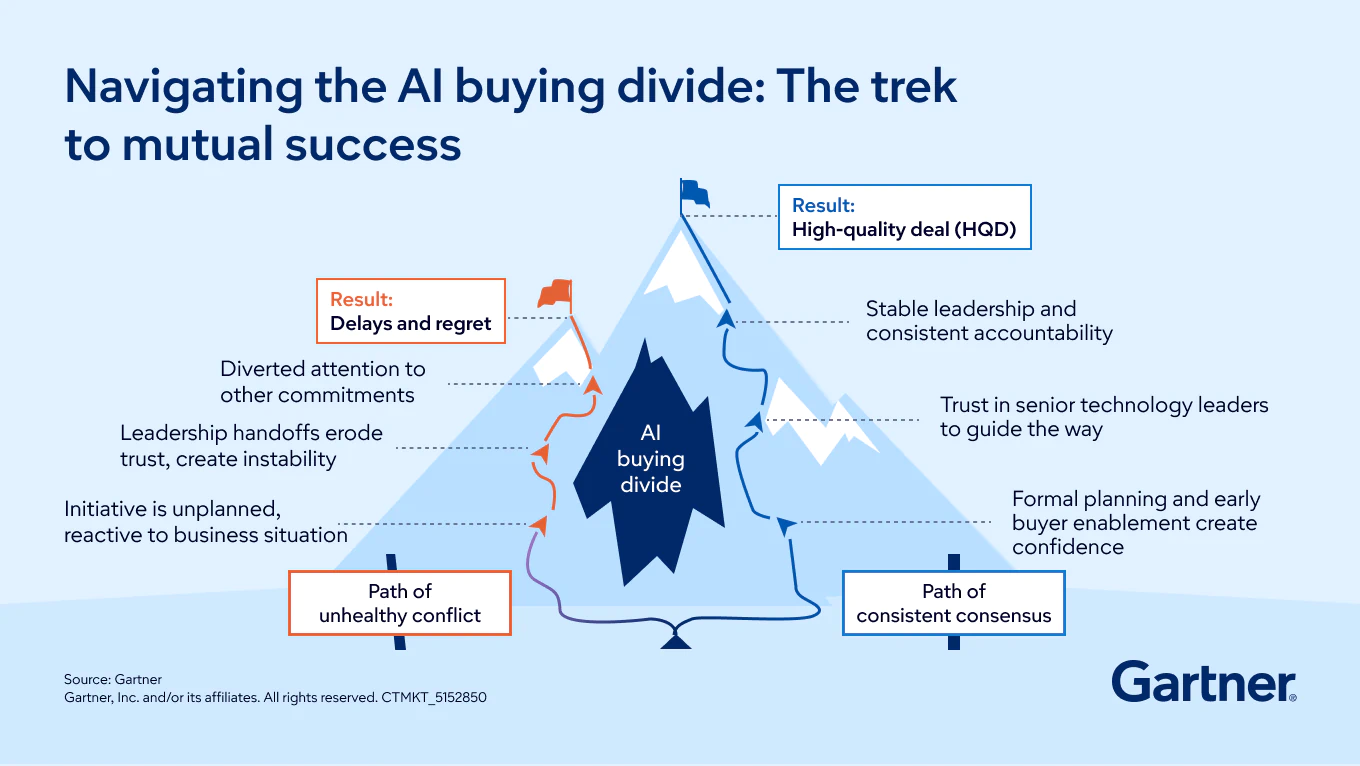
As organizations rush to invest in AI, many buying teams are struggling with increased friction and leadership disruption. According to the Gartner 2026 Tech Buying Behavior Study, 68% of buying teams experience unhealthy conflict, which leads to three times more project delays and seven times more purchase regret. Gartner Senior Director Analyst Kevin Lindsay notes, “The most urgent catalyst for this conflict is reactive purchases triggered outside of regular planning cycles, often at the urging of a board or CEO." These reactive moves are 1.5 times more likely to result in unhealthy conflict than initiatives built through stakeholder consensus.
Notably, CIO-led initiatives are 56% more likely to achieve consensus than CFO-led initiatives and 2.2 times more likely to secure a high-quality deal compared to those led by CEOs. To win in this disruptive landscape, high-technology leaders must become active partners, practice early change enablement and ensure empowered leadership remains accountable throughout the buying journey.
You might also like this webinar: Buying Dynamics in the AI Age
How unhealthy conflict derails tech buying decisions
Unhealthy conflict is a hallmark of ineffective buyers. Gartner identifies this conflict through indicators like frequent disagreements, recommendations being overruled and conflicting objectives among buying team members. These issues are more than just debates — they are symptoms of deeper organizational problems that can derail AI initiatives.
Reactive purchases spark friction and regret
Reactive AI purchases, often triggered by sudden business demands, create confusion and unhealthy conflict. These situations are 1.5 times more likely to be associated with conflict than well-aligned buying decisions. When unhealthy conflict is present, AI initiatives are delayed three times more often, and buyers are seven times more likely to regret their purchase.
To manage this, high-technology executives should recommend early alignment workshops, introduce change enablement frameworks and advise the team to establish a consistent technology sponsor — ideally the CIO — to stay accountable from start to finish.
Leadership discontinuity increases conflict
When executive sponsors move on to other projects, unhealthy conflict rises by 75% compared to when there is consensus. Leadership changes further complicate the buying journey: 49% of initiatives with unhealthy conflict had a change in purchase team leadership, and 42% had a change in accountability for the initiative’s goals. Each handoff increases confusion and the potential for misalignment and conflict.
High-technology executives must lean in as partners, practice early change enablement, and avoid a passive “wait and see” approach. Nearly half (43%) of buying teams end up scaling back their original AI initiatives when leadership is inconsistent and conflict is unmanaged.
CIOs drive consensus and high-quality deals
The most successful AI buying journeys occur when an empowered leader, typically the CIO, sponsors the initiative and remains accountable throughout. CIO-led projects are 30% more likely to achieve consistent consensus and are 2.2 times more likely to achieve a high-quality deal than CEO-led initiatives. Consistent leadership helps buying teams avoid unhealthy conflict, project delays and postpurchase regret.
Vendors should help ensure an empowered leader sponsors the initiative and stay accountable. Involving the CFO earlier can also help align business cases with strategic financial goals.
What to do next to win the AI vendor race
Maintaining a competitive edge in the AI vendor landscape requires more than adding AI features to existing products. Product leaders must develop new offerings and evolve portfolios with integrated AI capabilities that prioritize customer needs, accelerate adoption and support scalable business models. Winning the AI vendor race depends on data‑driven insight, composable architectures and compelling go‑to‑market strategies that deliver superior client outcomes.
The steps in that journey include:
Refining and implementing profitable AI use cases, connecting AI implementation strategies directly to tangible business results in order to reduce risk, accelerate value realization and maximize return on investment.
Anticipating shifts in the market, profiling buyer personas and decision‑making behaviors to tailor product strategy, packaging and go‑to‑market approaches as competitive dynamics evolve.
Understanding customer needs and revenue opportunities, using market and peer insights to uncover unmet demand, validate opportunities and prioritize AI investments that drive growth.
Differentiating from competitors, translating customer and market insights into distinctive product capabilities, messaging and value propositions that clearly separate offerings in crowded AI markets.
Tech buying behavior FAQs
What causes unhealthy conflict in tech buying behavior?
Unhealthy conflict is often triggered by reactive purchases outside regular planning cycles, leadership changes and diverted executive attention. These factors lead to delays and regret.
How can tech buying teams reduce conflict and improve outcomes?
Teams can reduce conflict by practicing early change enablement, holding alignment workshops and ensuring consistent leadership, ideally with a CIO sponsor.
Why are CIO-led initiatives more successful in tech buying behavior?
CIO-led initiatives are 30% more likely to achieve consensus and 2.2 times more likely to secure a high-quality deal, thanks to stable leadership and clear accountability.
Attend a Conference
Accelerate growth with Gartner conferences
Gain exclusive insights on the latest trends, receive one-on-one guidance from a Gartner analyst, network with a community of your peers and leave ready to tackle your mission-critical priorities.

Drive stronger performance on your mission-critical priorities.