Empower your cybersecurity team to drive AI innovation without exposing your enterprise to new risks.
- Gartner client? Log in for personalized search results.
Adapt cybersecurity strategies for AI to protect enterprise ambitions
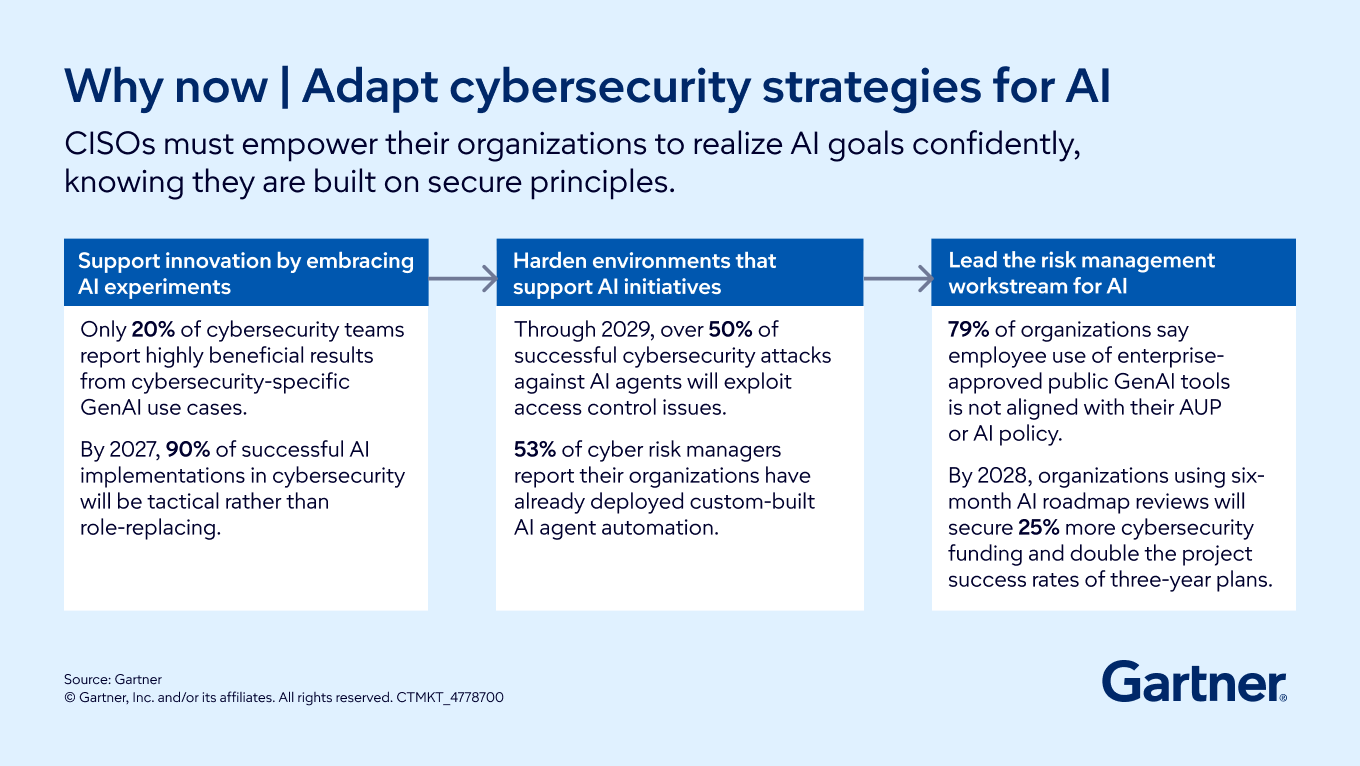
AI is reshaping your attack surface faster than most teams can respond. CISOs face a surge of employee-driven AI experiments, custom-built agents and new applications — often outside governance boundaries. Gartner analysts found that 79% of organizations report employee use of AI tools is not aligned with acceptable use policy, and 53% have deployed custom-built AI agents. Each new AI announcement, whether it’s a new AI browser or the emergence of personal assistants, forces a reset of security practices.
Today, only 20% of cybersecurity teams report highly beneficial results from GenAI use cases. Cybersecurity teams need pragmatic, fast-paced strategies to close AI security gaps and support enterprise innovation. Gartner predicts that by 2027, 90% of successful AI implementations in cybersecurity will be tactical. The challenge: Secure AI ambitions without slowing down business progress.
5 steps to lead AI cybersecurity transformation as a CISO
CISOs must execute a five-step journey to adapt cybersecurity strategies for AI. Here’s how:
Define AI risk boundaries and governance principles early
Start by gathering insights on every AI application your organization uses or builds. Build AI literacy across your team to understand risks and use AI for cybersecurity and IAM. Early governance sets clear boundaries, so you can foster safe experimentation and avoid AI-driven breaches.
Prioritize cybersecurity and IAM AI adoption aligned with business goals
Map risks and opportunities across all AI projects. Prioritize investments where AI delivers business value and secure critical resources. Gartner analysts warn: False confidence in AI maturity breeds security gaps that derail business-critical initiatives. Align your adoption to business goals, not hype.
Lead the risk management workstream for AI
Take charge of cross-team collaboration. Inform the business about new attack surfaces and provide a pragmatic view of current and potential AI-augmented threats. Your leadership ensures secure support for every AI ambition and minimizes organizational risks.
Support innovation by embracing AI experiments
Encourage your team to experiment with AI. Quickly build literacy, distinguish hype from reality and avoid wasted resources. Use leadership support and funding to run change management programs and build team buy-in. Innovation thrives when cybersecurity teams are empowered to try, learn and adapt.
Harden environments that support AI initiatives
Secure infrastructure, data, workloads, applications, AI models and third-party dependencies. Attackers will exploit any gap, so your cybersecurity program must cover the entire environment. Build comprehensive defenses that adapt as AI evolves.
Embed the 5-step framework into your AI security operating model
Move fast — AI adoption is accelerating, and your leadership is critical. Review your AI governance, risk management and security programs. Build cross-functional partnerships, invest in team literacy and experiment with emerging AI technologies. Design cybersecurity programs that support — not slow down — enterprise AI innovation.
Build resilient communication for AI volatility
Craft contextual communications to senior leadership. Address questions like: “What happens when posthype AI cybersecurity investments don’t deliver expected value?” Gartner helps CISOs navigate volatility and communicate risk clearly.
AI cybersecurity leadership FAQs
How can AI cybersecurity leadership close security gaps?
AI cybersecurity leadership closes gaps by defining risk boundaries early, aligning adoption with business goals and leading cross-team risk management. Gartner business and technology insights (BTI) show CISOs must secure employee-driven AI experiments, custom-built agents and new applications to prevent breaches and support innovation.
What are the top risks for CISOs in AI adoption?
Top risks include ungoverned employee AI use, false confidence in AI maturity and expanding attack surfaces from custom-built agents. Gartner BTI reports that most organizations have misaligned AI tool usage, and over half have deployed custom AI agents. CISOs must address these risks with governance and comprehensive security programs.
How should CISOs prioritize AI cybersecurity investments?
CISOs should map risks and opportunities across all AI projects, prioritize investments where AI delivers business value and secure critical resources. Gartner analysts recommend aligning adoption with business goals and avoiding hype-driven decisions to prevent gaps in security.
Attend a Conference
Accelerate growth with Gartner conferences
Gain exclusive insights on the latest trends, receive one-on-one guidance from a Gartner analyst, network with a community of your peers and leave ready to tackle your mission-critical priorities.

Drive stronger performance on your mission-critical priorities.