Use the Gartner strategic planning toolkit to set, communicate and execute your risk management strategy for 2027.
- Gartner client? Log in for personalized search results.
Risk Management Strategy Toolkit
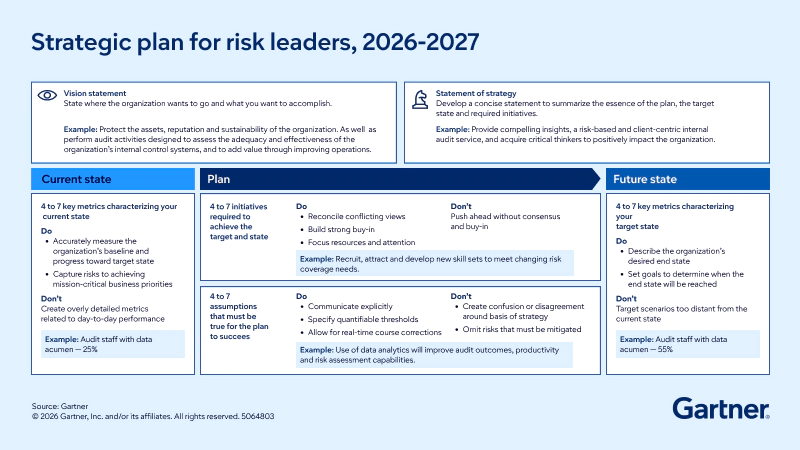
This year's top priority for ERM leaders is to unlock ERM's strategic value amid volatility and uncertainty.
Effective collaboration across the business is essential for crafting a robust risk management strategic plan that seamlessly aligns your enterprise strategy with specific functional initiatives. When done well, your risk management strategy should provide a clear roadmap for achieving your business goals and integrating your role into the organization's overarching strategic planning process.
Download the Gartner Risk Management Strategy Toolkit to:
- Apply 5 key activities for a high-impact risk management strategy
- Discover frameworks and tools to benchmark and measure risk effectiveness
- Capture and share your risk strategy with stakeholders using a concise one-page template
About the Risk Management Strategy Toolkit
The Gartner Risk Management Strategy Toolkit helps heads of ERM define the roadmap for executing the key actions required to meet their ERM department’s strategy initiatives in alignment with the enterprise business model and goals. Leaders can leverage this risk management strategy toolkit to create and communicate a clear action plan that states where the ERM function currently is, where it needs to be, how to get there and how to measure progress.
Risk Management Strategy FAQs
What is an effective risk management strategy?
An effective risk management strategy is a functional roadmap that assesses current resources, costs and budget and aligns them with the company’s mission and goals. It sets a plan to align with enterprise goals to grow and innovate, despite changing and often unpredictable business conditions. A risk strategy sets priorities, manages trade-off decisions and ensures the enterprise risk function continues to make critical investments to meet business needs.
What are the 5 key activities for an effective enterprise risk strategy?
- Verify the business context. Confirm the enterprise mission and goals and make sure your employees know how they apply to their everyday work. Align your ERM goals for impact.
- Assess your risk function’s ability to deliver on your goals and create a plan to fill the capability gaps that will slow your impact.
- Strategically manage ERM budgets to prioritize cost, budget and investment decisions to favor initiatives that will drive impact — and demote those that won’t.
- Decide how to measure your progress. Select measures and metrics that will demonstrate the progress you’re making against the commitments you’ve made.
- Document your strategy — ideally on just one page — to simply and clearly state where the risk organization is, where it is going and how it will get to the future state.
Why use the Gartner Risk Management Toolkit?
The Gartner Risk Management Strategy Toolkit helps enterprise risk leaders develop a multiyear department strategy and implement that strategy through identifying measurable annual targets. Working through this tool will enable you to:
Develop your strategic plan
Identify key threats, challenges and drivers to address through the strategic plan
Determine priority areas, goals and metrics that will address department and organizational challenges
Prioritize initiatives and track implementation to fulfill your strategic goals
Communicate the strategic plan across the department and organization