Ready or not, AI agents are rewriting the rules for data leaders — are you prepared to keep up?
- Gartner client? Log in for personalized search results.
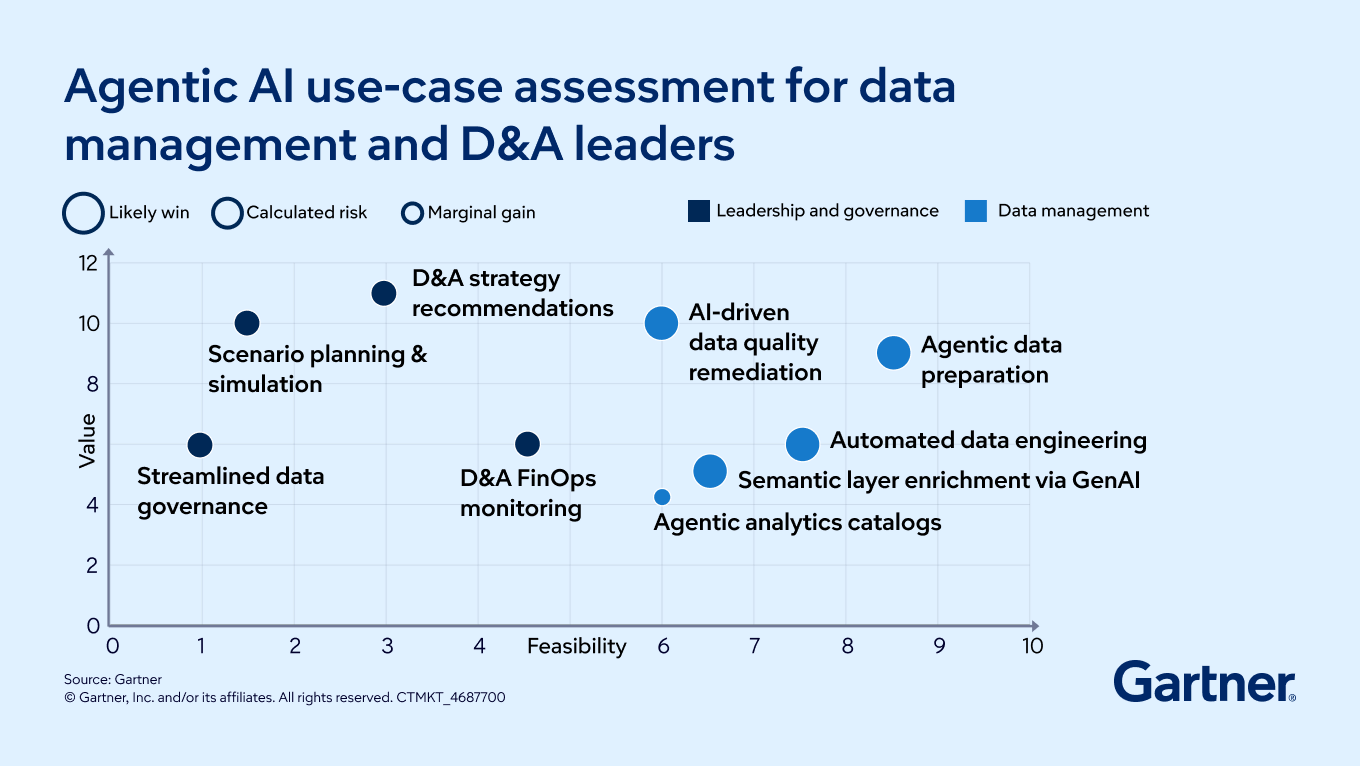
AI agents spark big productivity hopes and tough questions for D&A leaders
Seventy-nine percent of IT leaders surveyed in the 2025 Gartner CEO and Senior Business Executive Survey expect integrating AI agents into enterprise applications will deliver significant productivity gains. Twenty-six percent believe the impact will be transformative. But here’s the catch: Chief data and analytics officers (CDAOs) and heads of D&A are wrestling with the real value and feasibility of AI agents for their teams.
As a result, their most common questions are about use cases, strategy, governance, vendor landscape, market trends, integration, challenges, frameworks and enabling technologies.
D&A leaders’ top questions about AI agents: Use cases, strategy and market trends
AI agents promise efficiency, but D&A leaders need clarity on how to make them work. Here’s what they’re asking:
What are the most valuable use cases for AI agents in D&A?
CDAOs want examples of AI agents automating data ingestion, quality checks, cataloging and analytics. The goal: Free up teams for strategic work. But leaders need proof these use cases deliver real value.
How should D&A leaders approach strategy and governance for AI agents?
Strategy and governance questions are rising fast. CDAOs and heads of D&A want frameworks for deploying AI agents securely, managing risk and aligning with business goals. Gartner analysts recommend starting with pilot projects, robust governance and clear evaluation criteria.
What’s the vendor landscape and market trend outlook for agentic AI?
Vendor and market questions reflect uncertainty. D&A leaders need guidance on which vendors are credible, how solutions integrate with existing systems and what trends to watch. Gartner business and technology insights show rapid market evolution — leaders must stay informed to avoid costly missteps.
What are the main challenges and limitations for AI agents in D&A?
Challenges are real. Leaders worry about integration complexity, data quality, cultural readiness and governance gaps. Gartner highlights the need for strong frameworks, risk controls and ongoing evaluation to manage limitations and unlock value.
How CDAOs and heads of D&A can move forward with AI agents
Start by mapping your team’s questions to practical pilots. Prioritize use cases, build governance frameworks and evaluate vendors carefully. Engage your teams early, develop AI literacy and monitor outcomes closely. Don’t rush — scale only when you see clear value and feasibility.
Build clarity and confidence before scaling AI agent adoption.
Pilot agentic AI in controlled environments. Validate results, adapt governance and engage stakeholders. Gartner analysts recommend focusing on measurable outcomes and iterating strategy as you learn. Confidence comes from evidence — not hype.
What’s next?
D&A is approaching a defining moment as AI begins to rewrite the rules for data leaders. The challenge is no longer just adopting new technologies — it’s reimagining the very purpose, structure and impact of D&A in an AI‑driven enterprise. Using integrated, adaptive frameworks and emerging technologies to scale D&A governance is just one of several imperatives that CDAOs must navigate to fully deliver on the mission‑critical priority of redefining D&A and AI governance.
The other steps in this journey include:
Assess, select and implement technology, practices and tools to support data, analytics and AI governance.
Build a D&A-aligned AI governance framework that is aligned with and not siloed from the D&A governance program for maximum effectiveness of both.
Build a foundational value case for governance investment. Link trust initiatives to innovation, ROI and value realization to get buy-in from business leaders for D&A and AI governance.
Communicate data and analytics and AI governance risks and urgency with the board and business peers.
Establish a data, analytics and AI governance board while implementing best practices and avoiding pitfalls.
Identify best practices for D&A and AI governance and how these practices will need to evolve to support new requirements for AI, including agentic AI.
Create new outcome-driven metrics and leverage existing ones to demonstrate governance progress, business impact and ROI.
AI agents FAQs
What productivity gains can D&A leaders expect from AI agents?
Gartner insights show that most IT leaders expect significant productivity gains, and about a quarter expect transformative impact. But value depends on use case selection, governance and integration. Leaders must test and measure before scaling.
Why are use cases the top question for CDAOs and heads of D&A?
Use cases help leaders understand where AI agents add real value. Gartner highlights automation of data ingestion, quality checks and analytics as top priorities. Without clear examples, leaders risk investing in hype over results.
How should D&A leaders evaluate vendors and integration options?
Gartner analysts recommend careful vendor assessment, alignment with existing platforms and ongoing market monitoring. Leaders should prioritize proven solutions, pilot projects and frameworks that support secure, scalable adoption.
Attend a Conference
Accelerate growth with Gartner conferences
Gain exclusive insights on the latest trends, receive one-on-one guidance from a Gartner analyst, network with a community of your peers and leave ready to tackle your mission-critical priorities.

Drive stronger performance on your mission-critical priorities.