Physical AI will create value through coordinated capabilities rather than a single breakthrough.
- Gartner client? Log in for personalized search results.
![[ALT TEXT]](https://emt.gartnerweb.com/ngw/globalassets/en/information-technology/infographics/2026-hype-cycle-for-physical-ai.webp)
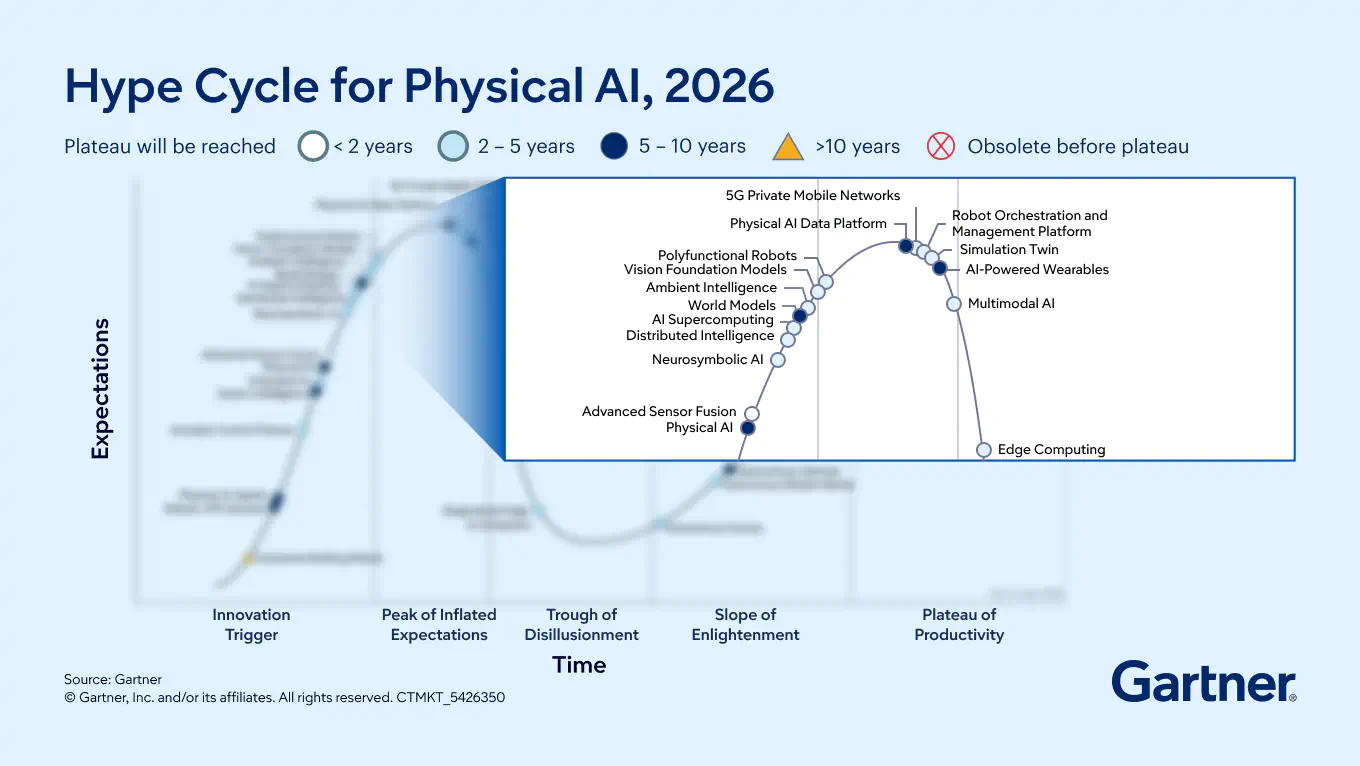
Physical AI prioritization is a portfolio decision
Physical AI is bringing AI into the real world through robotics, autonomous vehicles, industrial automation and autonomous operations. Yet the Gartner Hype Cycle™ for Physical AI, 2026, report highlights a misconception that could lead organizations astray: It’s not a single technology category.
In fact, treating physical AI as one technology can lead to poor investment decisions because value depends on how well multiple technologies work together. This challenge is especially important today as hype and risk outweigh business outcomes.
“Getting value out of physical AI requires orchestration across technologies, not breakthroughs in AI models, robots or edge infrastructure alone,” says Bill Ray, Distinguished Vice President Analyst at Gartner.
You might also like this webinar: Embrace the Future of Automation With Polyfunctional Robots
The five layers shaping physical AI adoption
The Hype Cycle groups physical AI innovations into five interconnected areas or layers. These layers need to evolve together to reduce the complexity of deployment, as weakness in one will limit reliability, increase integration costs and slow the move from controlled pilots to scalable operations.
Physical systems bring AI into the real world
Physical systems are the visible products and machines that attract the most attention. Autonomous vehicles, mobile robots, drones and polyfunctional robots are likely areas of nearer-term adoption due to clearer business cases and operating environments.
Polyfunctional robots are generating significant interest, but mass adoption will take longer because general-purpose physical autonomy remains difficult to train, validate, govern and scale.
Intelligence models and techniques enable autonomy
This layer allows systems to interpret context, plan actions and adapt to changing conditions. Vision foundation models, multimodal AI and embodied AI techniques will be drivers of nearer-term progress because they improve perception and task planning, but intelligent simulation will be needed to test plans to ensure safety and efficiency.
More advanced capabilities, such as neurosymbolic AI and physical AI agents, will take longer to mature because prediction and planning in uncertain physical environments remain difficult to validate.
Data and simulation foundations support deployment
Physical AI cannot scale through real-world training and teleoperation alone. Physical AI data platforms, simulation twins and simulation-oriented world models will be key enablers for training, testing and improving systems before deployment.
However, organizations must account for the simulation-to-reality gap, where systems that perform well in controlled environments may struggle in real-world conditions, in which even small changes can alter the perceived environment.
Compute and control infrastructure enables reliability
Physical AI raises requirements for latency, resilience and local decision making, which suggests infrastructure as a deployment gate rather than a back-end detail.
Near-term progress will depend on edge-heavy, sensor-rich architectures that keep perception, decision making and control close to the operating environment, especially when conditions change or connectivity degrades.
Operational safety and orchestration enable scale
Physical AI value will come from managed systems rather than isolated intelligent machines. As deployments expand across fleets, facilities and workflows, organizations will need stronger coordination, governance and oversight with fail-safe designs and cyberkinetic security.
The Hype Cycle identifies robot mission orchestration and management platforms, robot cybersecurity, swarm intelligence and IT/OT integration as important technologies for making physical systems observable, governable and interoperable.
Physical AI FAQs
What is physical AI?
Physical AI is a convergence layer that combines perception, reasoning, actuation and operational context to enable AI systems to interact with the physical world across robotics, autonomous vehicles, industrial automation and autonomous operations.
Which industries are likely to adopt physical AI first?
Adoption is likely to emerge first in warehousing, manufacturing, logistics, field service, defense-adjacent use cases and asset-intensive industries with structured environments and repeatable tasks, reducing operational risks.
Attend a Conference
Experience Information Technology conferences
With exclusive insights from Gartner analysts on the latest trends, sessions curated for your role and unmatched peer networking, Gartner conferences help you accelerate your priorities.
19 – 22 Oct 2026
Gartner IT Symposium/Xpo™
Orlando, FL

Drive stronger performance on your mission-critical priorities.