Exit strategies are moot if access to critical technology cannot be assured.
- Gartner client? Log in for personalized search results.
Data residency is no longer enough
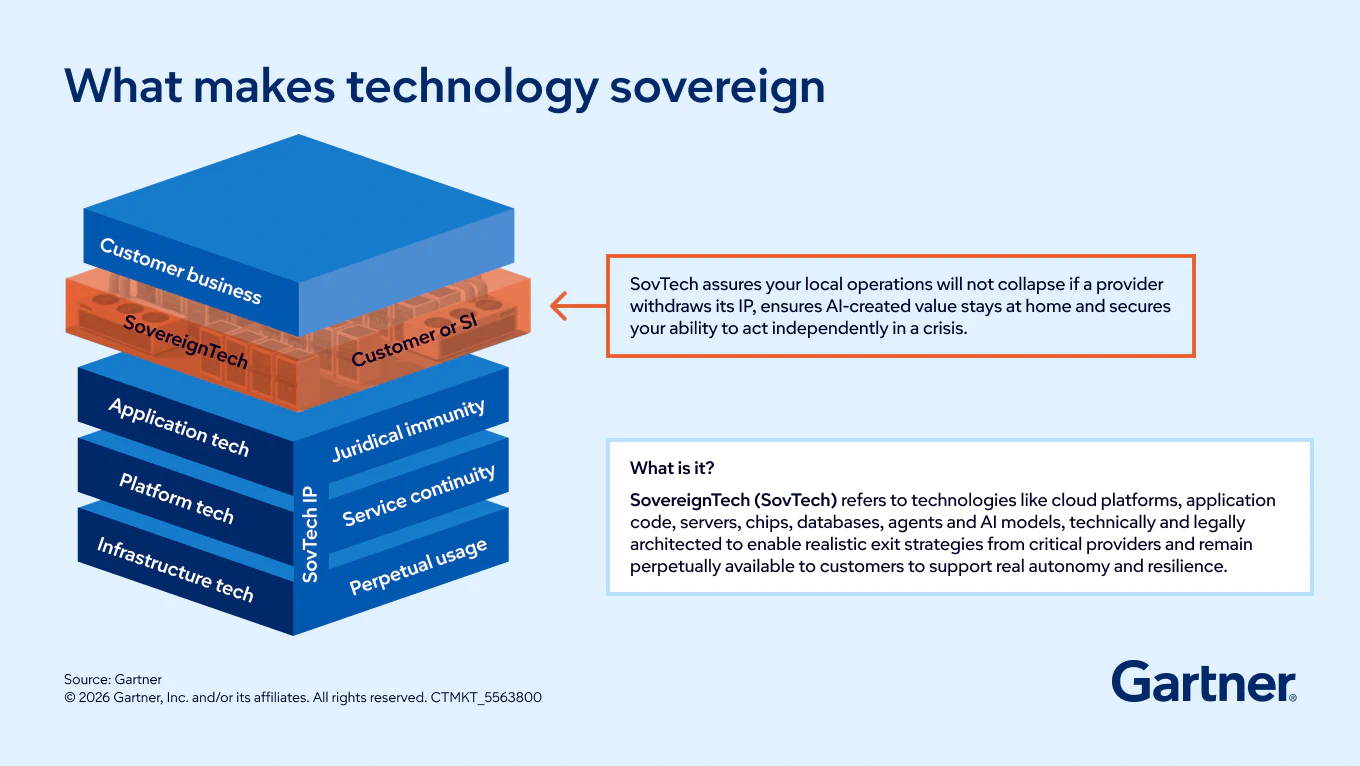
SovereignTech, one of the Gartner Top Strategic Technology Trends for 2027, reflects a growing shift in how organizations approach resilience and operational autonomy. It refers to technologies that are legally and technically architected to support realistic exit strategies from critical providers.
In fact, by 2030, more than 75% of regulated organizations outside the U.S. and China will adopt digital sovereignty strategies, shifting critical workloads to reduce geopolitical and vendor lock-in risks.
“The trend underscores a recognition that resilience depends not only on where data resides, but also on whether organizations can continue operating when access to critical technology is disrupted,” explains Gregor Petri, Distinguished Vice President Analyst at Gartner.
You might also like this webinar: The Gartner Top Strategic Technology Trends for 2027
Why SovereignTech changes the resilience conversation
SovereignTech shifts the focus from data location to technology availability. Its goal is not simply to help organizations leave a provider. It is to ensure they can assure continued access to critical technologies and maintain continuity when disruptions occur.
The real challenge is replacement, not exit
For years, moving workloads to global cloud providers was a rational decision. However, this approach also created dependencies on providers whose governments can compel access to services or restrict them. At the same time, popular as-a-service models frequently concentrate both intellectual property ownership and service delivery within a single provider.
As a result, organizations must think beyond the ability to walk away from a provider. They must ensure they have realistic alternatives that can sustain critical operations. SovereignTech addresses this challenge by emphasizing legal and architectural guarantees that reduce dependence on single proprietary sources of technology.
Foreign AI dependence may weaken national trade balances
As AI becomes a primary source of economic value creation, technology dependencies carry greater operational and economic consequences.
Organizations increasingly rely on external AI platforms, models and cloud services to deliver that business value. This can create exposure to service disruptions at a nationwide level, while increasing recurring subscription, API cost and token-based fees to levels that national economies cannot sustain long term.
The stakes extend beyond cost. Proprietary data used to train external AI models may become permanently absorbed into those models’ weights. As AI becomes more embedded in business operations, leaders should evaluate not only the capabilities they gain but also the long-term control they may be giving up.
Four actions leaders should take now
Take these practical steps to strengthen sovereignty and resilience:
- Track distributed sovereign delivery options. Monitor distributed, on-premises and ecosystem-driven delivery models and assess how providers, regulators and industries are supporting sovereign alternatives.
- Engage vendors directly. Evaluate vendors’ openness to sovereign delivery models and their participation in emerging sovereignty initiatives. Regularly test these commitments as offerings evolve.
- Follow sovereignty alliances. Track developments from initiatives such as the Trusted Tech Alliance, U.S. Pax Silica and the EU Tech Sovereignty Package to understand how sovereignty expectations are changing.
- Master lean innovation. Use n-1 technologies creatively, collaborate with trusted partners and focus national innovation efforts in areas where competitive differentiation can be maintained despite sovereignty-related constraints.
Keep in mind that some frontier technologies may never be available on sovereign terms. Organizations that plan around those limitations rather than ignore them will be better positioned to maintain operational autonomy during periods of disruption.
SovereignTech FAQs
What is SovereignTech?
SovereignTech refers to technologies that are legally and technically architected to support realistic exit strategies from critical providers and remain available over time. It helps organizations reduce vendor lock-in and maintain access to mission-critical technology.
Why is SovereignTech becoming important?
Growing geopolitical uncertainty, regulatory requirements for continuity planning, increased dependence on cloud and AI providers and concentrated technology ownership have elevated the risks associated with service disruptions and vendor lock-in.
What actions should leaders take regarding SovereignTech?
Gartner recommends tracking distributed and sovereign delivery models, engaging vendors about sovereignty capabilities, following sovereignty-focused alliances and using lean innovation approaches that leverage n-1 technologies when frontier capabilities are unavailable on sovereign terms.
Attend a Conference
Experience CIO and IT Executive conferences
With exclusive insights from Gartner analysts on the latest trends, sessions curated for your role and unmatched peer networking, Gartner conferences help you accelerate your priorities.
22 – 23 Feb 2027
Gartner CIO Leadership Forum
Phoenix, AZ

Drive stronger performance on your mission-critical priorities.