Explore how software leaders can maximize value and cut through the hype.
- Gartner client? Log in for personalized search results.
Investing to maximize value in software development
Software engineering leaders are under pressure to deliver measurable impact. AI-powered tools, new productivity platforms and security innovations flood the market, but not every investment pays off. Gartner business and technology insights show that only 35% of software engineering leaders report significant ROI from AI in the software development life cycle (SDLC). The core challenge: Separating high-value bets from hype and building the foundations to scale what works.
Six trends define high-impact technology adoption in 2026
There are six trends shaping your adoption strategy. Here’s what to watch out for:
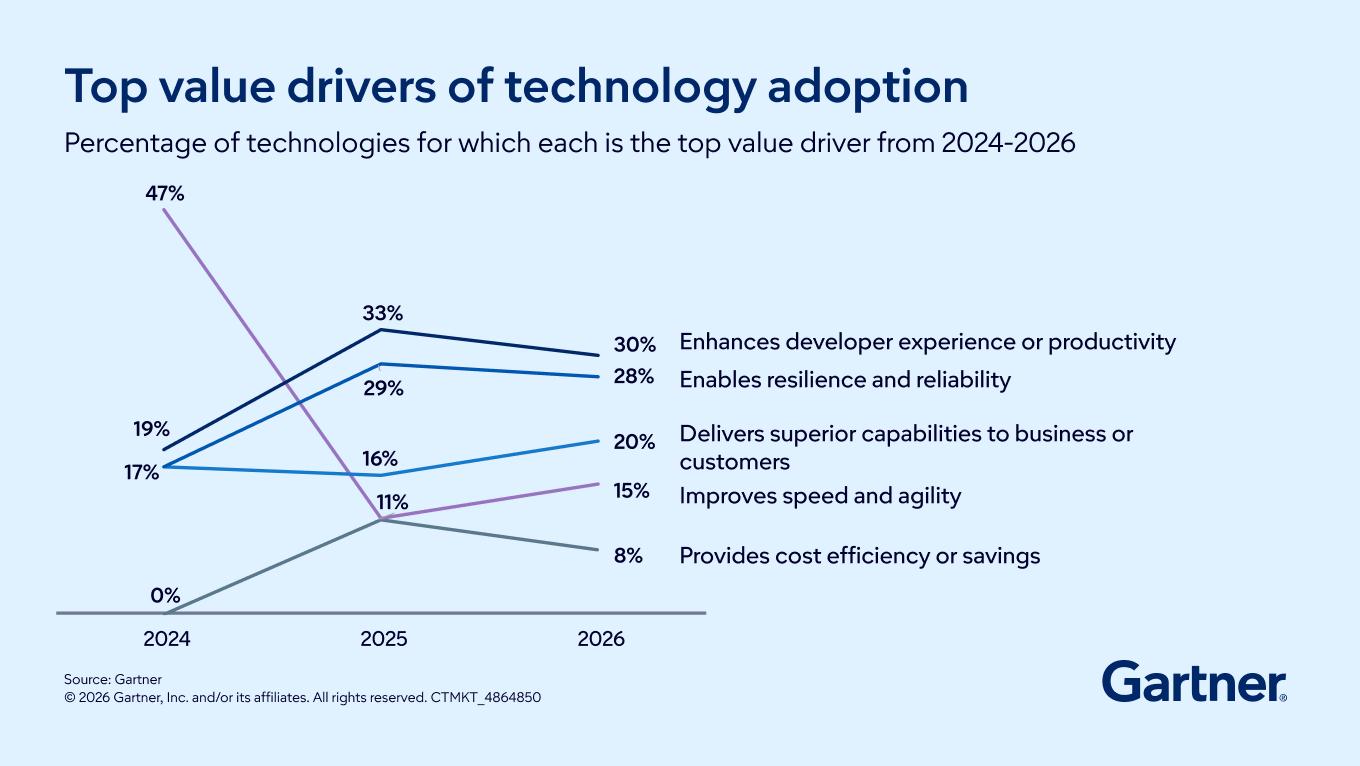
Enhancing productivity and developer experience drives technology adoption
The 2026 roadmap is clear. Enhancing productivity and developer experience is the leading value driver for technology adoption for the second year running. Platforms like cloud development environments, DevOps platforms and developer productivity insights platforms are rated as high-value. But targeting improved productivity isn’t enough — you need to translate those gains into measurable business outcomes like cost savings or shifting teams to higher-value work. The answer: Focus on demonstrated value tied to business results, and invest in the operating model changes and upskilling needed to turn new tools into real impact.
Architectural complexity remains the top adoption barrier
Technical incompatibility and architectural complexity block progress for 35% of surveyed technologies, which is the biggest barrier for three years straight. Legacy dependencies, fragmented systems and inconsistent data models sabotage integration. Even strong architecture practices can fail without clear ownership and governance. Leaders should systematically eliminate legacy dependencies, standardize data models, and improve service and data discoverability through better documentation and governance.
Most AI tools stall at pilot phase without strong foundations
Despite the AI hype, most tools remain stuck in pilots. Why? Only a few organizations have the technical foundations for scale: scalable infrastructure, quality data pipelines, seamless integration and robust security. Platform engineering is emerging as a key part of the strategy — internal developer platforms and DevOps platforms enable secure, efficient and consistent integration of AI. More than half of platform technologies are rated high-value, and 75% are in advanced piloting or deployment. Leaders who invest here deploy AI at scale and realize higher returns.
AI agents gain traction but cost unpredictability is a risk
AI agents promise big productivity gains but come with unpredictable costs. As agents manage tasks independently, expenses from token usage, APIs and cloud fees can escalate fast. To control costs, leaders should proactively monitor spending, use GenAI model routers to optimize resource allocation and regularly review deployments. The right approach keeps AI agent initiatives sustainable and aligned with business goals.
Security technologies reduce friction and boost resilience
Emerging security solutions like API threat protection and supply chain security are automating risk detection and compliance — improving resilience without slowing developers. AI-augmented testing and security code assistants are in advanced piloting, helping teams catch issues earlier. To maximize impact, embed security automation in CI/CD pipelines and workflows, and invest in training and governance to keep pace with evolving threats.
Experience and design investments remain undervalued
Most leaders rate experience and design technologies as lower-value, which is a risky oversight. GenUI frameworks and intelligent applications enable users to understand, guide and intervene in agent behavior, making AI outputs more trustworthy and effective. Prioritizing these technologies supports personalized, role-aware experiences and mixed-initiative collaboration, where humans and AI agents seamlessly share work. Don’t underestimate the UX challenge in scaling agentic AI.
Ready to move from pilots to impact? Focus on these three actions:
Prioritize high-value platforms. Invest in cloud development environments, DevOps platforms and developer productivity insights platforms with proven ROI.
Simplify architecture. Eliminate legacy dependencies, standardize data and clarify ownership to unlock integration.
Build AI foundations. Develop platform engineering, data readiness and security protocols to scale AI beyond pilots.
Technology adoption ROI FAQs
How can software engineering leaders maximize technology adoption ROI?
Focus on high-value platforms that boost productivity and developer experience, like cloud development environments and DevOps platforms. Simplify architecture to reduce integration barriers, and invest in platform engineering, data readiness and security protocols to scale AI. Regularly review technology performance and adjust investments with guidance from Gartner insights.
What are the biggest risks to technology adoption ROI in software engineering?
According to Gartner, architectural complexity and technical incompatibility are the top risks for 35% of technologies. High or unpredictable costs, especially for AI agents, and undervaluing experience and design investments also threaten ROI. Leaders should address these by simplifying architecture, monitoring costs and prioritizing user experience.
Why do most AI tools stall at the pilot phase in software engineering?
Without scalable infrastructure, quality data pipelines, seamless integration and robust security, AI tools remain stuck in pilots. Gartner insights reveal that platform engineering and investment in foundational technologies enable teams to deploy AI at scale and realize higher returns.
Attend a Conference
Accelerate growth with Gartner conferences
Gain exclusive insights on the latest trends, receive one-on-one guidance from a Gartner analyst, network with a community of your peers and leave ready to tackle your mission-critical priorities.

Drive stronger performance on your mission-critical priorities.