Data and analytics (D&A) leaders face a growing range of ontology offerings in the market. Microsoft’s Fabric IQ updates aim to give agents the business context to make faster, more informed decisions in real time. The key question is whether these capabilities are mature enough for broad deployment.
- Gartner client? Log in for personalized search results.
Fabric IQ ontology updates still need business expertise
On Tuesday, 29 September, Microsoft announced a plethora of updates to its Fabric Real-Time Intelligence and IQ series of offerings at FabCon Barcelona. For the enterprise context layer, the most significant updates were for Microsoft’s Fabric IQ ontology offering.
Note: This is Gartner’s first take on the announcement.


What does this mean?
Microsoft Fabric is moving beyond analytics toward a governed, real-time intelligence layer for AI agents. But with most new features being in preview, D&A leaders should view Fabric IQ as a promising work in progress but not a ready-to-deploy solution.
What you need to know about Microsoft Fabric IQ
The announced updates include the following new features in public preview:
Unified semantic modeling. Ontologies can reuse Microsoft Power BI measures, calculated columns and other model definitions without copying the underlying metadata. Simplifying bindings to large numbers of existing semantic models is a frequent client request raised in our Analyst Consultations.
AI-assisted ontology creation and management. A conversational agent can use available data, metadata, semantic models, documents and industry context to propose entities and relationships during the whole ontology life cycle, lowering the expertise and time needed to build and maintain an ontology. Proposals remain subject to review and approval by a subject matter expert, keeping a human in the loop.
Governance across the ontology life cycle. New capabilities improve ontology integrity and maintainability through reusable components, domain organization with namespaces, inherited definitions, versioning, rollback, auditability and the detection of changes to underlying schemas and bindings.
Open standards and developer experience. Microsoft affirmed its commitment to Apache Ossie (incubating) for exchanging semantic metadata. Ontologies can now import and export Resource Description Framework (RDF) definitions, fit into Continuous Integration and Continuous Delivery (CI/CD) and Git workflows, and be created, managed and queried through REST APIs, SDKs and Model Context Protocol (MCP) endpoints.
Natural-language business rules and agent context. Rules and policies can be attached to ontology entities and relationships in natural language to provide additional context for agents. Effective governance will be needed to identify and resolve contradictions between these rules and the ontology’s formal model.
Fabric IQ uses AI to address the ontology cold-start problem
A major barrier to enterprise ontology adoption is the effort required to establish and maintain an ontology, commonly known as the “cold-start problem” when referring to its initial creation. Fabric IQ addresses this challenge across the ontology life cycle with no-code visual tools and AI-assisted capabilities that enable business experts to build, update and govern ontologies with less reliance on specialist engineers.
Fabric IQ introduces a proposal-first pattern for AI-assisted modeling. The ontology agent inspects Power BI semantic models, Microsoft OneLake schemas and unstructured documents to propose entities, relationships and natural-language rules. The approach keeps a subject matter expert in the loop and addresses the cold-start challenge.
Although these approaches can accelerate initial implementation, they may inherit gaps in the source material and produce siloed or incomplete representations of complex business domains. D&A leaders should consider complementing bottom-up discovery with top-down, use-case-oriented modeling to develop a more comprehensive business representation.
Microsoft’s four IQ products add context (and complexity)
Microsoft Fabric IQ, Work IQ, Foundry IQ and Web IQ provide complementary forms of context for AI agents, spanning business data, workplace activity, enterprise knowledge and web information. The significance of the announcements is not the individual capabilities, which Microsoft has introduced progressively, but their emerging role as a combined context architecture for organizational AI.
These products could collectively provide agents with richer organizational context. However, each IQ workload currently operates as a distinct capability, creating two challenges for D&A leaders:
Entity alignment and conflicting context: The same customer, product or business unit may appear across multiple IQ products, but a shared identity-resolution mechanism is not yet available to ensure that each reference represents the same entity. Agents may therefore need to reconcile discrepancies themselves, increasing the risk of inconsistent decisions and unsupported outputs.
Authority and governance: Work IQ and Web IQ infer context from content and usage. Although useful, these sources should not be treated as authoritative for business definitions or governed operational decisions.
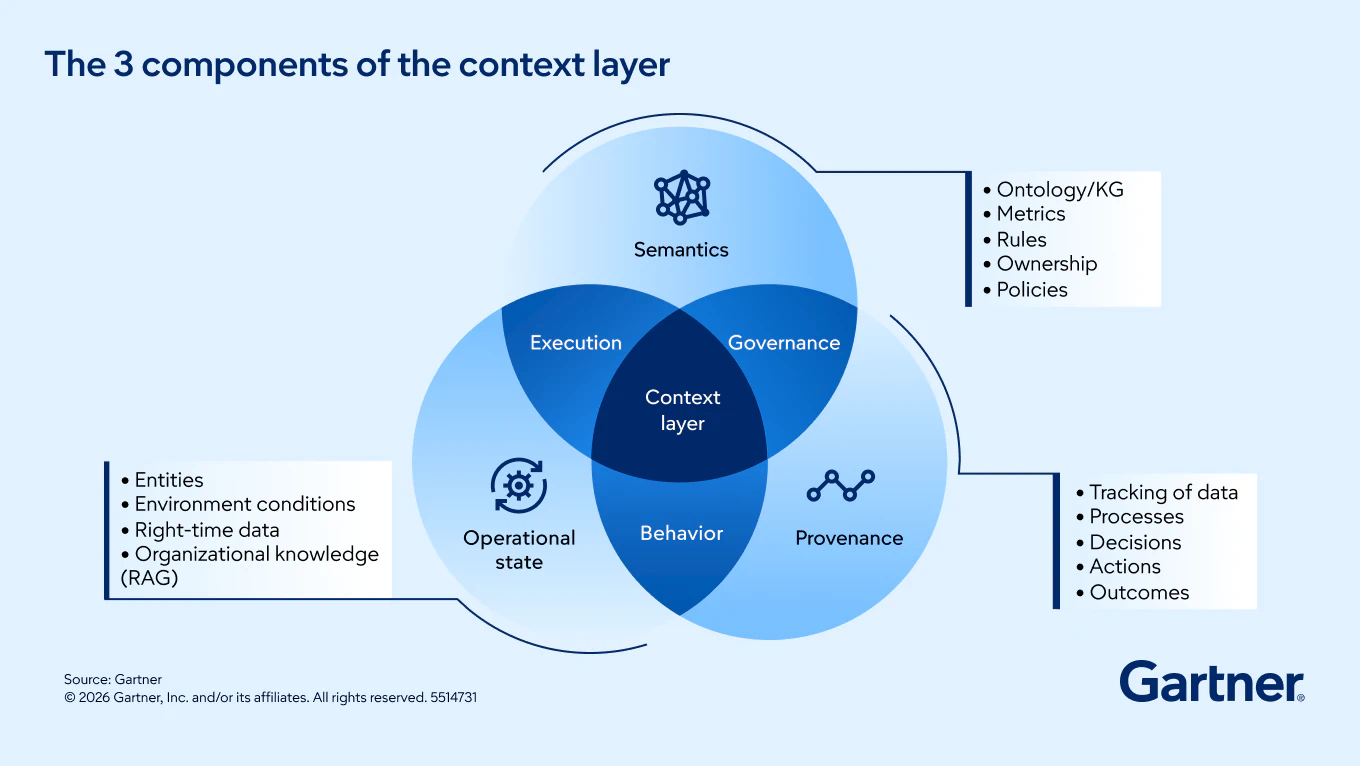
Fabric IQ provides business context grounded in analytical, real-time and operational data, translating that data into business concepts, objectives and rules. Its ontology is positioned as a candidate for an authoritative semantic backbone within the IQ family. Its practical ability to reduce conflicting context and unsupported agent outputs will depend on integration with other IQ sources, with new capabilities like IQ Share and effective governance.
Operations agents turn real-time analytics into real-time action
Fabric is extending analytics into operational intelligence. Microsoft has presented a clear vision of how agents can provide real-time actionable intelligence based on proactively analyzing data across complex environments. Gartner defines this usage of agents as perceptive analytics.
Operating within the Microsoft Fabric Real-Time Intelligence Framework and generally available since the June 2026 build, these agents automate the observe, analyze, decide and act cycle, enabling organizations to transform real-time data streams into actions.
The new features related to these capabilities include:
External access to ontologies through APIs, SDKs and MCP endpoints
Graph analysis of relationships and ripple effects
Operations Agent investigator insights that detect anomalies, identify causes and suggest remediation
These capabilities enable agentic solutions that respond to changing conditions in time-sensitive operational environments, where delayed decisions can have significant business impact. Full autonomy remains out of reach; Operations Agents depend on scheduled execution and known data sources, cannot yet collaborate with other agents and are not designed for long-horizon tasks. D&A leaders should include Operations Agents in technology roadmaps as an emerging capability for improving operational responsiveness, while planning for continued human oversight and platform maturation.
Start small with Fabric IQ, but keep your options open
Before committing to Fabric IQ, assess the type of ontology your use cases require. Fabric IQ is currently optimized as a Power BI extension for operational workloads within Fabric. That differs from formal RDF and Web Ontology Language (OWL) ontologies, which use logical rules and offer broader portability. Microsoft’s RDF import and export may improve interoperability, but RDF support alone does not guarantee OWL-level semantic richness.
With these considerations in mind, D&A leaders should use the following recommendations to guide Fabric IQ adoption:
Adopt Fabric IQ incrementally. Target use cases that can benefit from its current capabilities, while treating broader adoption as a future option.
Combine bottom-up discovery with top-down modeling. Fabric IQ can accelerate ontology creation from Fabric data sources and existing Power BI semantic models, which may produce incomplete or siloed representations. Add business-led definitions of key entities, relationships, properties and rules.
Plan for SME validation of AI-assisted ontology creation. Integrating AI capabilities to assist in ontology construction is a recognized best practice. Fabric IQ AI-generated proposals can accelerate ontology development, while subject matter experts remain essential to validate business meaning and approve authoritative definitions.
Establish a governed semantic backbone. Use Fabric IQ to define authoritative business entities and rules across priority use cases, while testing whether it can maintain consistent meaning across IQ products and AI agents. Do not assume it will prevent conflicting context or unsupported outputs without additional governance.
Attend a Conference
Experience Data and Analytics conferences
With exclusive insights from Gartner analysts on the latest trends, sessions curated for your role and unmatched peer networking, Gartner conferences help you accelerate your priorities.
8 – 10 Mar 2027
Gartner Data & Analytics Summit
Orlando, FL

Drive stronger performance on your mission-critical priorities.