Cost-cutting is non-negotiable for many leaders, but here’s why AI-driven reductions require caution (and what to do instead).
- Gartner client? Log in for personalized search results.
Why Your Headcount Strategy Matters More Than AI Downsizing
By Helen Poitevin and Nate Suda | January 23, 2026
Recognize the pressure and reframe your AI-driven headcount expectations
Executive leaders are under intense pressure to deliver cost savings, often through headcount reduction. For many, this is not optional; it’s a board-level mandate. AI is frequently seen as the lever to make these cuts painless. The reality? AI productivity gains are rarely sufficient to enable frictionless reductions without risk.
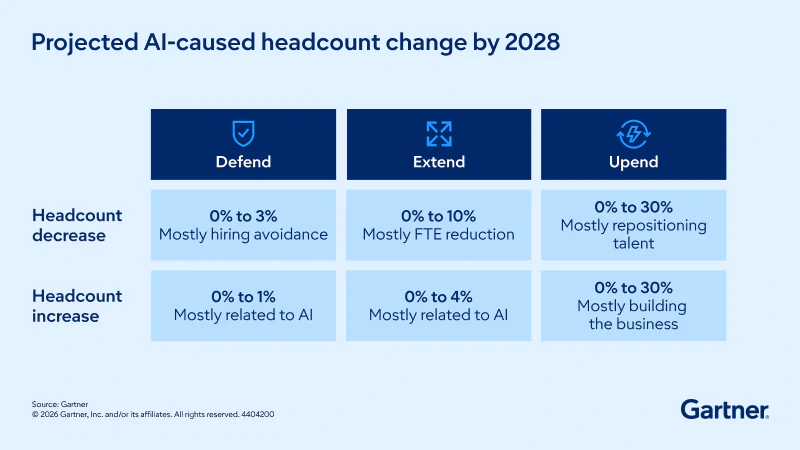
Gartner predicts that, through 2028, AI investments can lead to a net headcount increase within an enterprise — potentially as high as 30% in some business units, but typically under 10% for knowledge worker roles as a whole — driven by decreases in certain jobs and increases in others. That’s because realizing value from everyday AI has little impact on headcount, while disruptive, game-changing AI that upends the business is often more likely to create new types of roles.
If headcount reduction is unavoidable, base decisions on realistic assessments of AI’s impact — not hype. Overestimating what AI can deliver, or ignoring readiness gaps, can lead to operational risks and costly reversals. Headcount targets should be guided by enterprise strategy, AI ambition and talent strategy.
Set headcount expectations based on business use cases
Currently, organizations are embracing AI for three primary business cases — each of which has a distinct workforce impact.
Defend: Organizations augment individual productivity to stay competitive. Defending creates value in the form of return on employee (ROE).
Since employees are generally doing the same work following the same workflows (though assisted by AI), productivity gains are often materially lower than expected. The resulting AI-driven headcount reductions are about 0% to 3%.
Extend: Organizations leveraging AI to extend their value use the technology to transform existing processes or teams for competitive differentiation. Extending organizations creates return on investment (ROI).
Employees do different work, in redesigned roles, and with different processes and tools. The focus is on creating a more effective department, division or business unit. Depending on how it is applied, headcount reductions typically reach up to 10%, though there may also be headcount increases of up to 4% as process transformation creates new roles. In some exceptional cases — such as highly automated contact centers with strong operational metrics — reductions can be far higher, even up to 50%.
Upend: Organizations create new value propositions, products or markets. Value comes in the form of a return on the future (ROF).
Employees are taking on new work, in newly defined roles and with new sets of tools. The focus is on operating model effectiveness. While upending the organization through AI can cut as many as 30% of existing roles, it may also create just as many. Most redistribution will occur at the organizational level, not through seamless one-to-one transitions. Large-scale repositioning is possible, but individual redeployment will remain limited and challenging.
Evaluate your AI readiness
An organization’s AI readiness affects whether it will be at the low or high end of the range for headcount reductions associated with a given AI value strategy. Realizing value from AI will take longer and require more effort in organizations with high risk and low readiness across the following key factors, compared to those with low risk and high readiness:
Business value and impact: Consider how mature and standardized your processes are, whether they drive differentiation and if your organization is prepared for change.
Investments: Assess team skills, data quality for AI, technology alignment and whether platforms can scale as business needs evolve.
Complexity: Evaluate the complexity of your processes, the extent to which work relies on tacit knowledge, and the maturity of AI governance and security.
Define your approach to AI-driven headcount adjustments
Once you understand your AI ambition and AI readiness — and their likely impact on your talent needs — select a strategy for rightsizing your organization’s headcount.
AI-driven headcount strategies come in three forms. A given organization may focus on one approach everywhere or deploy all of them in different business units or functions. They are:
Restrain hiring: Already in use now, this approach is feasible when experienced staff can, with AI, do the same or more work without support from junior staff.
Reduce headcount: Not yet used at scale, organizations can reduce headcount if AI significantly increases the skills of the most junior workers.
Reposition FTEs: Happening in technology, consulting and professional services firms, repositioning involves the redistribution of talent from low-performing business lines or functions into net-new AI revenue streams.
Shift the AI-value narrative away from headcount reductions, without ignoring reality
Headcount reduction may be necessary, but executive leaders should model their headcount based on the enterprise’s AI ambition, strategy and AI readiness. At the same time, repeat early and often that headcount reduction is not the only way — or even the primary way — to realize value from AI investments. Instead, consistently highlight all the forms of value that AI brings, including cost reduction and revenue growth.
FAQs about headcount reductions from AI
How should you reset expectations about reducing headcount using AI?
The C-suite often focuses only on financial ROI from AI, whereas many organizations are focusing on AI initiatives that instead deliver return on employee (ROE). That is, they deliver indirect financial benefits in the form of helping employees do more, higher quality work. These investments produce an employee benefit, but the headcount impacts are minimal — to the order of 0% to 3%, often at the low end of that range.
For significant ROI, organizations need to make targeted investments with a scope that reaches beyond individual productivity tools.
How can you use AI to reduce organizational costs?
Reducing costs using AI starts with the line items on the budget. Focus on initiatives that have direct financial impact, such as preventing fraud, negotiating more favorable supplier terms or improving cash-flow forecasts. By emphasizing loss reduction, risk mitigation and capital efficiency, executives can leverage AI to reduce top-line expenses, improve balance sheets and cut operational costs. AI is a powerful tool for these types of tasks, which are themselves more measurable and less risky than cutting jobs.
Attend a Conference
Accelerate growth with Gartner conferences
Gain exclusive insights on the latest trends, receive one-on-one guidance from a Gartner analyst, network with a community of your peers and leave ready to tackle your mission-critical priorities.

Drive stronger performance on your mission-critical priorities.