Drive AI value fast. Start with a clear roadmap, upskill for AI and elevate your team’s impact.
- Gartner client? Log in for personalized search results.
![[ALT TEXT]](https://emt.gartnerweb.com/ngw/globalassets/en/marketing-communications/images/infographics/ccos-checklist-a-3-step-approach-for-ai-transformation.webp "CCO's checklist: A 3-step approach for AI transformation")
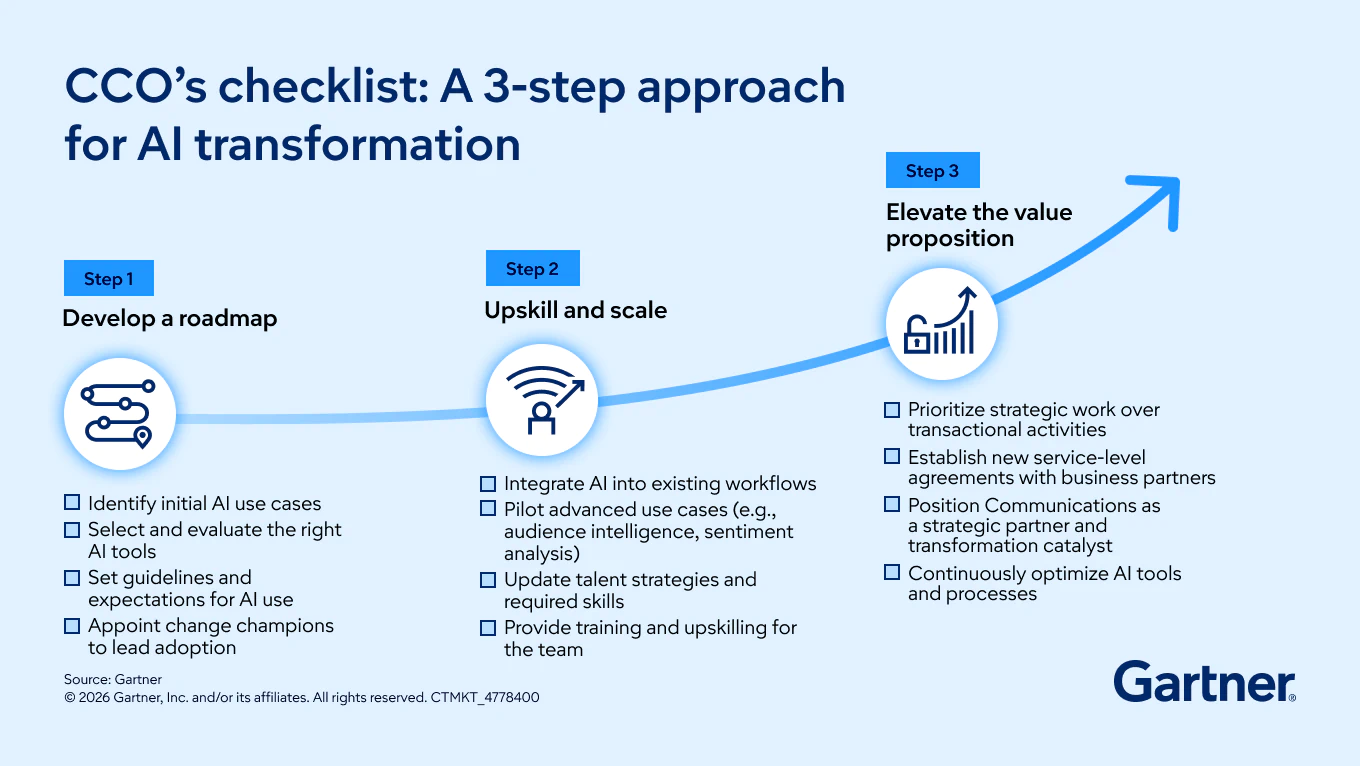
CCOs face urgent pressure to deliver AI-enabled value
Chief communications officers (CCOs) are under the spotlight. According to Gartner, 77% of CEOs and senior business executives cite AI as the key technology to drive future business growth and resiliency. The pressure is real — boards, regulators and stakeholders expect you to lead on digital trust now.
CCOs can accelerate AI transformation with three strategic actions
CCOs need to move fast — but without a plan, AI adoption and the return on investment can stall. The opportunity? A three-step framework to build credibility and value.
Develop a roadmap for responsible AI adoption.
Start with a clear, actionable plan. Build a roadmap that includes: a list of initial use cases and related tools, AI usage guidelines and expectations, and regular forums led by change champions for learning and discussion. Set early adoption goals and define productivity success measures. This approach creates clarity and confidence while demonstrating to stakeholders that you’re serious about responsible AI and digital trust.
Upskill teams and scale AI utilization in workflows.
AI is only as powerful as your people. Integrate AI into existing workflows — think drafting, editing and content creation. Identify next-level use cases, such as audience intelligence and advanced analytics. CCOs who upskill and scale AI see faster gains in efficiency and trust, so update your talent strategy to develop a team ready to deliver higher value.
Elevate the communications value proposition with AI.
AI should free your team to focus on high-value work. To make this real, update workflows, role descriptions and service-level agreements to emphasize strategy, narrative development, audience intelligence and creative production. Prioritize optimizing AI itself, so your team spends less time on routine tasks and more on work that drives trust and business outcomes.
CCO action plan: Next steps to drive transformation
Ready to accelerate?
Draft your AI adoption roadmap with clear use cases and guidelines.
Integrate AI into daily workflows and invest in upskilling.
Redesign roles and processes to focus on strategy and creative value.
Measure and communicate progress.
Track adoption rates, productivity gains and stakeholder trust metrics. Be sure to also plan frequent, periodic reviews — share wins and lessons learned to build ongoing credibility.
What’s next?
Capturing and demonstrating value from AI investments is just one of several imperatives that CCOs must navigate to fully deliver on the mission‑critical priority of transforming the communications function through AI. The other steps in this journey include:
Drive adoption of AI within the communications function through development and implementation of change management tactics. Examples include training programs and incentive structures that encourage sustained, productive use of AI tools across the team.
Prioritize and implement AI use cases, evaluating their potential value and feasibility, including their alignment to strategic goals and potential ROI. Then plan and execute pilot projects for top use cases.
Redefine the work of communications within an AI-enabled enterprise by reimagining roles, processes and workflows to maximize efficiency and impact in an AI-driven business context.
- Understand AI risks and opportunities for the communications function by assessing and planning to manage or capitalize on emerging risks and opportunities that AI presents for the communications function.
Government leaders are exploring many of the same AI opportunities, but within a distinct environment of public accountability, regulation and mission outcomes. Discover how public sector executives are turning AI investments into measurable value while managing risk and building stakeholder trust.
CCO AI transformation FAQs
What should a CCO’s AI adoption roadmap include?
List initial use cases, select related tools, set usage guidelines and expectations, and create regular forums for learning. Early adoption goals and clear productivity measures help demonstrate responsible progress.
How can CCOs upskill teams for AI-driven communications?
Integrate AI into daily workflows like drafting and editing. Identify advanced use cases, such as audience intelligence, and update talent strategies to build teams ready for higher-value work as this delivers faster trust and efficiency gains.
Why does elevating the communications value proposition matter for AI transformation?
Elevating the value proposition is the end goal in AI transformation. AI lets teams focus on strategy, narrative and audience insights. Updating workflows and roles to prioritize high-value work boosts trust and business impact — while routine tasks are automated or optimized.
Attend a Conference
Accelerate growth with Gartner conferences
Gain exclusive insights on the latest trends, receive one-on-one guidance from a Gartner analyst, network with a community of your peers and leave ready to tackle your mission-critical priorities.

Drive stronger performance on your mission-critical priorities.