Progress, not perfection, across seven dimensions of maturity drives real impact through communications measurement and analytics.
- Gartner client? Log in for personalized search results.
Communications analytics maturity starts with small, strategic steps
Strong communications measurement and analytics (CMA) capabilities are baseline requirements for driving faster, more accurate decisions, safeguarding reputation, elevating communications’ strategic value and maximizing business impact.
However, most communications functions measure their team’s output or content performance in an attempt to prove the value of the work that was done — often retrofitting their data incorrectly to fit their narrative of communications’ success. Instead, all CMA should be focused on improving the quality of current and future decisions.
You might like this webinar: The Path to Communications’ Data and Analytics Maturity
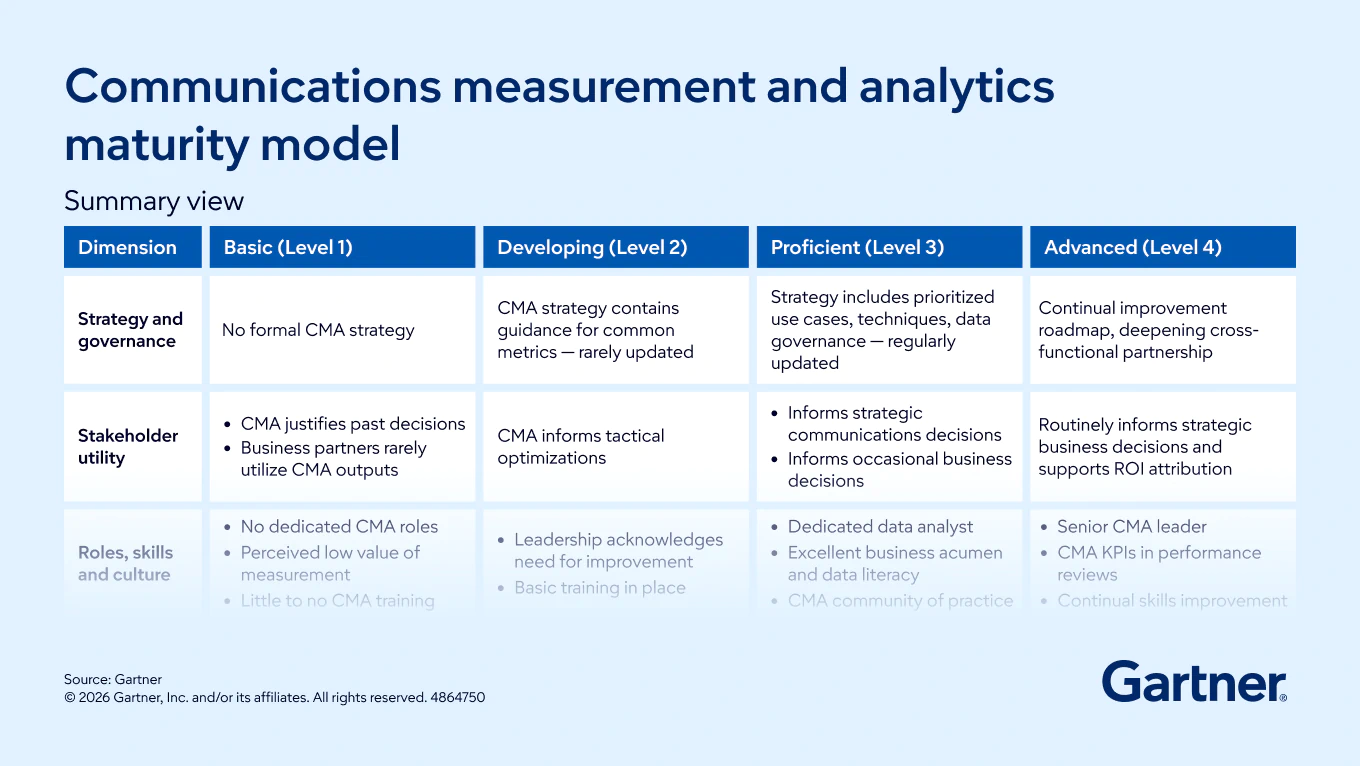
Communications analytics maturity model: Four levels, clear actions
According to Gartner, chief communications officers that allocate more than 5% of their budget to CMA are 1.5 times more likely to be perceived as value centers than teams that allocate less. The time to invest in CMA is now. Use our detailed CMA maturity model to focus capability uplift across seven key dimensions.
Basic: Ad hoc measurement, siloed data, limited skills
Most teams start here. There’s no formal strategy, measurement is inconsistent and data lives in silos. You might track basic outputs, but there’s little alignment with business goals. The focus is to identify one or two priority metrics and start centralizing data. Don’t try to fix everything at once.
Developing: Strategy emerges, dashboards centralize data
At this stage, you’ve defined a basic measurement strategy and started governance. Behavioral metrics like actions taken come into focus. Dashboards centralize data, but analytics are still mostly tactical. The next step is to formalize governance, expand reporting and connect metrics to business outcomes.
Proficient: Prioritized use cases, outcome-focused reporting
You now have a mature strategy, strong governance and dedicated analytics roles. Data quality improves, reporting is tailored to stakeholders and you measure real impact — not just activity. The focus shifts to prioritizing use cases and embedding analytics in planning.
Advanced: Integrated data, predictive analytics, strategic influence
Few teams operate at this level. Here, analytics is embedded in every decision, data is integrated across functions and advanced techniques like predictive and prescriptive analytics are routine. Automated insights and continuous improvement define the culture.
How to advance your communications analytics maturity now
You don’t need to leap to “advanced” overnight. Gartner analysts recommend practical steps that build momentum:
Benchmark your current level using the CMA maturity model.
Align with key stakeholders on CMA improvement priorities and success metrics.
Invest in ongoing training for your team’s analytics skills.
Prioritize one or two high-impact use cases before scaling.
Build governance and data quality incrementally.
Progress over perfection: Build momentum, not barriers
The biggest risk is waiting for the perfect plan. Communications leaders who prioritize progress, however small, see faster gains in credibility and influence. Small, consistent improvements outpace stalled perfectionism every time.
What’s next?
Auditing existing communications data capabilities and gaps is just one of several imperatives that CCOs must navigate to fully deliver on the mission‑critical priority of overcoming communications’ data and analytics deficit to drive performance.
The other steps in this journey include:
Developing a compelling business case that outlines expected benefits and costs of improving communications’ data and analytics to secure funding and cross-functional support where required.
Embedding data-savvy communications teams by building confidence in data and analytics, critical thinking and data fluency, while championing continuous learning and experimentation.
Identifying technologies, vendors and partnerships to enhance communications’ data collection, analysis and reporting capabilities.
Leveraging data and analytics to transform the speed and value of decision making and create dashboards that demonstrate the impact of the communications function.
For more on how Gartner helps drive success on this and other mission critical priorities for CCOs, speak to us today.
Communications analytics FAQs
How can I advance my communications analytics maturity?
Start by benchmarking your current level using the CMA maturity model. Align with stakeholders, prioritize key metrics and invest in ongoing training. Focus on small, practical steps. Progress over perfection is key for real, sustainable gains.
Why does communications analytics maturity matter for CCOs?
Analytics maturity is critical for CCOs to secure resources, influence strategy and prove value. By 2029, analytics budgets will double. CCOs who advance now will lead in data-driven decision making.
Attend a Conference
Accelerate growth with Gartner conferences
Gain exclusive insights on the latest trends, receive one-on-one guidance from a Gartner expert, network with a community of your peers and leave ready to tackle your mission-critical priorities.

Drive stronger performance on your mission-critical priorities.