The challenge is no longer creating software but knowing when to replace it.
- Gartner client? Log in for personalized search results.
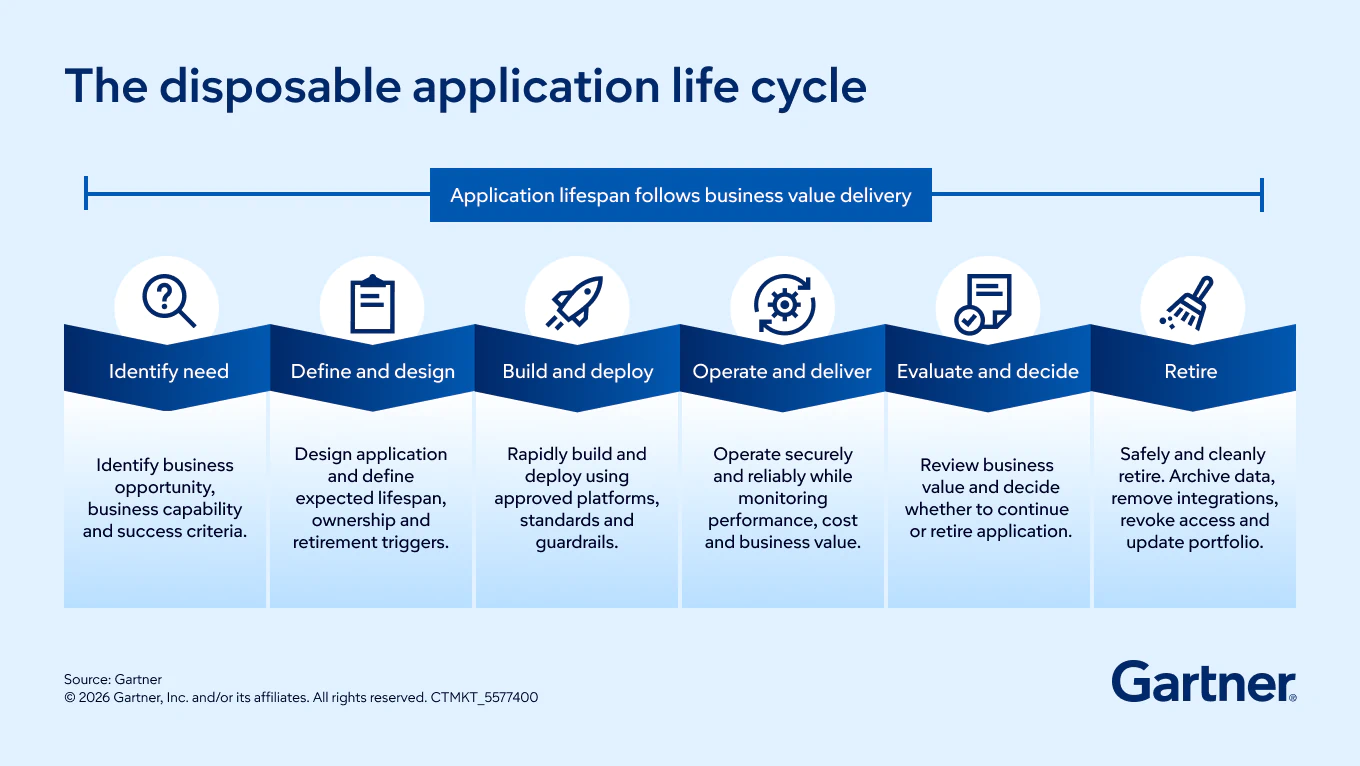
The real challenge is not building applications
Disposable applications, one of the Gartner Top 10 Strategic Technology Trends for 2027, reflect a fundamental shift in how organizations think about software. These purpose-built software applications are designed to be intentionally retired once their specific business purpose has been fulfilled or is no longer relevant. By 2031, 80% of new applications will be disposable and easy to replace.
As AI-enabled development makes applications faster and cheaper to create, the challenge shifts from building software to deciding what should endure, what should be replaced and what should be retired. Rather than treating every application as a permanent asset, leaders must align application lifespans with the business value they support and retire them when that value disappears.
“Stop building permanent monuments to temporary problems,” advises Nabeeha Ahmed, Director Analyst at Gartner. “You must actively engineer software to cleanly disappear when its job is done.”
You might also like this webinar: The Gartner Top Strategic Technology Trends for 2027
Why disposal becomes a strategic capability
Organizations do not need fewer applications. They need a better way to govern, manage and retire them. A disposable application strategy helps leaders capture the speed of AI-driven development without creating an unmanageable application portfolio.
AI changes the economics of software
Traditional IT operating models were built around software scarcity. Because applications were expensive and time-consuming to build, organizations invested heavily in maintaining them for years and continually extending their functionality.
AI changes that equation. Organizations can now rapidly create purpose-built applications for specific business objectives such as transformation programs, regulatory initiatives, product launches and other time-bound needs. As application creation accelerates, organizations risk accumulating software faster than they can govern or maintain it. This shift makes disposable applications practical. Instead of extending the life of every application indefinitely, organizations can create applications to solve a specific problem, achieve a business objective and then retire them when their purpose has been fulfilled.
The cost of keeping every application forever
Many organizations still operate with a permanence mindset, treating software as a long-term asset even when the business need it supports is temporary. As AI accelerates application creation, that approach can lead to portfolios that grow faster than the value they deliver.
A disposable application strategy replaces portfolio growth with portfolio renewal. Applications are introduced to address current business needs and retired when those needs no longer exist. The emphasis shifts from accumulating software to continuously aligning the application portfolio with business value.
This approach can help organizations sustain a manageable application portfolio, reduce long-term software ownership costs and support AI-driven application delivery without losing control of the application estate. Disposable applications can also enhance security. Rather than leaving unnecessary software in place indefinitely, organizations decommission applications once their objectives have been achieved, reducing the long-term attack surface.
Actions leaders should take now
To prepare for the emergence of disposable applications, CIOs and technology leaders should:
- Audit the application portfolio to identify which capabilities require permanent applications and which can be served by temporary, on-demand applications.
- Define application lifespans up front based on the business objectives each application supports.
- Plan for retirement from the start by ensuring disposable applications have clear end-of-life plans and retirement processes.
- Invest in supporting capabilities, such as platforms, standards, automation and retirement processes, that enable applications to be created and safely retired at scale.
- Establish a dedicated platform team to govern and manage the flow of transient software assets across the enterprise.
- Create accountability for outcomes by ensuring business owners are responsible for application costs, value and eventual decommissioning.
Disposable applications FAQs
What are disposable applications?
A disposable application is a purpose-built software application designed to be intentionally retired once its specific business purpose has been fulfilled or is no longer relevant. Unlike a prototype, it operates as a complete business solution and is designed with a planned end-of-life process.
Why are disposable applications becoming more important?
Disposable applications are emerging because AI is making software creation faster and less expensive. As organizations create more applications, they need a way to prevent application portfolios from expanding indefinitely while maintaining governance, security and operational control.
What business benefits do disposable applications provide?
A disposable application strategy can help organizations maintain a manageable application portfolio, enhance organizational agility, reduce long-term software ownership costs and scale AI-driven application delivery without losing control of the application estate.
Attend a Conference
Experience CIO and IT Executive conferences
With exclusive insights from Gartner analysts on the latest trends, sessions curated for your role and unmatched peer networking, Gartner conferences help you accelerate your priorities.
22 – 23 Feb 2027
Gartner CIO Leadership Forum
Phoenix, AZ

Drive stronger performance on your mission-critical priorities.