CIOs: Build a three-year, outcome‑driven roadmap that reduces waste, improves performance and reinvests in growth.
- Gartner client? Log in for personalized search results.
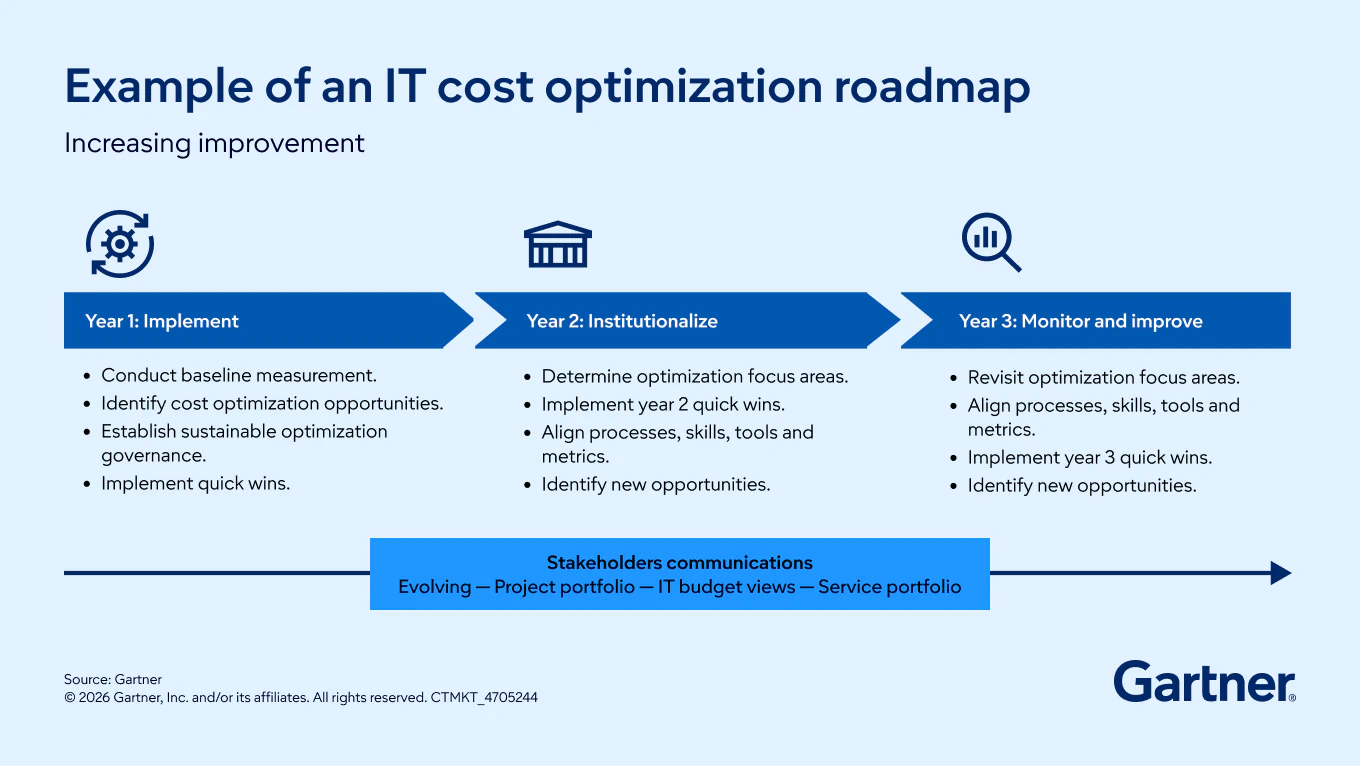
Make cost optimization continuous to fund growth
Fifty-two percent of respondents to the 2026 Gartner CIO and Technology Executive Survey identified that reducing costs will become an even more important objective over the next two years. CIOs challenged to optimize costs within IT need to invest in internal initiatives that improve IT performance to generate savings, not just cut costs.
This pragmatic, three‑year roadmap unlocks savings to fund transformation while strengthening performance and scale.
You might also like this webinar: Make Cost Optimization Strategic, Proactive and Programmatic
Why CIO‑led cost optimization must evolve now
Cloud and AI have turned a high share of IT spend from fixed to variable and fluid. Without proactive consumption management, forecasting and scenario planning, enterprises leak value and struggle to scale confidently. CIOs who reposition cost as a strategic capability — governed, measured and reinvested — create competitive advantage instead of short‑term cuts that erode capability.
The Gartner perspective: Modern cost optimization has three aims executed in parallel — reduce low‑value spend, improve enterprise performance and reinvest in future sources of value — all tied to business outcomes and run/grow/transform trade‑offs.
A 3-year plan that wins buy‑in — and results
Year 1: Assess and prove
Establish the baseline, run external benchmarks, and launch disciplined transparency and governance. Pair this with quick wins to demonstrate stewardship — tightening cloud usage, rationalizing licenses, pruning redundant applications and standardizing support tiers.
Year 2: Align and reinvest
Extend beyond IT supply‑side savings to demand management with business partners. Align to value by defining business‑valued products/services, prioritize investments tied to enterprise strategy, execute against measurable outcomes and iterate as needs evolve.
Year 3: Mature and scale
Institutionalize a community of savings and accountability across IT and the business. Carry on with continuous improvement, revisit the roadmap, and upgrade data and delivery methods as maturity rises. Show the delta between the actual budget and the hypothetical “no‑program” budget to prove value creation.
What “good” looks like in large enterprises
Leaders who excel at cost optimization:
Treat cost as a continuous discipline with shared accountability and multiyear horizons.
Maintain a strong link between cost, capability and performance, avoiding reductions that undercut differentiation.
Use scenario planning and adaptable roadmaps that are deliberately revised with stakeholders.
How to start (this quarter)
Publish a one‑page, three‑year IT cost optimization roadmap to align executives and drive prioritization. State that timing may be adjusted as needs evolve.
Pioneer outcome‑driven transparency (incorporate a baseline, benchmarking and targets) and define a recurring governance cadence.
Launch a quick‑wins portfolio focused on consumption management and rationalization with clear before/after metrics.
Channel savings into a value‑creation backlog (data platform, AI productivity, app modernization) with business‑outcome KPIs.
Where to go next to manage costs strategically
This three-year roadmap is part of the toolbox CIOs need to manage costs strategically in order to spend smarter and scale faster.
Other steps in that journey include:
Enabling financial transparency: Shifting from asset‑level tracking to outcome‑driven metrics, so stakeholders see spend in the context of the business capabilities it enables.
Reducing cost: Systematically identifying non‑value‑adding spend across portfolios (applications, platforms, licenses, support, shadow IT).
Improving performance: Redesigning workflows, consolidating redundant tools and applying automation where it lifts both productivity and consistency.
Investing in new value creation: Harvesting savings are not the outcome; it is the fuel. Reinvest deliberately in data foundations, platform modernization, AI integration, workforce upskilling and operating‑model changes that deliver measurable business outcomes — defined, prioritized and tracked against a plan of record.
For more on how Gartner helps drive success on this and other mission-critical priorities for CIOs, speak to us today.
Attend a Conference
Experience Chief Information Officer Head of IT conferences
With exclusive insights from Gartner analysts on the latest trends, sessions curated for your role and unmatched peer networking, Gartner conferences help you accelerate your priorities.
21 – 23 Sep 2026
Gartner CIO & IT Executive Conference
São Paulo, Brasil

Drive stronger performance on your mission-critical priorities.