Move beyond rigid, legacy IT operating models to orchestrate enterprisewide technology, deliver value and manage AI-driven complexity.
- Gartner client? Log in for personalized search results.
Traditional IT operating models are now a liability, not just a limitation
Designed for centralized control and predictable delivery, traditional IT operating models cannot absorb the pace of AI disruption, geopolitical volatility or the reality that technology work is now widely distributed beyond IT. This is recognized at the highest levels, with 71% of CEOs stating their IT operating models are not fit for the age of AI, while only 24% of CIOs believe their models effectively adapt to business needs. As a result, CIOs remain accountable for risk, resilience and value while lacking the control to govern how technology is actually created and scaled.
This mismatch creates a widening gap between responsibility and influence, allowing fragmentation, hidden technical debt and misaligned AI-enabled execution to proliferate. In this environment, clinging to legacy operating models does not simply slow progress, it actively exposes the enterprise to unmanaged risk, lost value and an inability to compete at the speed and scale required.
Redesign IT operating models to unlock AI value
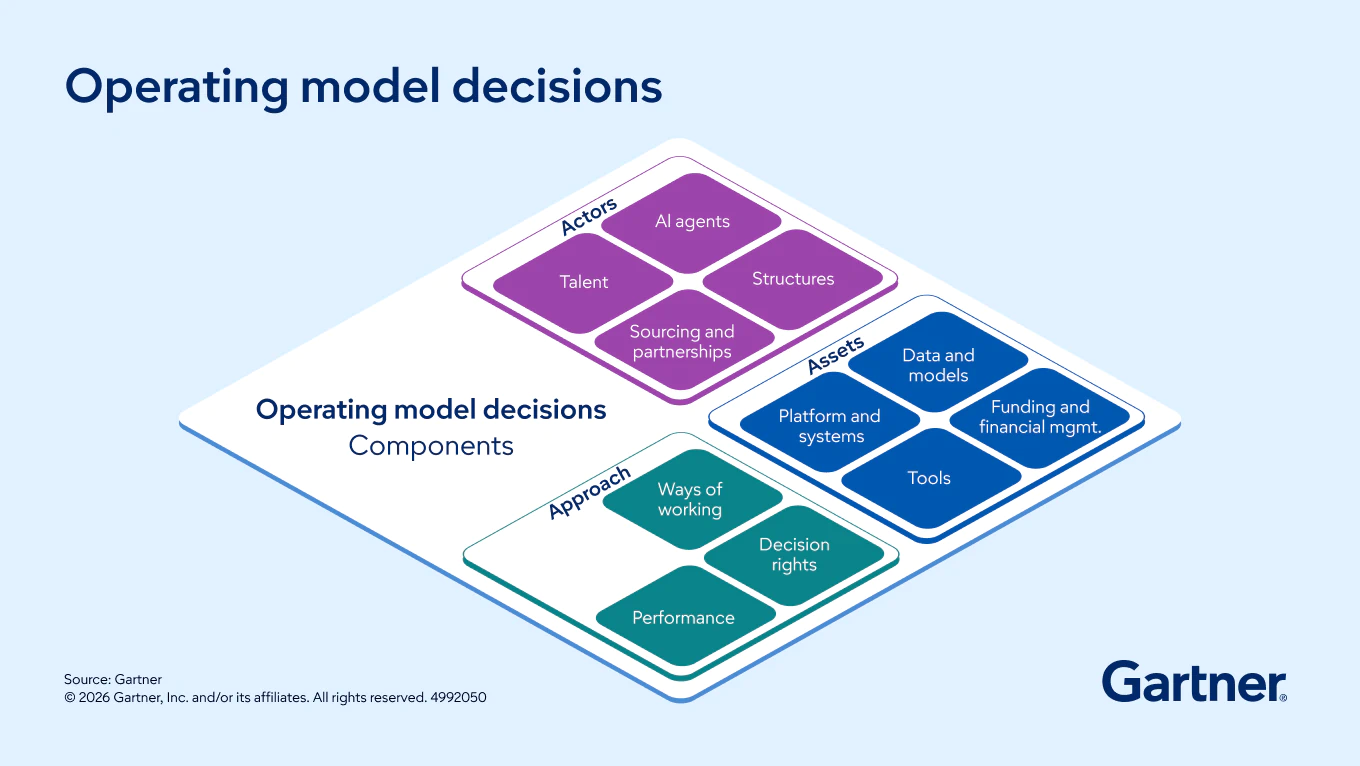
Design a technology operating model that reflects shared ownership of technology across IT, business leaders and AI-enabled actors. This requires deliberate alignment across three interconnected dimensions: actors (who do the work, including IT, business technologists and AI), assets (the platforms, data and funding that enable scale) and approach (how work is governed, measured and coordinated). By aligning these elements to business priorities, CIOs shift from delivering outputs to orchestrating enterprisewide outcomes, ensuring technology capabilities operate cohesively across functions. Done well, this transforms technology from a functional support role into a core driver of enterprise performance, capable of continuously adapting to disruption while maximizing value creation.
Design a future-ready technology operating model.
Rather than evolving incrementally from legacy structures, CIOs must deliberately select and design a technology operating model archetype that reflects the organization’s business strategy, risk posture and ambition for technology-enabled growth. Whether emphasizing efficiency, scaling output, enabling business-led innovation or expanding enterprisewide technology creation, each archetype defines a different balance of control, autonomy and collaboration.
Alignment requires ensuring that operating model components work cohesively to support this choice, enabling CIOs to reduce friction, focus investment and orchestrate technology capability at scale. Without this intentional alignment, organizations risk defaulting into fragmented delivery models that undermine both performance and enterprise coherence.
Make trade-off decisions to implement change.
CIOs cannot optimize for every objective simultaneously and must make deliberate trade-offs between cost, innovation, agility and reliability, aligning these choices to the priorities of the enterprise. The focus of the technology operating model should reflect whether the organization is pursuing efficiency, growth, customer experience or resilience, rather than attempting to achieve all outcomes equally.
Implementing this shift requires building alignment with executive peers, securing sponsorship and empowering teams to adapt within clearly defined boundaries. The scale and pace of change must match the organization’s capacity to absorb it, with clear articulation of expected benefits and ongoing measurement to ensure the operating model delivers tangible value.
Evolve rightsourcing and shared services strategies.
Sourcing and shared services are no longer just cost optimization levers, but critical design choices within the technology operating model that determine how value is created and scaled. Shared services and rightsourcing are evolving rapidly, with 71% of IT managers expecting increased use of shared services and 89% anticipating greater reliance on AI, reflecting a shift toward platform-based, AI-enabled delivery. CIOs must therefore move beyond fragmented, bottom-up sourcing decisions and adopt a deliberate, principle-led approach that aligns sourcing with enterprise priorities for value, cost and risk.
This includes focusing outsourcing on nondifferentiating capabilities while retaining strategic capabilities in-house, and increasingly leveraging AI to substitute external labor, with up to 40% of external IT resources expected to be replaced by internally enabled employees. When supported by strong governance, funding transparency and clear decision rights, shared services become a coordinated system that strengthens resilience, improves cost efficiency and accelerates enterprisewide innovation rather than fragmenting it.
Manage governance and performance at AI speed.
Governance structures must become more flexible and adaptive to balance risk management with the need for speed in an AI-driven, distributed environment. Traditional, centralized models cannot keep pace, requiring CIOs to adopt dynamic, principles-based approaches that embed guardrails, decision rights and accountability directly into platforms and ways of working.
Governance must shift from periodic oversight to continuous orchestration, with performance measures aligned to business outcomes to drive transparency and ongoing optimization of the technology operating model. At the same time, the cost of governing AI is rising, with Gartner estimating that by 2028, AI governance costs will offset 60% of the savings generated by agentic AI, reinforcing the need to design governance that scales efficiently while maintaining control and trust.
What to do next to redesign the technology operating model for effectiveness
Redesigning the technology operating model is essential to ensure technology can support changing enterprise priorities, constrained resources and rising expectations for measurable impact in an AI-driven and distributed environment. This shift moves beyond optimizing IT as a function to orchestrating technology as an enterprise capability shared across IT, business units, partners and AI-enabled actors.
The steps in that journey include:
Align the technology operating model to business value by identifying the outcomes, capabilities and priorities the enterprise needs most, and validating these with stakeholders to ensure shared ownership across IT and the business.
Design the core operating model across actors, assets and approach, defining who does the work (including business technologists and AI), what platforms and capabilities enable it and how governance, decision rights and accountability are structured.
Implement operating model changes through phased, adaptive transformation, using change management, executive sponsorship and iterative delivery to embed new ways of working without disrupting business continuity.
Rebalance sourcing and shared services as strategic enablers, optimizing the mix of in-house capability, partners and platform-based shared services to support scale, reuse and innovation across distributed teams.
Continuously manage and optimize performance, using outcome-aligned metrics and feedback loops to monitor effectiveness, drive accountability and evolve the model as enterprise needs and external conditions change.
In this context, a technology operating model defines how enterprise technology work gets done across distributed actors, aligning IT and business capabilities to deliver value, scale AI and sustain agility and resilience.
Recommended resources for Gartner clients*:
*Note that some documents may not be available to all Gartner clients.
Technology operating model FAQs
What is a technology operating model and why is it important for CIOs?
A technology operating model defines how technology work is executed across the enterprise, spanning IT, business units, partners and AI-enabled actors. It aligns actors, assets and approaches to business priorities, enabling CIOs and their peers to collectively deliver agility, innovation and resilience in an environment where technology ownership and execution are increasingly distributed.
How should CIOs adapt technology operating models for AI and rapid change?
CIOs must design flexible, AI-native technology operating models that explicitly account for both human and AI contributions to work. This includes embedding automation into workflows, accelerating decision making through distributed yet governed decision rights, and applying adaptive, principles-based governance to orchestrate enterprisewide value while keeping pace with continuous disruption.
What are best practices for rightsourcing in a technology operating model?
Best practices include focusing external sourcing on nondifferentiating capabilities while retaining strategic, value-creating capabilities in-house. At the same time, CIOs should leverage AI to scale internal capacity, reduce reliance on external labor and rebalance delivery models so that shared services, platforms and partners operate as a coordinated ecosystem aligned to enterprise outcomes.
Attend a Conference
Experience Information Technology conferences
With exclusive insights from Gartner experts on the latest trends, sessions curated for your role and unmatched peer networking, Gartner conferences help you accelerate your priorities.
21 – 23 Sep 2026
Gartner CIO & IT Executive Conference
São Paulo, Brasil

Drive stronger performance on your mission-critical priorities.