Positioning AI as a driver of efficiency and solution to CIO challenges is key to demonstrating business value.
- Gartner client? Log in for personalized search results.
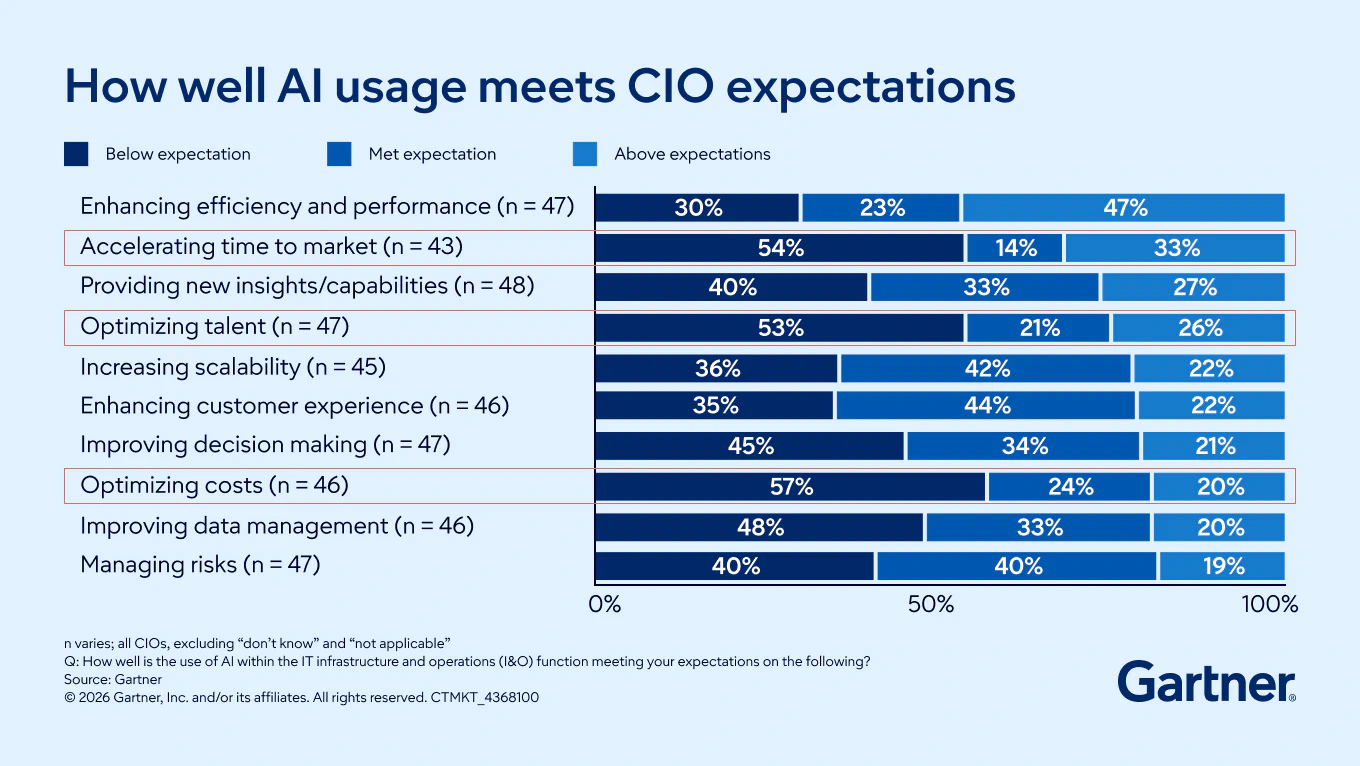
Focus on the business value of AI
Most heads of IT infrastructure and operations (I&O) report that AI usage is meeting or exceeding expectations across key drivers, such as enhancing customer experience, improving efficiency and performance, and optimizing costs. However, aligning with the CIO and clearly demonstrating the business value of these projects can be challenging. Despite their overlap, CIOs and heads of I&O often have different priorities. To move AI initiatives forward, heads of I&O need to communicate how AI addresses the CIO’s concerns and strategic focus.
Think like a CIO for AI conversations
CIOs and heads of I&O both want AI initiatives to succeed, but their perspectives and challenges often differ. CIOs focus on the broader, strategic implementation of AI, while heads of I&O are more attuned to day-to-day operations. For AI to deliver its full potential, CIOs and I&O heads must bridge this gap and adopt a joint approach to rolling out the technology.
Address the CIO-related benefits and concerns
When considering the main factors driving AI adoption in I&O, both CIOs and heads of I&O identify optimizing costs, enhancing customer experience, and boosting efficiency and performance. However, CIOs place a much greater emphasis on efficiency and performance. This broader perspective means that, when engaging with CIOs, heads of I&O should highlight how AI impacts organizational efficiency and performance above all.
While cost savings and customer experience remain important, heads of I&O should position them as enablers of efficiency and performance. For example, automating routine tasks not only reduces costs but also allows resources to be redirected to higher-value, performance-driven activities. Similarly, improved customer experience can increase retention and speed up delivery.
Increasingly, these conversations should include the rise of agentic AI — autonomous, goal-driven agents that are moving from pilots to mission-critical roles in I&O. Gartner predicts that by 2029, 70% of enterprises will use agentic AI to operate IT infrastructure, a shift that enables organizations to automate complex workflows and move from reactive troubleshooting to proactive, predictive operations. These outcomes directly align with CIO priorities for measurable business value and strategic transformation.
When presenting AI business cases to the CIO, it’s also important to discuss the risks of delayed adoption, such as increased operational bottlenecks and loss of competitive advantage. Understanding and addressing the CIO’s top concerns, even if they differ from those of I&O, will lead to more productive conversations and help advance key use cases.
Align on budget and business value
Heads of I&O face three main challenges in adopting AI: lack of budget, demonstrating business value and integrating AI with existing IT infrastructure. Budget constraints are typically a bigger concern for heads of I&O, who are closer to the realities of operational costs for technology, talent and training. While CIOs may be willing to fund successful initiatives, they often underestimate the resources required for full-scale AI deployment. This can create a disconnect between what I&O teams request and what CIOs prioritize.
Demonstrating clear business value is closely tied to securing budget. If the value is evident, funding is less likely to be an issue. However, expectations around AI can be unrealistic.
Heads of I&O should align AI initiatives with critical business drivers, such as productivity, risk mitigation and measurable value, focusing on the outcomes that matter most to the CIO.
Meet and manage CIO expectations for AI
While heads of I&O are generally satisfied with AI’s impact, CIOs often have broader, more holistic expectations. They look for AI to deliver significant cost reductions, accelerate time to market and drive meaningful improvements in workforce productivity.
Heads of I&O can take three key steps to demonstrate progress and deliver greater AI impact:
Partner with vendors to experiment instead of waiting for perfect operational data. According to Gartner, 39% of CIOs and heads of I&O cite selecting the right AI technology as a top challenge. However, waiting for the perfect conditions can delay AI initiatives and their benefits. Successful organizations partner with vendors to experiment and learn.
Integrate talent with AI, rather than simply adding AI to existing processes. True value from AI comes from redesigning workflows, processes and talent around AI — not just retrofitting AI into what already exists. Consider how roles, skills and teams will evolve alongside AI initiatives.
Expand from small, visible wins that address specific pain points, rather than spreading resources too thin. Start with projects that solve clear, immediate problems, and use those lessons to scale AI into core processes. Communicate early wins and keep teams engaged so adoption feels natural, not forced.
To meet and manage CIO expectations, heads of I&O should communicate a clear vision for workforce transformation. As agentic AI automates more complex tasks, the role of IT operators will shift from “doers” to supervisors and orchestrators. The need for manual operators will diminish, while demand for AI strategists, engineers and governance specialists will rise. Investing in upskilling teams — and positioning this as a strategic workforce evolution — will reassure the CIO that the organization is ready for the future of AI-driven operations.
Recommended resources for Gartner clients*:
Case Study: Adopt Generative AI for Service Desk Productivity
Address the Hidden Barriers to AI and GenAI Adoption
*Note that some documents may not be available to all Gartner clients.
AI for I&O FAQs
What are the top factors driving I&O adoption of AI?
The top factors driving AI adoption within IT infrastructure and operations are optimizing costs, enhancing customer experience, and improving efficiency and performance. Today, the adoption of agentic AI is also driven by the need to automate complex workflows, reduce reliance on specialized skills and enable more predictive IT operations — outcomes that directly align with CIO priorities.
What are the top challenges to AI for I&O?
The top challenges to AI adoption in I&O are lack of budget, difficulty integrating AI with IT infrastructure and demonstrating business value. With agentic AI, organizations also face new challenges: managing operational and compliance risks, ensuring robust governance and developing the skills to supervise autonomous systems. Communicating how these challenges are being addressed is key to building CIO confidence.
How can organizations overcome challenges with adopting AI for I&O?
Organizations can overcome AI adoption challenges in I&O by aligning AI projects with business goals, partnering with vendors for experimentation and focusing on measurable outcomes. To maximize the value of agentic AI, invest in engineering platforms, update vendor contracts with enforceable SLAs and proactively upskill teams. Start with high-impact automation tasks and scale as confidence and capabilities grow — always tying progress back to strategic business outcomes.
Attend a Conference
Join Gartner analysts and your peers to accelerate growth
Gather alongside I&O leaders in Las Vegas to gain insight on emerging trends, receive one-on-one guidance from Gartner experts and create a strategy to tackle your priorities head-on.
8 – 10 Dec 2026
Gartner IT Infrastructure, Operations & Cloud Strategies Conference
Las Vegas, NV

Drive stronger performance on your mission-critical priorities.