AI is shortening the lifespan of work designs and forcing organizations to adapt continuously.
- Gartner client? Log in for personalized search results.
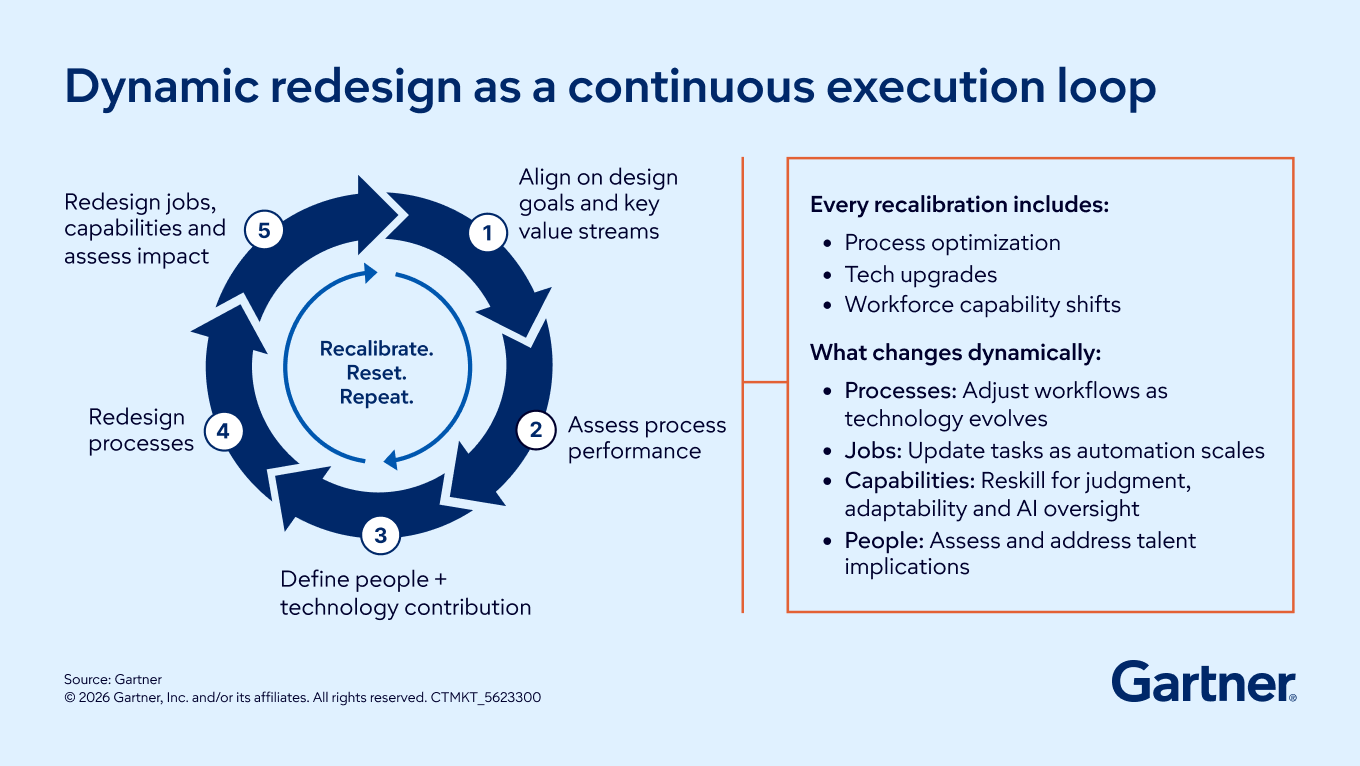
Every transformation assumes eventual stability
Every workforce transformation has traditionally been built around the same assumption: Endure today’s disruption to reach tomorrow’s operating model. Organizations redesign jobs, workflows and structures because they expect a period of stability on the other side. Increasingly, however, stability itself is becoming temporary.
“Organizations that continue to apply AI within static operating models will struggle to convert automation into sustained business value,” says Caroline Hewings, Senior Director Analyst at Gartner.
Continuous redesign becomes a core organizational capability
Dynamic redesign reflects a shift from treating work redesign as an initiative to treating it as an ongoing organizational capability. Rather than periodically redesigning work and then optimizing around stability, organizations must continuously rebalance workflows, decision rights, talent deployment and accountability as technology capabilities and business needs evolve. The ability to repeatedly redesign work becomes a competitive advantage rather than a temporary transformation effort.
HR must stop assuming work will settle
Most HR practices were built to help organizations reach a future state. The challenge for HR leaders now is that the future state may not last long enough to optimize around. AI capabilities continuously create new opportunities to redesign work, while changing business priorities, customer demands and workforce realities require organizations to constantly adjust how value is created. As work becomes increasingly dynamic, organizations can no longer assume roles, workflows and decision rights will remain stable between redesign efforts. Organizations create advantage by building systems that continuously realign work, talent and accountability as conditions change rather than waiting for the next transformation cycle.
Managers increasingly decide how work changes
In many organizations, managers have operated within structures where roles, workflows and accountability remained relatively stable between redesign efforts. Managers must now redefine work, redeploy talent and adjust accountability as priorities evolve. Their role expands from supervising stable work to shaping how work is distributed across people, teams and AI-enabled capabilities. Organizations that adapt fastest may be those whose managers can continuously redesign work as conditions change rather than waiting for formal transformation programs to intervene.
Employees create value through adaptability
Employees have traditionally created value by developing expertise within relatively stable roles and responsibilities. As work evolves more continuously, organizations increasingly value employees who can learn, unlearn and apply their capabilities in new contexts. Organizations are no longer preparing people for fixed roles. They are preparing people to contribute as work itself continues to evolve.
AI and the future of work FAQs
What is dynamic redesign?
Dynamic redesign is the organizational capability to continuously redesign workflows, decision rights, jobs and talent deployment as AI capabilities, business priorities and execution realities change. It treats work redesign as an ongoing organizational capability rather than a periodic transformation initiative.
Why are traditional workforce transformation approaches becoming less effective?
Traditional transformation approaches assume organizations can move from one stable operating model to another. AI-enabled work is evolving more quickly than traditional redesign cycles can accommodate, reducing the period of stability between transformation efforts.
Does continuous redesign require continuous restructuring?
No. Continuous adaptation is different from continuous restructuring. Many redesign decisions occur at the workflow, task and decision level, while broader changes to organizational structures are typically reserved for more sustained shifts in how value is created.
What role do managers play in dynamic redesign?
Managers increasingly help redefine work, redeploy talent and adjust accountability as business conditions change. Their role extends beyond supervising execution to actively shaping how work is organized and performed.
What happens if organizations continue preparing for stability instead of continuous change?
Organizations risk treating transformation as a destination when work itself continues to evolve. The organizations most likely to sustain AI-enabled value creation will be those that build the capability to continuously redesign work as technologies, priorities and execution realities change. They are preparing for continuous movement rather than a final destination.
Attend a Conference
Join Gartner analysts and your peers to accelerate growth
Gather alongside your peers in Orlando to gain insights on emerging trends, receive one-on-one guidance from a Gartner analyst and create a strategy to tackle your priorities head-on.
25 – 27 Oct 2027
Gartner HR Symposium/Xpo™
Orlando, FL
Drive stronger performance on your mission-critical priorities.