HR is at a crossroads. Reinvent HR to deliver business value in the AI era or risk becoming irrelevant. CHROs need to act — now.
- Gartner client? Log in for personalized search results.
AI is changing HR priorities — and more disruption is coming
HR stands at an AI-led inflection point. Experimentation is high, but true readiness is lagging. Many HR functions are running AI pilots, but few have a clear AI-in-HR strategy or feel prepared to integrate AI into their operating model. The result? A widening gap between experimentation and enterprise impact.
Looking ahead, the pace of change will only accelerate. By 2030, about half of today’s HR activities could be automated or performed by AI — reshaping roles, workflows and service delivery end to end. CHROs who don’t reposition HR for this reality risk having the function bypassed as AI becomes embedded in the business. The message is clear: Treat AI as a strategy driver and replatform how HR creates value, or risk losing relevance.
The vendor landscape only adds to the complexity. “Agentic” labels are everywhere, but true orchestration and execution remain inconsistent. Today, buying outcomes — not labels — and sequencing investments where business need meets technology maturity is a leadership test, not just a tooling decision.
HR must reinvent itself
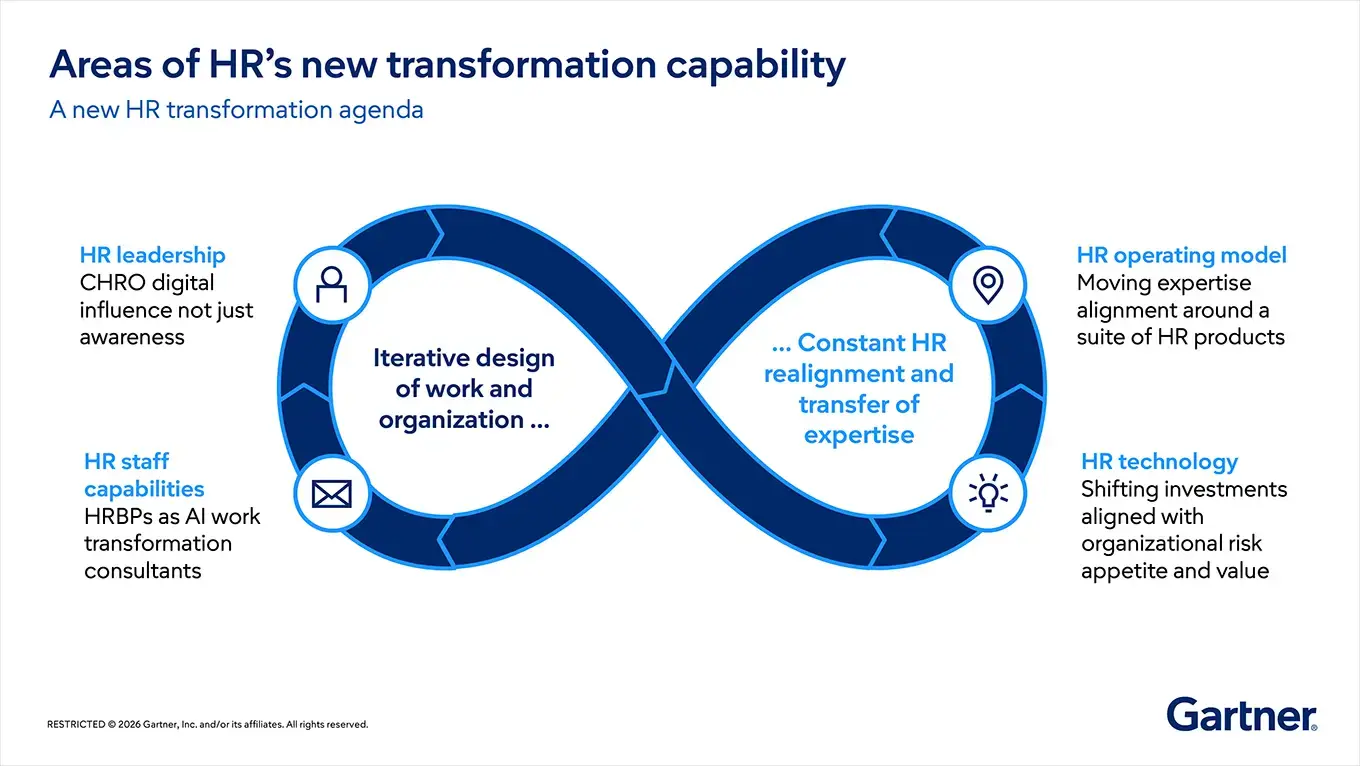
HR’s mandate is expanding. It’s no longer about enabling the workforce but about enabling how work gets done. HR transformation must build permanent adaptability that allows HR to consistently reinvent itself while guiding the evolution of work. Think: an AI‑integrated HR strategy tied directly to enterprise priorities, an AI-infused HR operating model that elevates human judgment where it matters and lets AI accelerate the rest, a focused portfolio of high‑value use cases and technologies, and governance that is both simple and strong enough to protect trust.
Watch webinar: To Lead a Successful HR Transformation, a Good Process Is Not Enough
Create an HR strategy that supports enterprise transformation
AI can’t be an add-on or a parallel tech roadmap. It must be embedded from the start, reshaping both what HR delivers and how it delivers it. HR transformation must build permanent adaptability that allows HR to consistently reinvent itself while guiding the evolution of work. For CHROs, this means articulating a clear AI vision for HR that stays a step ahead of the enterprise’s own AI ambition, and specifies the business outcomes HR will own — growth, productivity, decision quality and risk posture — not just the initiatives HR will fund.
From there, reframe what HR delivers and how it creates value. Tie HR’s goals directly to enterprise priorities, and recognize that AI changes the operating model as much as the roadmap. In practice, this means HR’s plan should elevate the decisions that matter (like workforce bets, role and skills architecture, and organization design) and make clear the metrics for success: financial efficiency and nonfinancial impact, such as better manager capability and higher-quality talent decisions.
Done well, this is the pivot from pilots to purpose: a concise, enterprise-linked strategy that sets direction, signals accountability and positions HR to lead the organization through AI-enabled change.
Redesign the HR operating model and HR roles
Reinvention is a leadership choice. CHROs must show how HR will create business value in an AI-enabled enterprise — not by simply adding tools, but by recasting the function’s value, so judgment, trust and enterprise context sit at the center, while AI accelerates the work.
This is the pivot from “HR supports the workforce” to “HR enables the work.” It requires resetting role expectations at the top — elevating business-facing talent leadership while letting agent-assisted workflows handle routine tasks — not just tinkering at the edges.
Organizations that avoid this shift risk seeing HR routed around as AI becomes part of how the business operates. By 2030, about half of HR activities may be automated or performed by AI, fundamentally changing roles, workflows and decision making.
Prioritize high-value AI use cases and analyze the vendor landscape
Prioritize AI where technology maturity and business pull intersect, so early wins are visible in enterprise outcomes like decision quality, manager effectiveness and employee experience. Use the Gartner Hype Cycle™ for AI in HR visual to separate near-term, scalable capabilities (like AI in talent acquisition and machine learning across HR) from emerging bets (like agentic AI), and stage investments accordingly.
When selecting solutions, buy outcomes, not labels. Require evidence of cross-workflow orchestration, transaction execution, explainability and fairness. Guard against “agentic AI-washing,” as vendors rebrand chatbots as “agents” without the autonomy or integration to deliver real results.
Build governance that sustains HR transformation over time
Governance must be simple enough to guide decisions, and strong enough to protect trust. At the leadership level, make human decision rights explicit, enforce bias and explainability standards, and monitor model drift. Pair this with a balanced scorecard that tracks cost and speed alongside decision quality, manager capability and employee experience — so value is visible and defensible.
Governance should also enable regular strategy resets: a cadence that resequences the portfolio as capabilities and regulations evolve, keeping HR transformation compounding long after go-live.
FAQs on HR transformation
What’s the pivotal shift to unlock HR transformation with AI?
Treat AI as a strategy driver, not just a tools program. Set an HR AI vision a half-step ahead of enterprise ambition, tie it to business priorities, and concentrate early bets on strategic workforce planning and organization design — where AI can move enterprise metrics, not just automate tasks.
Why does the HR operating model matter if we’re already funding AI?
By 2030, about half of today’s HR activities may be automated or performed by AI agents. Without reinventing the operating model and elevating roles, HR risks being sidelined as other functions adopt AI to enable how work gets done. Value depends on how HR creates value — not just what it buys.
How should CHROs prioritize use cases and HR technology in a noisy market?
Focus on where maturity and business pull intersect, and buy outcomes, not labels. Use the Gartner Hype Cycle for AI in HR to stage near-term, scalable capabilities versus emerging bets, and require evidence of orchestration, transaction execution, explainability and fairness to avoid “agentic AI-washing.”
What governance stance sustains momentum without slowing the business?
Keep it simple enough to guide decisions and strong enough to protect trust. Codify human-override and bias/explainability expectations, monitor model drift, and track a balanced scorecard that pairs cost and speed with decision quality, manager capability and employee experience. Then, rebaseline the portfolio as capabilities and regulations evolve.
Attend a Conference
Accelerate growth with Gartner conferences
Gain exclusive insights on the latest trends, receive one-on-one guidance from a Gartner analyst, network with a community of your peers and leave ready to tackle your mission-critical priorities.

Drive stronger performance on your mission-critical priorities.