By 2030, half of HR's work will be done by AI. Leaders who adapt their operating model now will gain a competitive edge.
- Gartner client? Log in for personalized search results.
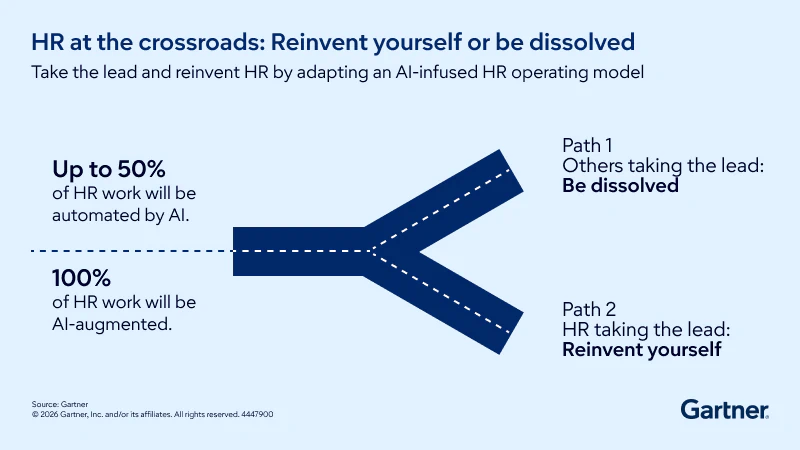
AI will fundamentally transform how HR operates
The era of incremental change in HR is over. By 2030, 50% of current HR activities will be AI-automated or performed by AI agents, fundamentally transforming HR's work, roles and workflows. While AI adoption in HR has surged—reaching 95% of CHROs by the end of 2025—the expected business value has yet to fully materialize. Nearly three-quarters of HR leaders report only moderate or minimal returns from their AI investments, highlighting a critical reality: technology is only part of the equation.
The stakes are clear. AI solutions are poised to augment 100% and perform up to 50% of HR's current tasks, fundamentally challenging HR's traditional value proposition and operating model. The question isn't whether AI will transform HR — it's whether your organization will lead or lag in this transformation.
Adapting your operating model is the key to AI productivity gains
Here's what many HR leaders miss: having AI tools isn't enough. According to Gartner, successful AI transformation depends only 30% on the technology itself and 70% on how effectively organizations redesign HR processes, workflows and roles to unlock AI's full potential. In other words: AI transformation depends on the HR Op Model.
The three-pillar transformation:
Elevate HR operations into digital HR solutions and delivery
Traditional transactional HR must evolve into digital HR solutions and delivery. This means leveraging AI agents as HR front door and agile delivery teams to provide streamlined, scalable, and employee-centric services. The goal: move from ticket-based support to intelligent, self-service solutions that anticipate employee needs.
Form dynamic pods of strategic talent leaders
Replace the fixed HRBP model with flexible pods of strategic talent leaders (STLs) who leverage AI-driven insights to deliver strategic HR guidance across the business. Depending on the industry, this shift could drive dramatic productivity gains. Within the next one to five years, the current ratio of one HRBP per 423 employees could rise to one per 800 to 1,200 employees.
Evolve centers of excellence into HR product designers
Transform COEs from siloed policy creators into custom HR product designers that develop hyperpersonalized solutions along horizontal value streams. Using AI-powered insights, these teams will co-create experiences tailored to individual employee needs rather than one-size-fits-all programs.
Start your transformation with four critical moves
The window for advantage is closing. Redefine your HR value proposition with your executive team — focus on how AI can amplify strategic impact. Build an HR innovation team reporting to the CHRO to drive your AI agenda alongside IT. Develop your AI roadmap now: identify what to automate, where human judgment matters, and how roles will shift. Keep it human-first: communicate openly, co-create the journey with your team, and invest in upskilling.
What to do next
HR is approaching a defining moment as AI reshapes how organizations operate and create value. For CHROs, the challenge is no longer just adopting new technologies — it’s reimagining the very purpose, structure and impact of HR in an AI‑driven enterprise. Redesigning the HR operating model and HR roles for the AI era is just one of several imperatives that CHROs must navigate to fully deliver on the mission‑critical priority of transforming HR through AI.
The other steps in this journey include:
Analyze existing AI capabilities within the HR tech stack, as well as complementary capabilities and AI tools in the market, to cut through the hype in a fast-moving technology market.
Determine the effort and resources needed for AI deployment, factor in technology costs and pricing models, and calculate hard and soft benefits from AI investments to drive continued success in an evolving AI era.
To transform and grow, build a vision and strategy for your HR function to support and embrace AI, both within HR and the enterprise.
Investigate the highest-value AI and technology use cases across HR and prioritize those best aligned with business and strategic objectives.
For more on how Gartner helps drive success on this and other mission-critical priorities for CHROs, speak with us today.
HR operating model FAQs
How quickly should HR implement AI-driven operating model changes?
Start planning your AI transformation roadmap immediately, even as some AI technologies (especially AI agents) continue maturing. With 82% of HR leaders planning to deploy agentic AI within 12 months, the competitive landscape is shifting rapidly. Begin with pilot programs in controlled areas, then scale based on results and organizational readiness.
What’s the biggest risk of not adapting the HR operating model for AI?
The risk isn't just falling behind competitors — it's becoming irrelevant. As AI augments 100% and performs up to 50% of current HR tasks, organizations that don't adapt their operating model will face declining productivity, diminishing strategic influence, and inability to attract top talent who expect modern, AI-enhanced HR experiences.
How do we balance AI automation with the human element in HR?
The goal here is to elevate human intelligence. By automating transactional work, HR professionals can focus on strategic guidance, complex problem-solving, and genuine human connection where it matters most. The transformation enables HR to become more human, not less, by freeing professionals from administrative burden to deliver personalized, strategic value.
Attend a Conference
Accelerate growth with Gartner conferences
Gain exclusive insights on the latest trends, receive one-on-one guidance from a Gartner analyst, network with a community of your peers and leave ready to tackle your mission-critical priorities.

Drive stronger performance on your mission-critical priorities.