Workforce gaps — not technology — are limiting enterprise AI impact.
- Gartner client? Log in for personalized search results.
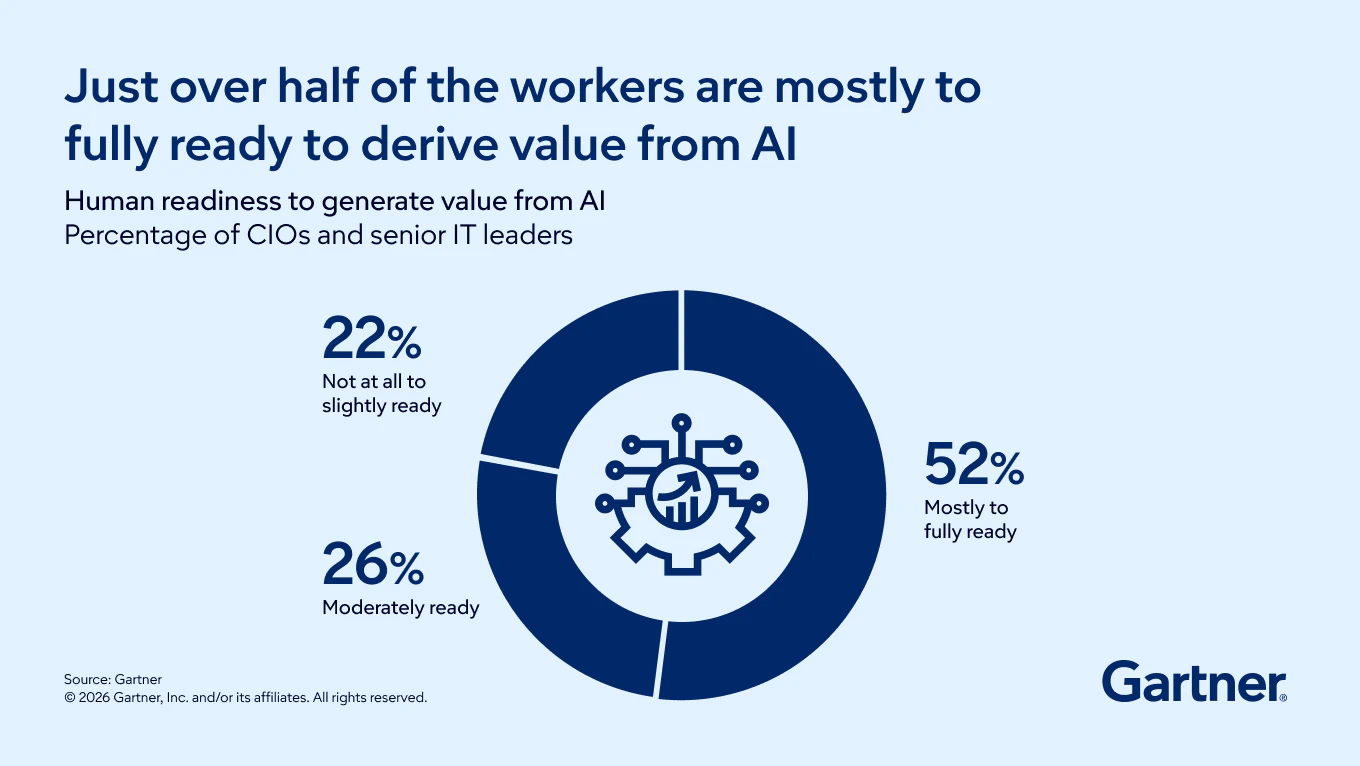
AI talent gaps are stalling enterprise value
Many CIOs are seeing early AI productivity gains stall before reaching enterprisewide impact. The constraint is not technology maturity. It’s the workforce’s ability to absorb, translate and scale AI into daily work and decision making.
Gartner insights show that organizations often struggle to move beyond pilot success into sustained enterprise value because of overlooked talent gaps. Four workforce blind spots quietly erode AI impact, even as adoption accelerates. CIOs who address these gaps can activate the workforce to accelerate meaningful use of AI that translates into durable, enterprise‑scale value.
Four workforce blind spots CIOs must address now
To move from experimentation to enterprise value, CIOs must confront four critical workforce gaps that limit AI value realization.
Versatilists are underrepresented in IT teams
AI is shifting the nature of IT work. As execution becomes increasingly automated, value now depends on employees who can connect technology to business context, workflows and decisions. Yet most IT organizations remain heavily specialist‑oriented. Only about one‑quarter of IT employees qualify as versatilists. By contrast, high‑performing AI teams typically have 40% to 60% versatilists.
A versatilist is a worker who can combine technical depth with cross‑domain skills.
This imbalance limits the organization’s ability to apply AI across business contexts. Crossing the 25% threshold represents a measurable inflection point in realizing sustained AI value. CIOs must redesign roles, career paths and incentives to deliberately cultivate versatilist talent.
Human-centric skills are undervalued in AI strategies
As AI increasingly shapes decisions and outcomes, human capabilities such as judgment, trust‑building and persuasion become more critical. However, these skills still rank near the bottom of CIO talent priorities. This disconnect creates predictable risks: overreliance on AI outputs, erosion of critical thinking and unmanaged behavioral impacts as AI reshapes how people work.
CIOs must shift from teaching how to use AI to enabling employees to work effectively with AI. That means embedding decision quality, ethics and trust into competency models, training programs and performance expectations.
Accountability for AI workforce outcomes is fragmented
Most CIOs recognize workforce enablement as a shared responsibility. But shared ownership often becomes diffuse accountability. Eighty‑five percent of CIOs say they share responsibility for AI workforce enablement, yet only a minority believe it should be CIO‑led. This fragmentation delays action and weakens results.
Gartner insights show that CIO‑led workforce enablement consistently produces stronger outcomes, including higher skill development, productivity and revenue per employee. CIOs are already positioned at the center of AI strategy, governance and execution, but many underestimate their mandate to lead workforce transformation.
How CIOs can close AI talent gaps and unlock value
CIOs cannot scale AI without scaling the workforce. To close these gaps and accelerate value, they should:
Shift IT teams toward versatilists. Redesign roles, career paths and incentives to build cross-domain talent capable of scaling AI across business contexts.
Embed decision quality and ethics AI training. Move beyond tool proficiency to focus on judgment, trust and accountability in AI-augmented work.
Prioritize the “messy middle” as AI translators. Invest in frontline managers and non-IT roles to drive workflow redesign and change leadership at scale.
Own workforce enablement as a CIO mandate. Integrate talent strategy into every AI initiative, business case and stage-gate decision to ensure accountability and execution.
Gartner insights show that when CIOs lead workforce enablement, organizations are far more likely to translate AI potential into sustained enterprise value.
AI talent FAQs
Why must CIOs prioritize versatilists now?
Versatilists — employees who combine technical depth with cross‑domain skills — are underrepresented in most IT organizations. Increasing the presence of versatilists enables CIOs to apply AI across business contexts, which is a key ingredient in scaling value beyond technical execution.
What risks emerge when human-centric skills are undervalued?
Organizations risk overreliance on AI outputs, weakened critical thinking and unmanaged behavioral impacts. Embedding judgment, ethics and trust into core competencies helps ensure employees use AI effectively and responsibly, turning opportunity into advantage.
Why does the “messy middle” matter for AI success?
Frontline managers and non‑IT workers make up a majority of the workforce. Their ability to integrate AI into daily work is critical for deriving value from AI. When these roles lack readiness, organizations are far more likely to underperform on value realization. Closing this gap is essential to scale AI beyond pilots.
Attend a Conference
Accelerate growth with Gartner conferences
Gain exclusive insights on the latest trends, receive one-on-one guidance from a Gartner analyst, network with a community of your peers and leave ready to tackle your mission-critical priorities.

Drive stronger performance on your mission-critical priorities.