Cloud architects can deliver cloud governance and empower self-service application teams via infrastructure as code.
- Gartner client? Log in for personalized search results.
Use Infrastructure as Code to Unlock Your Organization’s Cloud Potential
By Lydia Leong | October 18, 2024


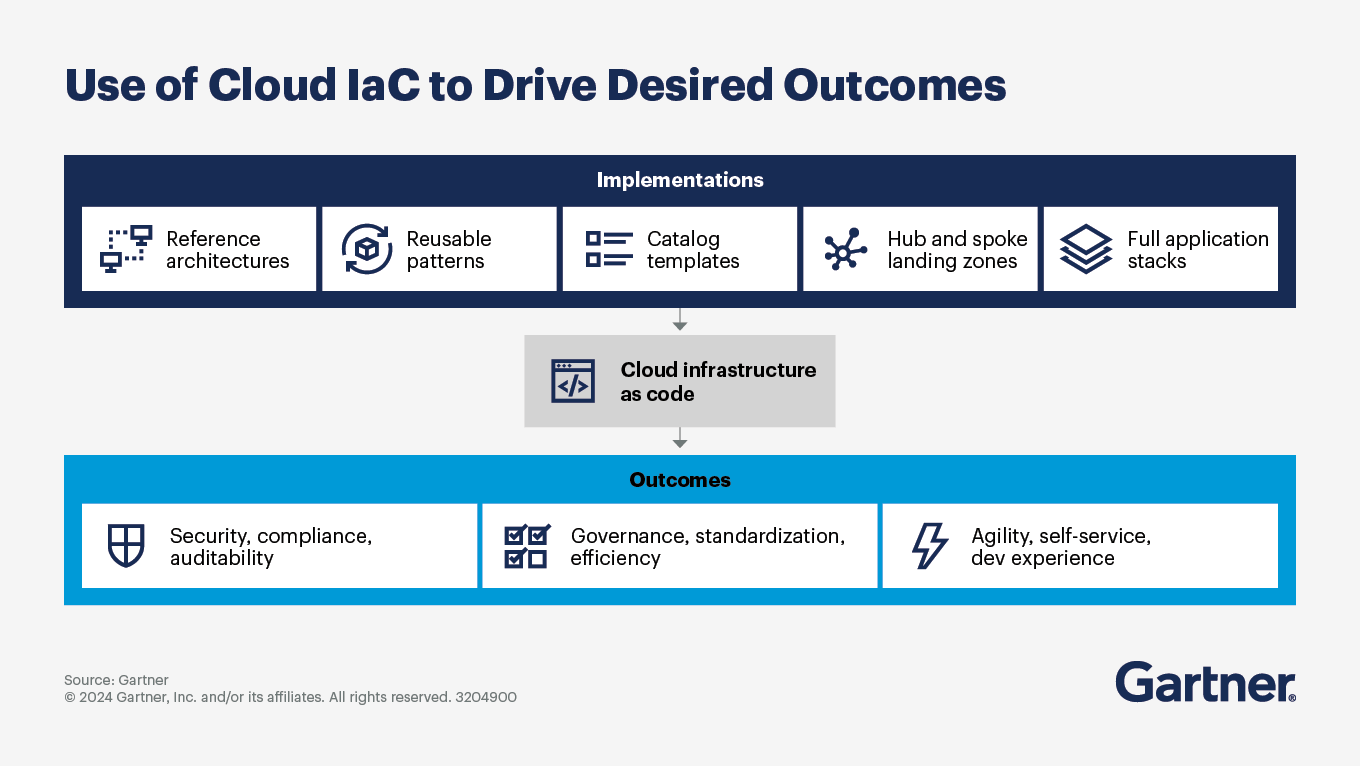
Infrastructure as code (IaC) enables consistent cloud implementation practices
Infrastructure as a service (IaaS) and platform as a service (PaaS) environments are quickly replacing traditional enterprise infrastructures. Configuring servers, databases and other tech stack components in IaaS and PaaS environments requires consistent implementation practices. Cloud architects can deploy infrastructure as code (IaC) to govern the process and reduce the workload of application teams.
How streamlined orgs deploy IaC for productivity and efficiency
Use infrastructure as code to create stronger cloud workflows.
Manage public cloud environments with an “application-down” approach
Technical professionals working with public cloud environments often struggle to align desired business outcomes and corporate cloud strategy, in part because they are stuck in the “infrastructure-up” mindset. Infrastructure as code enables an “application-down” approach. With IaC, cloud architects and application teams can conceptualize applications as bundled with their infrastructure and other resources, rather than apps placed on top of a separate infrastructure layer.
Using IaC, you can bring traditional software engineering principles to your cloud operations. Organizations find the adoption of IaC to be an accelerator for cloud migrations and adoptions because of its ease of use for expressing reference architectures.
IaC drives productivity improvements for application teams and technical users
Cloud infrastructure as code improves the agility, productivity and efficiency of application teams and technical end users. IaC also provides the foundation for cloud governance, security, regulatory compliance and more agile operations.
This adaptive form of governance enables a differentiated approach to risk management in development, testing and production environments. However, the path to IaC adoption isn’t always straightforward, and organizations may struggle to get started.
Roadblocks to IaC adoption include:
Determining when and how to use cloud IaC
Allocating responsibilities for creating and updating cloud IaC and managing the IaC library
Governing the intersection of cloud policies, self-service and the use of IaC
Take a strategic approach to IaC adoption
In the Gartner recommended cloud operating model, an organization’s cloud enterprise architecture function, such as the cloud center of excellence (CCOE), is responsible for the enterprise’s governance and brokerage of public cloud computing. As such, cloud architects in the CCOE may be asked to lead the adoption of IaC in the public cloud, even if their organization has already adopted some IaC on-premises.
CCOE cloud architects should:
Create enterprisewide standards and best practices for using the public cloud.
Deliver reference architectures for cloud solutions and express those architectures as IaC.
Maintain service catalog items for cloud solutions using IaC.
Express cloud governance guidelines and guardrails using IaC and policy as code.
Serve as the product manager for a cloud platform operations function or platform engineering team, setting the vision for using IaC, automation and continuous configuration management in the context of public cloud implementation.
Infrastructure as code (IaC) FAQs
What are the advantages of infrastructure as code?
Infrastructure as code (IaC or infra as code) ensures consistent deployment and management of infrastructure resources. Combined with its policy enforcement features, IaC provides an excellent foundation for cloud governance. By automating routine tasks and providing self-service features, IaC empowers application teams to provision and manage their infrastructure, accelerating the development process.
How does IaC differ from traditional infrastructure management?
With traditional infrastructure, administrators configure services manually. IaC defines infrastructure using code. Changes are, therefore, managed in version-controlled IaC templates, allowing for change tracking, rollback and collaboration among various teams (application developers, end users, etc.).
Does IaC work with all cloud environments?
Infrastructure as code works with all major cloud environments. All of the popular public cloud providers offer native IaC tools, and several popular open-source IaC tools are available to manage infrastructure across multiple public and private cloud environments.
Attend a Conference
Experience IT Infrastructure and Operations conferences
With exclusive insights from Gartner experts on the latest trends, sessions curated for your role and unmatched peer networking, Gartner conferences help you accelerate your priorities.
11 – 12 May 2026
Gartner IT Infrastructure, Operations & Cloud Strategies Conference
Sydney, Australia

Drive stronger performance on your mission-critical priorities.